
TL;DR
- Google Ads for plumbers in South Africa works best when you bid on emergency intent — burst pipes, blocked drains, geysers that fail at 2am.
- Tight geo-targeting, call extensions, and negative keywords stop you bleeding rand on tyre-kickers and DIY browsers.
- Track calls and form fills, not clicks — a single emergency job often pays back a week of ad spend.
What’s in this guide
- Why Google Ads for plumbers beats word of mouth
- Which keywords actually book plumbing jobs?
- How much should a South African plumber spend?
- Building a Google Ads campaign for plumbers that converts
- What mistakes drain your budget?
- How do you know it’s working?
- Key takeaways
- Frequently asked questions
It’s a Sunday evening in Randburg. A geyser bursts, water sheets down a passage wall, and a homeowner stands ankle-deep in panic with a phone in his hand. He doesn’t open a directory. He doesn’t ask a neighbour. He types four words into Google — “emergency plumber near me” — and rings whoever appears first.
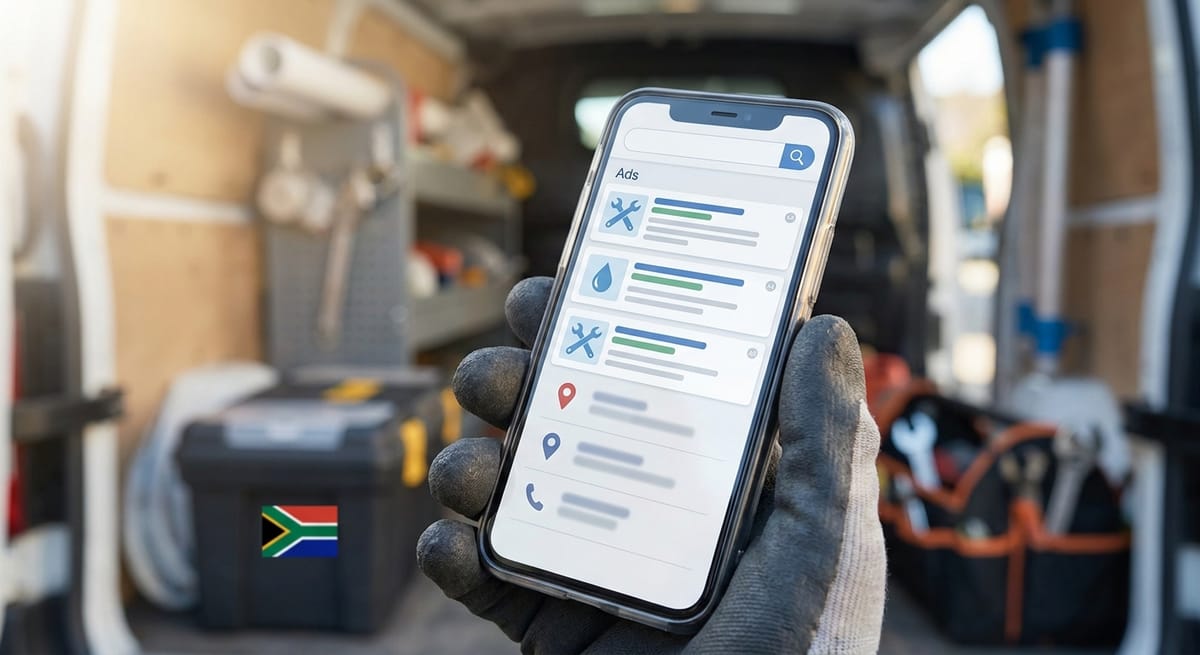
Google Ads for plumbers in South Africa exists for precisely that moment. When a pipe fails, nobody shops around. They call the business that shows up at the top of the screen, with a phone number one tap away. That visibility is something you can buy, today, without waiting months for organic rankings to mature.
I’ve spent years watching how words and placement reshape decisions under pressure. A plumbing emergency is one of the purest examples of buying intent in the entire market. The question isn’t whether to advertise — it’s whether you’re the name on the screen when the water’s rising.
Why Google Ads for plumbers beats word of mouth
Google Ads puts your plumbing business in front of someone at the exact second they need you — not next month, not when they remember your van. That speed is the whole game.
Word of mouth is wonderful, but it’s slow and unpredictable. You can’t summon a referral on the day cash flow dips. Search advertising flips the timeline: you decide to be visible, and within hours you are. According to Google’s own research on “near me” searches, local intent queries have grown sharply year on year, and a large share lead to a call or visit within twenty-four hours.
For a trade with genuine emergencies, that immediacy is gold. A burst pipe doesn’t care about your brand story. It cares that you answer the phone and arrive fast. Ads let you be the answer to that urgency, and they let smaller, sharper operators outmanoeuvre big firms who waste budget on vague targeting.
Which keywords actually book plumbing jobs for google ads for plumbers?
The keywords that book jobs are the ones soaked in urgency and location — “emergency plumber Sandton”, “burst geyser repair Durban”, “blocked drain Cape Town”. Intent beats volume every time.
A broad term like “plumbing” attracts students, DIY hobbyists, and people three weeks away from a decision. An emergency term attracts someone with a wallet already open. Build your account around that distinction.
| Keyword type | Example | Intent | Priority |
|---|---|---|---|
| Emergency | emergency plumber near me | Very high — calling now | Top |
| Specific job | burst geyser replacement Pretoria | High — ready to book | High |
| Service + suburb | blocked drain Bryanston | Medium-high | Medium |
| Generic | plumbing tips | Low — researching | Avoid |
Pair every campaign with a robust negative keyword list. Add words like “job”, “salary”, “course”, “DIY”, “parts”, and “free”. These quietly strip out the searches that will never become customers — and in my experience, that single habit can cut wasted spend by a fifth or more.
How much should a South African plumber spend?
Most independent South African plumbers see solid results starting around R4,000 to R8,000 per month, scaling up as the numbers prove themselves. Begin small, measure ruthlessly, then grow.
Cost-per-click for plumbing terms in metros like Johannesburg and Cape Town typically ranges from roughly R15 to R60, depending on competition and time of day. Emergency terms cost more — because they’re worth more. One geyser replacement might earn you R8,000 to R15,000, so a R400 cost-per-acquisition is a bargain, not an expense.

The trap is judging a campaign by its monthly invoice rather than its return. I’d rather a plumber spend R6,000 and earn R30,000 than spend R2,000 and earn R5,000. Frugal isn’t the same as profitable. Start at a level that lets the data breathe — too little spend produces too little learning, and you’ll abandon a strategy before it had a chance.
Building a Google Ads campaign for plumbers that converts
A converting plumbing campaign is structured around urgency, tightly geo-fenced to your service area, and built to trigger a phone call within seconds. Everything else is decoration.
Here’s the skeleton I’d build for almost any local plumber:
- Search campaigns only to start. Skip Display and Performance Max until your search numbers are healthy — they spread budget too thin too early.
- Geo-targeting set to your real travel radius. A Roodepoort plumber shouldn’t pay for clicks from Polokwane. Set radius targeting to “presence” so you reach people actually in your area.
- Call extensions and a click-to-call mobile ad. Most emergency searches happen on a phone. Make the call button impossible to miss.
- Tight ad groups by service. Geysers, drains, leaks, and general plumbing each deserve their own ad copy and landing section.
- A fast, honest landing page. Response time, service areas, a phone number above the fold, and proof you’re real — not a stock-photo soup.
For the wider strategy across trades, I’ve unpacked the full framework in our pillar guide on Lead-Gen PPC for SA Service Businesses: Plumbers, Electricians & Dentists. If you also rely on map listings, pair your ads with the tactics in our Google Business Profile optimisation guide — the two together dominate the local screen.
What mistakes drain your budget?
The fastest way to waste money on Google Ads is to send paid clicks to a slow, generic homepage with no clear call to action. The second fastest is ignoring negative keywords.
I see the same leaks again and again across South African trade accounts. Broad match keywords with no negatives. Ads running 24/7 when nobody answers the phone after 9pm. Tracking that counts clicks but never calls. And landing pages that bury the phone number beneath a hero image and a wall of text.
The ad gets the click. The page gets the call. Lose either and you’ve paid for nothing.
Fix conversion tracking first. Google’s conversion tracking documentation walks through call and form tracking, and without it you’re flying blind — optimising for the wrong things and scaling the wrong campaigns. For a deeper checklist of leaks to plug, our piece on common PPC mistakes small businesses make covers the rest.
How do you know it’s working?
You know Google Ads is working when your cost per booked job sits comfortably below the profit from that job — and the calls keep coming. Everything else is vanity.
Track three numbers and you’ll never be confused again: calls and form fills per month, cost per lead, and your close rate from lead to paying job. A plumber paying R350 per lead, closing one in three, and netting R6,000 per job is sitting on a machine that prints money. Feed it more budget.
Reviews matter too. BrightLocal’s Local Consumer Review Survey (2024) found the overwhelming majority of consumers read reviews before choosing a local business — so the ad earns the click, but your star rating often earns the trust. Run the ads and tend the reputation. They compound.
Key takeaways
- Bid on urgency and location — emergency searches book jobs; generic terms burn budget.
- Start at R4,000–R8,000 per month, then scale on proven cost-per-job, not gut feeling.
- Set up call and conversion tracking before you spend a single rand at scale.
- Geo-fence to your real travel radius and stack negative keywords to kill waste.
- Judge success by booked jobs and profit, never by clicks or impressions.
Frequently asked questions
Do Google Ads for plumbers in South Africa actually work?
Yes — when built around emergency intent and tight local targeting. Plumbing is one of the highest-intent categories on Google, because people search at the moment of crisis and call immediately. With proper conversion tracking and a fast landing page, most South African plumbers see a positive return well within the first two to three months of disciplined management.
How quickly will I get calls after launching?
Often within the first few days. Unlike SEO, which takes months, paid search switches visibility on almost instantly. Expect early calls within 24 to 72 hours of going live, though it takes two to four weeks of data before you can optimise confidently and trust the cost-per-lead figures you’re seeing.
Should I run ads all day and night?
Only if you can answer. If you offer genuine 24-hour emergency call-outs, run round the clock — late-night searches are high value. If you don’t, schedule ads for hours you actually answer the phone. A missed call from a paid click is the most expensive silence in marketing.
What’s the difference between Google Ads and Google Business Profile?
Google Ads are paid placements you control instantly. Your Google Business Profile is the free map listing that earns local visibility over time through reviews and relevance. They’re complementary, not competing — ads deliver immediate calls while your profile builds long-term trust and organic map presence.
Can I manage Google Ads myself?
You can, and small accounts are manageable with effort. But the common errors — broad keywords, no negatives, weak tracking — quietly waste more than a manager would cost. If you’d rather fix taps than audit search terms, professional management usually pays for itself in reduced waste alone.
If you’d rather spend your evenings asleep than wrestling with match types, let us build and run it for you. We’ll set up tracking, geo-target your real service area, and send you booked jobs — not vanity clicks. See how our lead-gen PPC works for SA service businesses, then book a no-obligation strategy call. If the numbers don’t make sense for your plumbing business, I’ll tell you straight.
— David Watts, Watts Digital