
TL;DR
- Pick a platform (Shopify or WooCommerce), register your business and domain, then connect a local payment gateway like PayFast or Yoco.
- Sort the boring-but-vital bits early: CPA and POPIA compliance, VAT registration once you cross R1 million, and a clear returns policy.
- Budget R3,000–R30,000 to launch depending on your build, and spend your first marketing rand where buyers already are — Google and social search.
What’s in this guide
- Why now is the moment to sell online in South Africa
- What do you need to start an online store in South Africa?
- How do you choose the right ecommerce platform?
- Payments and shipping that actually work locally
- The legal and tax bits you cannot skip
- How much does it cost to start an online store in South Africa?
- Getting your first customers
- Key takeaways
- Frequently asked questions

It was a Saturday morning in Pretoria, and a friend of mine — a leatherworker with hands like worn riverstone — sold his first wallet online. He’d spent six weeks building a store, second-guessing every button. Then a stranger in Cape Town paid R650 while my friend was still in his pyjamas. He stared at the screen as though it had spoken to him.
That small ping of a notification is the whole promise. If you want to know how to start an online store in South Africa, the good news is that the tools are cheap, the buyers are online, and the barriers that once protected big retailers have quietly fallen away. The hard news is that everyone else has noticed too.
So this guide is the map I wish my friend had been handed. Not theory — the order of operations. Platform, payments, paperwork, and the unglamorous work of finding people willing to pay you. Let’s begin where it actually starts.
Why now is the moment to sell online in South Africa: how to start an online store in south africa
South Africa’s ecommerce market is growing fast — local online retail sales passed R71 billion in 2023, according to World Wide Worx, and the curve has kept climbing. Translation: more South Africans are buying online than ever, and the habit is now permanent.
The pandemic did in two years what marketers had been begging for over a decade. People who had never bought groceries online learned to trust the basket and the card field. That trust, once earned, doesn’t evaporate. It compounds.
But here is the truth beneath the trend. Opportunity and competition arrive on the same bus. The same low barriers that let you launch a store this weekend let a thousand others do exactly the same. Winning isn’t about getting online — it’s about being findable, trustworthy, and easy to buy from once you are.
That distinction shapes everything that follows.
What do you need to start an online store in South Africa for how to start an online store in south africa?
To start an online store in South Africa you need five things: a product, a registered business, a domain and ecommerce platform, a local payment gateway, and a shipping plan. Get those in place and you can legally sell within a week.
Let me unpack each in the order I’d tackle them.
1. A product people actually want
Sounds obvious. It is the step most people skip. Before you fall in love with a logo, validate demand. Search Google for your product plus “South Africa” and study who already ranks. Use the free Google Trends tool to check whether interest is rising or fading. If three established stores already dominate page one, you’ll need a sharper angle — a niche, a price, a story they can’t copy.
2. A registered business
You can trade as a sole proprietor under your own name, but registering a Pty Ltd through the CIPC gives you a separate legal identity, easier banking, and a more professional face. Registration costs around R175 and can be done online. Open a dedicated business bank account on day one — mixing personal and business money is a wound that bleeds slowly.
3. A domain and platform
Buy a .co.za domain — South African shoppers trust it instinctively — for roughly R80–R120 a year. Your platform is where the store lives; we’ll compare the main options next.
4. A payment gateway
This is the part international guides get wrong. You can’t simply switch on Stripe and walk away. South Africa has its own gateways, and choosing the right one affects your conversion rate and your fees.
5. A shipping plan
Decide upfront: courier, postal, or pickup? Delivery is where many local stores quietly lose trust, so settle it before you launch, not after the first angry email.
How do you choose the right ecommerce platform?
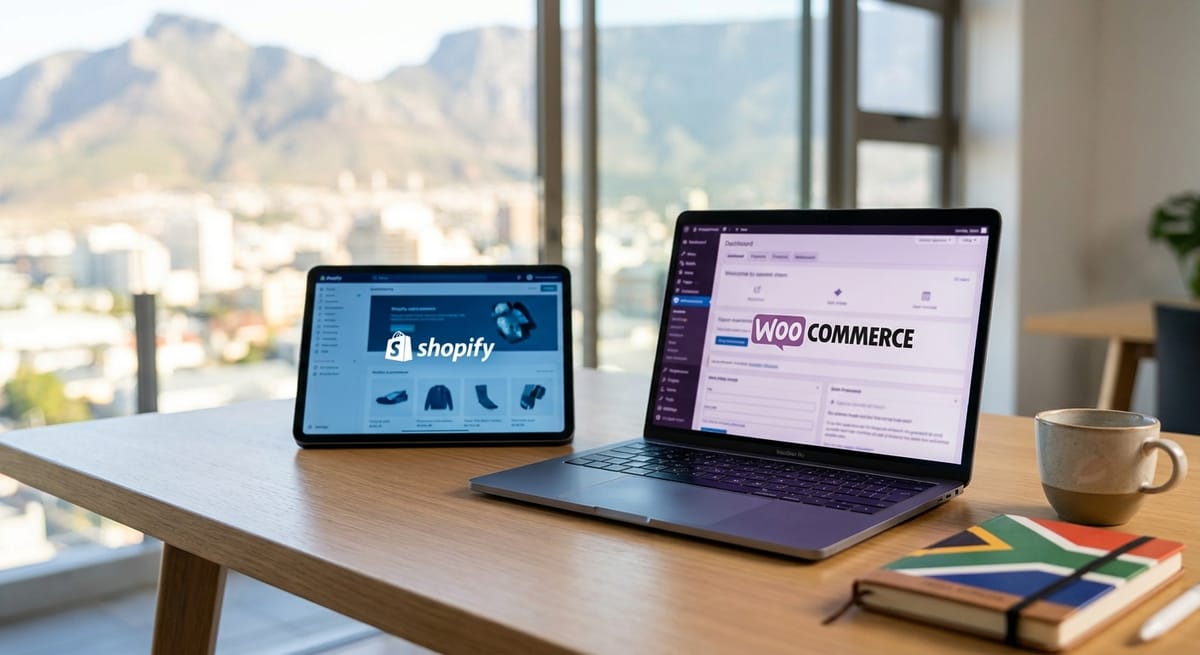
For most South African sellers, the choice comes down to Shopify (hosted and hassle-free) or WooCommerce (a WordPress plugin offering total control). Shopify suits speed and simplicity; WooCommerce suits ownership and lower long-term costs.
Think of it like renting versus building. Shopify rents you a beautifully maintained shop in a busy mall — you pay monthly, but the plumbing is someone else’s problem. WooCommerce hands you the keys to your own premises. More freedom, more responsibility.
Here’s how the leading options compare for a South African store.
| Platform | Monthly cost (from) | Best for | Local payment support | Technical skill |
|---|---|---|---|---|
| Shopify | ~R550 (Basic) | Fast launch, scaling brands | PayFast, Yoco, Payflex via apps | Low |
| WooCommerce | ~R150 (hosting only) | Control, content-rich stores | All local gateways via plugins | Medium |
| Wix eCommerce | ~R350 | Very small catalogues | PayFast, limited | Low |
| Shopstar / local builders | ~R200 | Beginners wanting SA support | Built-in local gateways | Low |
My honest steer? If you want to sell this month and dislike fiddling, choose Shopify. If you care about owning your platform, building serious content, and keeping monthly costs lean as you scale, choose WooCommerce. There is no universally correct answer — only the one that fits how you work.
If you’re weighing this up carefully, our team breaks it down further in our guide to ecommerce website design.
Payments and shipping that actually work locally
The most reliable local payment gateways are PayFast, Yoco, Peach Payments, and Ozow — each supporting cards, instant EFT, and increasingly buy-now-pay-later. Choosing one that South Africans recognise reduces abandoned baskets at the final step.
Here is something I learned the expensive way. A shopper will forgive a plain design, a slow page, even a typo. They will not forgive a checkout that feels foreign or unsafe. The moment trust wobbles at the card field, they leave — and they rarely come back.
Comparing local payment gateways
- PayFast — the most widely used. Supports cards, instant EFT, and Masterpass. Transaction fees around 3.5% + R2. Plays nicely with both Shopify and WooCommerce.
- Yoco — beloved by small retailers, especially if you also sell in person. Simple, transparent pricing near 2.95% online.
- Peach Payments — strong for growing businesses needing more advanced features and subscriptions.
- Ozow — instant EFT specialist, lower fees, useful for higher-value or banked-but-cardless customers.
Offer at least two methods: card and instant EFT. A surprising number of South Africans prefer paying directly from their banking app, and excluding them quietly costs you sales.
Sorting out shipping
Delivery is where reputations are made. Partner with a reliable courier — The Courier Guy, Aramex, or Pargo’s pickup-point network — and be honest about timelines. Three days promised and delivered beats next-day promised and missed.
Consider these three approaches:
- Flat-rate shipping — simple, predictable, easy for customers to understand.
- Free shipping over a threshold — say, free over R750. It nudges basket size upward, a gentle lever drawn straight from behavioural economics.
- Pickup points — Pargo and PUDO let buyers collect locally, cutting cost and theft risk in areas where door delivery is tricky.
Whatever you choose, display it clearly before checkout. Surprise delivery fees are the single most common reason South Africans abandon their carts.
The legal and tax bits you cannot skip
Every South African online store must comply with the Consumer Protection Act (CPA), the Electronic Communications and Transactions Act (ECTA), and POPIA for data privacy. VAT registration becomes compulsory once your turnover exceeds R1 million in any 12-month period.
I know — your eyes glazed over at “Act”. Stay with me. These rules aren’t bureaucratic cruelty. They are the scaffolding of trust, and trust is the only currency that matters online.
What the law actually requires
- A clear returns and refunds policy — the CPA grants consumers a cooling-off period on many online purchases. Spell out your terms plainly.
- Visible business details — ECTA requires you to display your legal name, registration number, physical address, and contact details. No anonymous shopfronts.
- A privacy policy and lawful data handling — POPIA, enforced by the Information Regulator, governs how you collect and store customer data. Get consent. Store securely. Don’t sell people’s details.
- Terms and conditions — the contract between you and your buyer. Don’t copy a competitor’s verbatim; have it tailored to what you sell.
Tax, plainly
Register for income tax through SARS from the start. You do not need to register for VAT until you cross R1 million in turnover, though you may register voluntarily above R50,000. Keep every invoice and receipt. A shoebox of crumpled slips in March is a tax season spent in tears.
If compliance feels overwhelming, that’s normal — and it’s exactly the sort of thing worth getting right once rather than fixing under pressure later.
How much does it cost to start an online store in South Africa?
You can start an online store in South Africa for as little as R3,000 with a DIY build, or R15,000–R30,000-plus for a professionally designed store. The biggest ongoing costs are platform fees, payment processing, and marketing.
Let me give you the real numbers, not the dreamy ones.
| Item | Once-off | Monthly |
|---|---|---|
| Business registration (CIPC) | ~R175 | — |
| Domain name (.co.za) | ~R100/year | — |
| Platform (Shopify Basic) | — | ~R550 |
| WooCommerce hosting + theme | ~R1,500 | ~R150 |
| Professional store build | R10,000–R30,000 | — |
| Payment gateway fees | — | ~3% per sale |
| Marketing (Google/social ads) | — | R2,000+ |
The honest budgeting truth: the build is the cheap part. Marketing is the real ongoing cost, because a beautiful shop nobody visits is just an expensive hobby.
My advice for tight budgets? Spend less on the build, more on the first months of marketing. A simple, fast, trustworthy store that 500 people see will outperform a stunning store that 5 people stumble upon.
Getting your first customers
Your first customers come from being visible where buyers are already searching — Google, social media, and word of mouth. The most cost-effective long-term channel is SEO; the fastest is paid search and social ads.
Here is the uncomfortable reality. Nobody is waiting for your store. The internet did not feel a gap when you arrived. You have to go and find your people, and then give them a reason to choose you over the option they already trust.
The channels that work, in order of priority
- Search engine optimisation (SEO) — when someone types your product into Google, you want to be there. This is slow but compounding; it’s the gift that keeps giving. Start with our breakdown of SEO that brings in buyers.
- Google Shopping and Search ads — pay to appear at the exact moment of intent. Expensive if mismanaged, brilliant when targeted.
- Social media — Instagram and Facebook for visual products, TikTok for momentum, all reinforced by genuine content rather than constant selling.
- Email — the channel everyone underrates. The buyers you already have are cheaper to sell to than strangers. Collect emails from day one.
- Marketplaces — listing on Takealot can bring volume, though it costs you margin and the customer relationship. Useful as a supplement, dangerous as a sole strategy.
The principle beneath the tactics
Robert Cialdini taught us that people follow social proof — we look to others to decide what’s safe. So put your reviews where they’ll be seen. Show real photos of real orders. Display your business details proudly. Every signal that says “others trusted us and were glad” quietly lowers the wall between browsing and buying.
And here is the deeper truth my leatherworker friend learned. His store didn’t succeed because of clever code. It succeeded because he photographed his hands at work, told the story of each piece, and answered every message like a human. The technology gets you the shop. The humanity gets you the sale.
If you’d rather have experts build and grow it for you, see how we help businesses launch with our digital marketing services.

Key takeaways
- Validate demand before you build — a wanted product on a plain store beats an ignored product on a beautiful one.
- Choose Shopify for speed and simplicity, or WooCommerce for control and lower long-term cost.
- Use local payment gateways (PayFast, Yoco, Ozow) and be transparent about shipping to protect trust at checkout.
- Comply with the CPA, ECTA, and POPIA from the start, and register for VAT once you cross R1 million in turnover.
- Budget for marketing, not just the build — visibility, not aesthetics, makes or breaks an online store.
- Lead with social proof and genuine human storytelling; trust is the real conversion engine.
Frequently asked questions
How do I start an online store in South Africa with no experience?
To start an online store in South Africa with no experience, choose a beginner-friendly platform like Shopify or a local builder, register a .co.za domain, connect a gateway such as PayFast or Yoco, and add your products. Start small with a handful of items, follow each platform’s setup guide, and learn marketing as you go rather than waiting to feel ready.
Do I need to register a company to sell online in South Africa?
No, you can trade legally as a sole proprietor under your own name. However, registering a Pty Ltd through the CIPC for around R175 gives you a separate legal identity, easier business banking, and a more professional image. Most growing stores register a company within their first year for protection and credibility.
How much money do I need to start an online store?
A lean DIY launch costs roughly R3,000, covering registration, a domain, hosting, and a basic theme. A professionally built store typically ranges from R15,000 to R30,000. Beyond setup, budget at least R2,000 monthly for marketing — because visibility, not the build itself, is what actually generates sales.
Which payment gateway is best for a South African online store?
PayFast is the most widely used and trusted, supporting cards and instant EFT with broad platform compatibility. Yoco suits small sellers who also trade in person, while Ozow specialises in low-fee instant EFT. Offering both card and EFT options reduces abandoned checkouts among South African shoppers.
Do I need to pay VAT on my online store?
VAT registration only becomes compulsory once your turnover exceeds R1 million in any 12-month period. You may register voluntarily above R50,000 if it suits your business. You should, however, register for income tax with SARS from the start and keep accurate records of all sales and expenses.
Ready to stop planning and start selling? If you’d like a store built to convert — fast, trustworthy, and tuned to South African buyers — explore our ecommerce website design service and let’s turn that first notification ping into a steady stream. Book a free consultation and we’ll map your launch together, no obligation.
Written by David Watts, founder of Watts Digital, who has spent two decades studying how words and design reshape buying decisions.