
TL;DR:
- AI writing tools save SA SMBs 4–8 hours per blog post, but only when paired with editorial oversight, original data and a clear brand-voice prompt library.
- Google’s March 2024 spam policy and the 2024 core updates explicitly target scaled, unedited AI content — generic output is now a ranking liability, not a shortcut.
- POPIA compliance, factual accuracy and human review are non-negotiable. Build an AI workflow with a verification step or expect refunds, Hellopeter complaints and lost rankings.
A client in Sandton phoned me last year, halfway to panic. His traffic had fallen off a cliff in a fortnight. He’d hired a freelancer who, it turned out, was pasting keywords into ChatGPT and hitting publish — twelve posts a month of confident, faceless filler. Google had quietly stopped trusting the whole site. He wanted to know if AI writing tools had wrecked his content marketing, or whether he’d simply used them like a fool.
Both, really. Used carelessly, tools like ChatGPT, Claude and Jasper churn out the bland, occasionally hallucinated copy that Google’s March 2024 spam update was built to suppress. Used with judgement, the same tools halve your production time and free you to do the work AI cannot — interview customers, hold an actual opinion, build local authority that no model can fake.
I’ve spent the last two years auditing AI workflows inside SA agencies and in-house marketing teams, from Sandton to Stellenbosch. The pattern never wavers. Businesses that treat AI as a junior writer on a tight editorial leash win. Businesses that publish raw output get punished — by Google, by readers, and by POPIA regulators if they’ve been feeding customer data into prompts without thinking it through.
What follows is the workflow I actually run with paying clients: the prompt structure, the tools worth paying for in rand, the POPIA guardrails, and the editorial checks that keep your content on the right side of E-E-A-T.
Why AI Writing Tools Matter for South African SMBs Right Now
South African SMBs work under a particular squeeze — rising marketing costs, load shedding eating into the productive hours of the day, and competitors pumping out three blog posts a week. Hiring a full-time content writer in Johannesburg now runs between R18,000 and R35,000 a month. A ChatGPT Plus or Claude Pro subscription costs roughly R380–R450 at current exchange rates. The maths is obvious. It only holds, though, if the output earns trust.
The thing that’s shifted across 2024–2026 is Google’s stance. The March 2024 spam policy update went after ‘scaled content abuse’ — pages made primarily for search engines with no meaningful editorial input. According to Search Engine Land’s coverage of the rollout, sites publishing unedited AI output picked up manual actions and steep traffic drops within weeks. AI is not banned. Lazy AI is.
For SA SMBs, that’s quietly good news. The bar for ranking has risen, which means a thoughtful operator with real local expertise — a plumber in Randburg, a boutique in Sea Point, an accountant in Umhlanga — can now outrank generic AI-spam competitors by adding the one thing a model can’t manufacture: lived experience, real local pricing, named suppliers, and advice that takes POPIA into account.
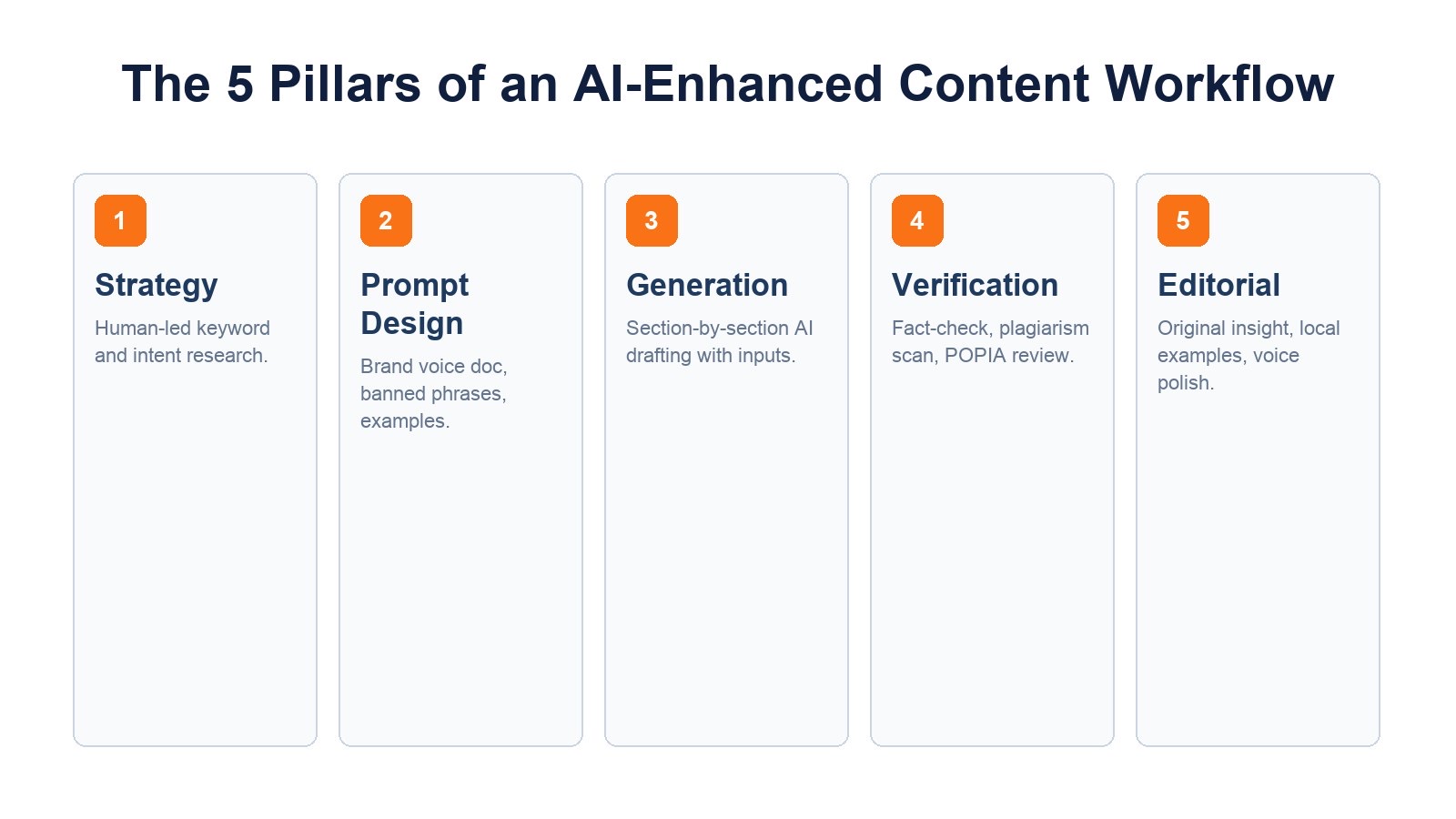
The Five Pillars of an AI-Enhanced Content Workflow
An AI writing tool is one link in a chain. Drop any link and the whole thing falls apart. Across my audit work with SA SMBs, the workflow that reliably produces content that ranks rests on five non-negotiable pillars — keyword and intent research, a brand-voice prompt library, generation, editorial verification, and measurement.
Notice that generation is only one step. Prompt design and editorial verification eat more time than the AI draft ever does — and that’s exactly the point. The agencies I audit who get this right spend roughly 70% of their effort on the human side of the chain.
Choosing the Right AI Writing Tools (with ZAR Pricing)
I get asked for tool recommendations most weeks. There is no single best AI writing tool — there are good fits for specific jobs. Here’s what I currently pay for and recommend for SA SMBs, based on real subscriptions, not affiliate links.
Steer clear of the all-in-one ‘AI marketing platforms’ that bundle 47 templates and charge R2,000+ a month. Most are thin wrappers around the OpenAI API. You’ll get better output paying for ChatGPT or Claude directly and writing your own prompts.
| Tool | Best For | Approx. Monthly Cost (ZAR) | Notes |
|---|---|---|---|
| ChatGPT Plus (GPT-4o) | Long-form drafts, prompt iteration | R380 | Strongest general writer, decent at SA English with prompting |
| Claude Pro (Sonnet) | Editing, brand voice, long context | R400 | Better for nuanced editing and longer source documents |
| Jasper | Marketing teams needing templates | R900+ | Overkill for most SMBs; useful for agencies |
| Grammarly Premium | Final proofread layer | R230 | Catches the small errors AI introduces |
| SurferSEO | On-page optimisation against SERP | R1,300 | Pair with AI drafts before publishing |

How AI Writing Tools Can Enhance Your Content Marketing Strategy: A Practical Workflow
Here’s the exact workflow I run for clients. It assumes you already have a keyword target and a working sense of search intent. If you don’t, fix that first — AI cannot rescue a bad topic choice. Research the intent, load your brand-voice prompt, generate a structured draft, then rewrite and fact-check every claim before it goes anywhere near the publish button.
Run this end to end and an 1,800-word post takes roughly 3–4 hours of human time instead of 8–10. The quality gap between this workflow and ‘paste keyword into ChatGPT, hit publish’ is the gap between ranking on page one and getting quietly deindexed.
POPIA, Plagiarism and the Compliance Risks Nobody Talks About
Here’s the part most AI marketing articles skip. Under the Protection of Personal Information Act (POPIA), you are the responsible party for any personal data you process — including the data you paste into an AI prompt. Drop a customer email thread, a sales call transcript or a leads list into ChatGPT to ‘turn this into a case study’, and you’ve potentially handed personal information to a third-party processor (OpenAI) with no lawful basis and no processing agreement in place.
The Information Regulator has been issuing enforcement notices since 2023. The fines aren’t theoretical — they reach R10 million per contravention. Before you point AI at anything customer-related, anonymise the data, get explicit consent, or use an enterprise AI tier with a signed data processing agreement.
Beyond POPIA, watch two more risks. First, plagiarism — AI models occasionally regurgitate near-verbatim source text, so run every final draft through Copyscape or something similar. Second, the Consumer Protection Act and Advertising Regulatory Board rules apply to AI-written claims exactly as they do to human ones. If your tool spits out a line like ‘South Africa’s number one accountant’, you’re the one who has to substantiate it. The AI walks away clean.
I watched one Cape Town e-commerce brand catch a Hellopeter complaint that escalated to ASA review because their AI-generated product descriptions claimed certifications they didn’t actually hold. Editorial oversight isn’t only about SEO. It’s legal hygiene.

Measuring Whether Your AI Content Strategy Is Actually Working
Volume is not a metric. I’ve audited SA SMBs publishing 12 AI-assisted posts a month with precisely zero organic growth to show for it. The four numbers I track for every AI-enhanced content programme are organic clicks per post (Google Search Console, 90-day rolling), assisted conversions (GA4 attribution), average time on page against the pre-AI baseline, and editorial revision ratio — how much human editing the draft actually needed.
If your revision ratio sits under 20%, you’re probably shipping mediocre content. If it’s over 70%, the AI isn’t saving you time and you should rethink your prompts or your tool. The sweet spot for the workflows I run is 35–50% — meaningful AI contribution, meaningful human craft.
Track these in a plain Google Sheet for at least 90 days before you judge whether AI is earning its keep. Most SA SMBs panic in week three when the numbers haven’t moved. Content marketing — AI-assisted or not — compounds. Give it a quarter.
- Organic clicks per published post (GSC, 90-day window)
- Assisted conversions from blog landing pages (GA4)
- Average engagement time vs. your pre-AI baseline
- Editorial revision ratio — aim for 35–50%
- Branded search lift (a leading indicator of authority)
FAQ
Will Google penalise my site for using AI writing tools in 2026?
Google’s official position, restated in their March 2024 spam policy update, is that AI content isn’t penalised by default — but scaled, unedited content created mainly to manipulate rankings is. In practice, AI-assisted content with genuine human editing, original insight and accurate information ranks perfectly well. Raw AI output published at scale gets caught by the spam systems and core updates. The safest stance for SA SMBs is to treat AI as a drafting assistant and keep a human editor between the model and the publish button.
Is it POPIA-compliant to paste customer information into ChatGPT?
Generally no, not without safeguards. Pasting personal information — names, emails, ID numbers, transaction details — into a public AI tool means sharing that data with a third-party processor outside South Africa, which triggers POPIA obligations around lawful basis, cross-border transfer and processing agreements. The compliant path is to anonymise the data first, obtain explicit consent, or use an enterprise tier (ChatGPT Enterprise, Claude for Work) with a signed DPA. When in doubt, talk to a POPIA-aware attorney before you wire AI into any customer-facing workflow.
What’s the cheapest AI writing tool stack for a small SA business?
For most SA SMBs, ChatGPT Plus at roughly R380 a month plus Grammarly Premium at around R230 covers 90% of content needs — under R650 a month all in. If you publish more than four blog posts a month, add SurferSEO for on-page optimisation. Avoid the bundled ‘AI marketing suites’ charging R2,000+; they’re typically thin wrappers around the same models you can reach directly. Spend the saved budget on a freelance editor or a Hellopeter monitoring tool instead.
How do I stop AI-written content from sounding generic?
Three habits fix this. First, build a prompt library that captures your brand voice, your banned phrases (no ‘delve’, no ‘navigate the landscape’) and a few example paragraphs. Second, feed the AI original inputs — interview transcripts, real customer reviews from Hellopeter, internal data — so it has something specific to chew on. Third, rewrite the intro and close of every piece by hand. Those are the highest-trust sections, and where the generic AI tells show up most. Do these three things consistently and readers won’t be able to tell the difference.
Should I disclose that I use AI writing tools to create content?
There’s no SA legal requirement to disclose AI assistance for general marketing content as of 2026, but disclosure builds trust and readers increasingly expect it. The ASA hasn’t issued specific AI-disclosure rulings, yet misleading claims remain actionable regardless of who — or what — wrote them. My recommendation: disclose AI use in your content policy or about page rather than on every post. Frame it as ‘AI-assisted, human-edited’ — accurate, transparent, and a signal of editorial standards rather than an apology for the tooling.
Key takeaways
- AI writing tools enhance your content marketing strategy only when paired with editorial oversight — raw output gets penalised under Google’s 2024 spam policies.
- Build a brand voice prompt document once and reuse it. This single artifact does more for output quality than any tool upgrade.
- Budget R600–R1,500 a month for a sensible AI stack (ChatGPT Plus, Grammarly, optionally SurferSEO). Avoid R2,000+ bundled suites.
- Treat POPIA seriously: never paste customer personal information into public AI tools without anonymisation, consent or a signed DPA.
- Track editorial revision ratio (target 35–50%), organic clicks, and assisted conversions for at least 90 days before judging whether AI is working.
- Add first-hand experience, local examples, and original opinion to every AI-assisted post. That’s what AI can’t fake and what Google now rewards.
The client in Sandton recovered, by the way. We binned the AI-spam archive, rebuilt a handful of posts properly around his actual expertise, and his rankings climbed back over the following quarter. The tools never were the problem. The absence of a human was. If you’d rather not learn that the hard way, get in touch with Watts Digital.
About the author: David Watts is the founder of Watts Digital, a South African SEO and content agency working with SMBs across Gauteng and the Western Cape. He has 12+ years of experience in digital marketing and writes about AI content workflows, technical SEO and POPIA-compliant marketing for South African business owners.
Ready to put this into action?
If you would like help making AI writing tools work for your content marketing — without losing your brand voice — book a free 20-minute consult and let us show you how.