
TL;DR
- 3D rendering cost South Africa at a glance: a single still render typically costs between R2,500 and R12,000, depending on detail, scene complexity, and revisions.
- Animations, aerial fly-throughs, and photoreal interiors sit far higher — often R25,000 to R150,000+ per project.
- Your brief, not your budget, is the biggest hidden cost driver — vague instructions inflate quotes and revision cycles.
What’s in this guide
- What does 3D rendering cost in South Africa?
- What actually drives the price?
- How much do different project types cost?
- Should you hire local or go overseas?
- How to brief smarter and pay less
- Key takeaways
- Frequently asked questions
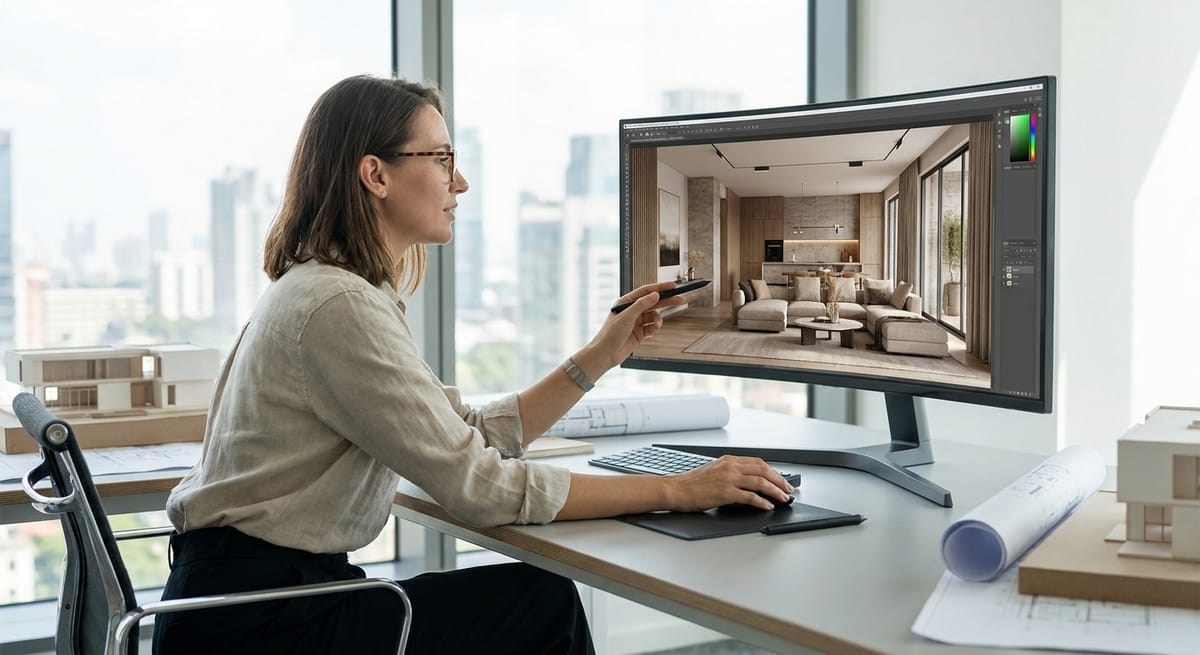
A property developer in Cape Town once slid a napkin sketch across my desk and asked what it would cost to “make it look real”. No dimensions. No materials. No idea whether he wanted one image or twenty. He wanted a number. I understood the impulse — but that napkin was the most expensive thing in the room.
The truth about 3D rendering cost in South Africa is that the number you are quoted says as much about your brief as it does about the studio. Two people can ask for “a render of a house” and receive quotes R30,000 apart, both entirely fair.
So let me walk you through what you are really paying for, what nudges the price up or down, and how to ask the right questions before money changes hands.
What does 3D rendering cost in South Africa for 3d rendering cost south africa?
In South Africa, a single still 3D render generally costs between R2,500 and R12,000, while full animations or complex photoreal projects range from R25,000 to well over R150,000. The wide band reflects detail, realism, scene size, and the number of revisions included.
Think of it less like buying a product and more like commissioning a portrait. The cost of the canvas is trivial. What you are paying for is the eye, the hours, and the judgement of the person holding the brush.
Most local studios price in one of three ways: per image, per hour, or per project. Per-image pricing is common for architectural stills. Hourly rates — often R450 to R1,200 — appear on messy, evolving jobs. Project pricing is the norm for anything involving movement, storytelling, or multiple deliverables.
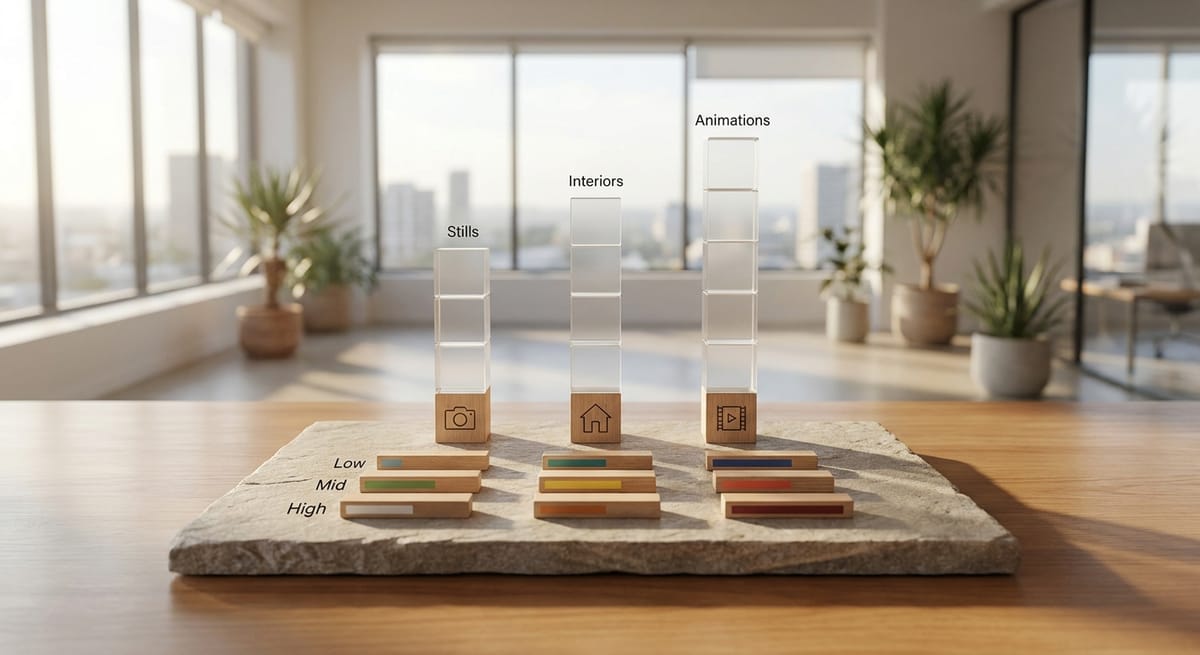
What actually drives the price for 3d rendering cost south africa?
The main cost drivers are scene complexity, level of realism, number of camera angles, revision rounds, and turnaround speed. Rush jobs and last-minute changes are the two most common ways budgets quietly balloon.
Here is the part most people miss. A render is not one job — it is a stack of decisions, and each decision has a price. Modelling the geometry is one cost. Texturing surfaces so glass reads as glass and concrete reads as concrete is another. Lighting, which is where realism lives or dies, is a third. Then comes the rendering itself, and finally the post-production polish.
The single biggest driver, though, is revisions. A studio quotes assuming two or three rounds of feedback. When a client returns for the eighth time asking to “try the sofa in blue, actually no, green”, the meter runs.
Factors that raise your quote
- Photorealism — near-photographic quality demands far more lighting and texture work than stylised visuals.
- Multiple angles — each new camera position is effectively a new render to light and refine.
- Animation — you are paying per frame, and there are 25 to 30 frames per second.
- Tight deadlines — overnight or weekend turnaround typically adds 25–50%.
- Detailed environments — landscaping, furniture, people, and cars all add modelling hours.
Factors that lower it
- Supplying clean CAD files or accurate measurements upfront.
- Approving a clear style reference before work begins.
- Batching several images in one commission rather than dripping them out.
- Accepting daytime-only lighting instead of dusk shots, which take longer to balance.
How much do different project types cost?
Costs vary enormously by project type. Below is a realistic snapshot of South African market rates in ZAR, based on typical SMB and property commissions rather than headline agency pricing.
| Project type | Typical ZAR range | What you get |
|---|---|---|
| Basic exterior still | R2,500 – R6,000 | One angle, standard lighting, light landscaping |
| Photoreal interior still | R4,500 – R12,000 | Furnished room, realistic materials, one to two angles |
| Product visualisation | R3,000 – R10,000 | Single product on clean or styled background |
| Floor plan (3D) | R1,800 – R5,000 | Furnished top-down or perspective plan |
| Short walkthrough animation | R25,000 – R70,000 | 30–60 seconds, interior or exterior fly-through |
| Full development animation | R80,000 – R150,000+ | Multi-scene, aerials, people, branded edit |
Property and architecture make up the bulk of local demand, which is unsurprising given how competitive the residential market has become. A well-crafted visual can sell a unit that exists only on paper — and buyers now expect it. Global visualisation demand continues to climb; industry analysts at Grand View Research peg the 3D rendering software market on a steep multi-year growth curve, and South African studios are riding that wave.
If you are weighing rendering against other visual tools for your business, our guide to visual content marketing puts the choice in context.
Should you hire local or go overseas?
Local studios usually offer better communication and quicker feedback loops, while overseas freelancers can undercut on price. The right answer depends on how complex your brief is and how much hand-holding it will need.
I have watched founders chase a bargain on an international freelancing platform, only to lose two weeks to time-zone lag and a translator’s version of “warm, coastal light”. The render was cheap. The delay was not.
Overseas talent shines on well-defined, self-contained jobs — a single product shot with a locked brief, for instance. But anything requiring nuance, iteration, or a walk through a show flat tends to favour someone who understands the local market, the light, and the buyer.
The cheapest quote is rarely the cheapest project. Revisions, delays, and misread briefs cost more than the render ever will.
There is also the matter of trust. When a studio can meet you, understand your business, and stand behind the work, you are buying accountability — not just pixels. That principle sits at the heart of everything we teach about building trust in business.
How to brief smarter and pay less
The fastest way to reduce your 3D rendering cost in South Africa is to write a precise brief before requesting quotes. Clarity upfront shrinks revision rounds, and revisions are where budgets die.
A good brief is a gift to your own wallet. Every ambiguity you remove is an hour the studio does not have to guess at — and guessing, when it is wrong, is billed to you.
- Define the deliverable. One still? Three angles? A 45-second animation? Say so explicitly.
- Supply reference images. Two or three examples of the mood, realism, and style you want beats a page of adjectives.
- Provide accurate source files. CAD drawings, dimensions, and material specifications save modelling time and money.
- Set the resolution and use. A social post and a billboard are not the same job.
- Agree revision limits. Pin down how many rounds are included and what a fresh one costs.
For deeper guidance on writing briefs that get results, the team at Canva’s design resources offer a solid, practical framework you can adapt. And if you want your visuals working across every channel, our piece on content marketing strategy ties it all together.
One last word on realism. Photoreal rendering is a craft with real technical depth — the physics of light, the behaviour of materials, the subtlety of shadow. The Blender Foundation’s open-source ecosystem has democratised much of this, which is partly why capable South African freelancers can now compete on quality while keeping costs sane.
Key takeaways
- A single still render in South Africa typically runs R2,500–R12,000; animations start around R25,000 and climb past R150,000.
- Realism, camera angles, and revision rounds are the biggest levers on your quote.
- A clear, referenced brief is the cheapest cost-control tool you have.
- Local studios win on communication and accountability; overseas freelancers can win on price for simple, locked briefs.
- The cheapest quote often becomes the most expensive project once delays and re-dos are counted.
Frequently asked questions
What is the average 3D rendering cost in South Africa?
The average 3D rendering cost in South Africa for a single still image sits between R2,500 and R12,000, depending on realism, detail, and revisions. Photoreal interiors and product shots trend toward the upper end, while simple exteriors sit lower. Animations are priced separately and start at roughly R25,000 for a short walkthrough.
Why do 3D render quotes vary so much?
Quotes vary because a render is a stack of billable decisions — modelling, texturing, lighting, rendering, and post-production. Complexity, the number of camera angles, and how many revision rounds you need all shift the price. Two identical-sounding requests can differ by thousands of rand based on brief clarity alone.
Is it cheaper to hire an overseas freelancer?
Sometimes, yes — overseas freelancers can undercut local rates, especially for simple, well-defined jobs. But time-zone gaps, communication friction, and misread briefs often erase the saving on complex projects. For anything needing iteration or local market nuance, a South African studio usually delivers better value overall.
How can I reduce my rendering costs?
Write a precise brief before requesting quotes. Supply accurate CAD files and dimensions, include two or three reference images, define the exact deliverable and resolution, and agree revision limits upfront. Batching several images into one commission is also cheaper than ordering them one at a time.
How long does a 3D render take to produce?
A single still typically takes two to five working days once the brief and source files are confirmed. Complex interiors or multiple angles can take a week or more, and animations often run three to six weeks. Rush turnaround is possible but usually adds 25–50% to the cost.
Ready to get an accurate quote?
Stop guessing at your budget. Send us your brief and we will return a clear, itemised quote — no napkins required — with revision terms spelled out upfront so there are no surprises. Request your no-obligation rendering quote today, and if the estimate doesn’t fit your goals, you owe us nothing.
Written by David Watts — founder of Watts Digital, writing on communication, marketing, and the psychology of persuasion.