

TL;DR:
- Reviews are the third-largest factor in Google’s Local Pack ranking — behind only proximity and Google Business Profile completeness (Whitespark 2024).
- For SA SMBs the biggest leverage is velocity (steady monthly reviews via WhatsApp + QR codes), not raw volume.
- POPIA compliance and Google’s anti-gating policy are non-negotiable — break either and you lose the listing.
If you run a small business in Johannesburg, Cape Town, Durban — or anywhere else in South Africa — your single biggest organic-search lever in 2026 isn’t another blog post or technical audit.
It’s reviews.
Whitespark’s 2024 Local Search Ranking Factors study found review signals — count, velocity, recency, content — accounted for 15.44% of Local Pack ranking weight. Third-largest factor, behind only proximity to the searcher and Google Business Profile completeness.
Yet most SA SMB owners I work with treat reviews as a vanity metric. They don’t have a system for asking. They don’t respond. They don’t know their own Google review count off the top of their head.
This guide changes that. By the end you’ll have a 3-phase plan you can execute this quarter — covering Google Business Profile, Hellopeter, and POPIA-compliant review collection. If you want the broader picture first, my Ultimate Guide to Local SEO for Small Businesses walks through the full local-search stack.
How do you improve your Google ranking in South Africa?
Improving your Google ranking in South Africa means winning two separate contests on the same page. The map pack — the three local results with stars and a map — is decided largely by proximity, profile completeness and reputation. The blue links beneath it are decided by content, technical health and earned authority. Reviews move the first contest hard and the second barely at all.
That is worth saying plainly, because it is exactly where South African business owners waste money. They commission blog posts hoping to appear in the map pack, or chase reviews hoping to rank nationally. Neither works. What does:
- For the map pack — a complete Google Business Profile on the most specific category available, a steady flow of recent reviews, replies to all of them, and identical contact details across Hellopeter, Brabys and Snupit.
- For organic results — pages that answer real questions in real depth, loading fast on a mobile connection, plus links earned from South African sites that matter in your industry.
- For both — suburb-level specificity. “Emergency electrician Linden” is winnable. “Electrician South Africa” is a vanity target that will never ring your phone.
Reviews are the cheapest and fastest of those levers, which is why this guide concentrates on them — a business with no budget and no developer can still move its local ranking this quarter. The organic half is covered in my guide to search engine optimisation in South Africa. Here, we start with why reviews carry more weight in 2026 than they ever have.
Why local SEO reviews matter more in 2026 than ever
Three forces compound:
1. Google’s NLP reads the text. It’s no longer just star count. Google’s algorithm parses review content for entities — your service category, your suburb, your product names. A review that says “Best laptop repair in Sandton — fast turnaround” is worth more for that query than ten 5-star reviews with no text.
2. Consumer trust has shifted. BrightLocal’s 2024 Local Consumer Review Survey found 87% of consumers read reviews for local businesses (up from 76% in 2020), and 79% trust them as much as personal recommendations. With the rand under pressure, SA consumers are more careful — that gap matters.
3. The local pack got smaller. Google Maps’ Local Pack now shows three results above the fold on most mobile searches in SA. If you’re not in the top 3, you may as well be on page 5. Reviews are how you get there.
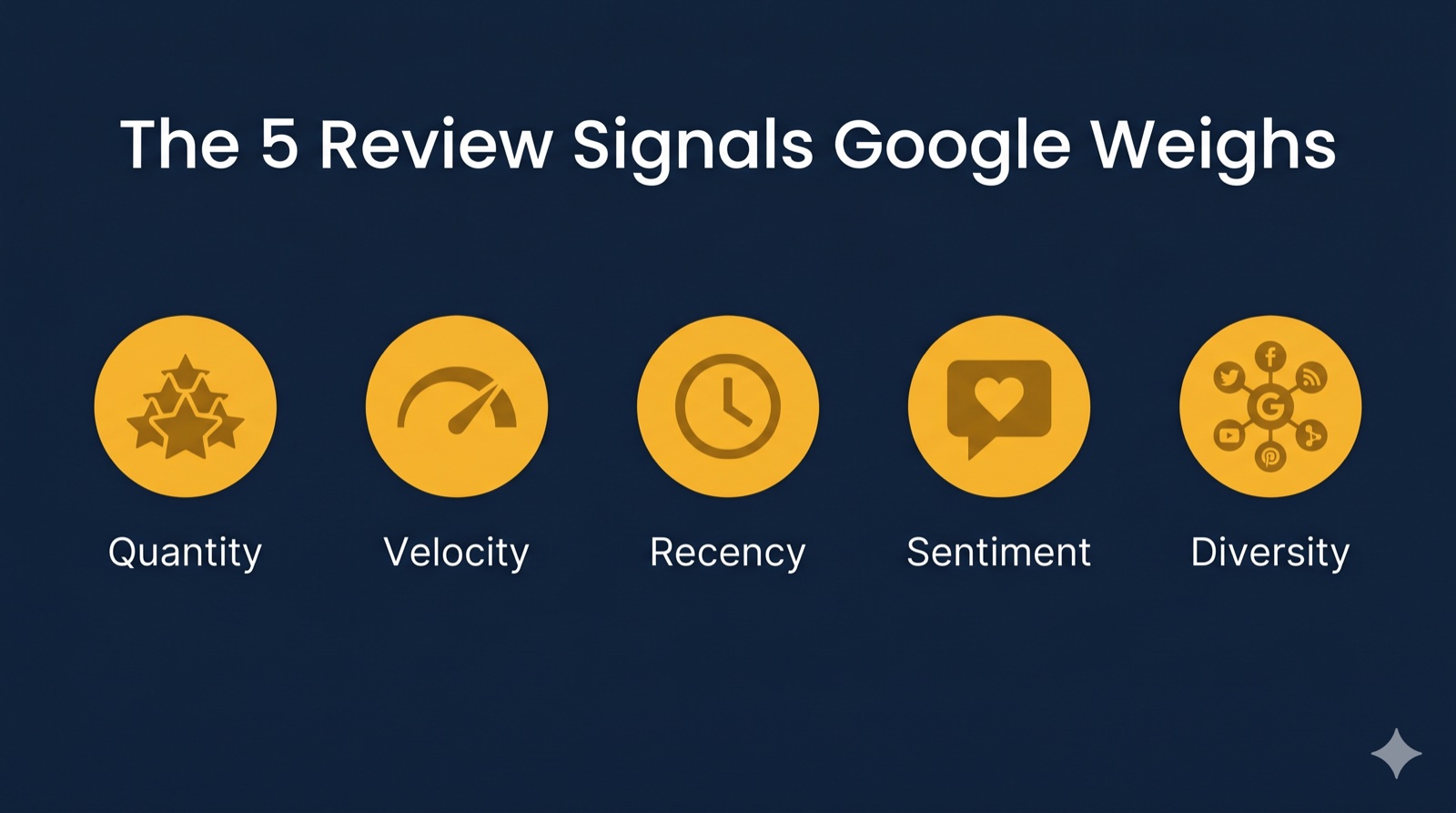
The 5 review signals Google actually weighs
| Signal | What it means | How to influence |
|---|---|---|
| Quantity | Total review count | Steady asking, every transaction |
| Velocity | Reviews per month | Maintain a rhythm — Google notices spikes and droughts |
| Recency | How fresh your newest reviews are | Profiles with no reviews in 6 months get demoted |
| Sentiment | NLP score on review text | Quality of service shows in language patterns |
| Diversity | Reviews across multiple platforms | Google, Hellopeter, Facebook, industry directories |
If you only optimise for one, optimise velocity — it’s the signal Google can verify is genuine (you can’t fake consistent monthly reviews easily) and it’s correlated with all the others.
How often should you ask for reviews — and how important are they really?
Two questions that come up in nearly every local SEO audit we run: how frequently should an SMB request reviews, and how heavily does Google actually weigh them? The answers are tighter than most operators expect.
Frequency: a sustainable ask cadence is one review request per transaction, sent within 24–72 hours of service delivery. For a busy local business that translates to roughly 10–30 fresh reviews per month — enough volume to keep recency signals strong without triggering the suspicious-burst pattern Google penalises. Long flat periods followed by a sudden spike of 50 reviews in a week is the single biggest red flag in Google’s local algorithm. Steady is better than spectacular.
Importance: review signals account for roughly 15–17% of local pack ranking factors according to Moz’s annual Local Search Ranking Factors survey — making them the third-most influential cluster after Google Business Profile signals and on-page SEO. The five signal types broken down in the section above each contribute, but they don’t carry equal weight in every audit I’ve run.
Translation for an SA SMB: ask consistently, respond to every review (good and bad), and don’t try to game the system with a once-a-quarter review push. The 3-phase playbook below operationalises that into a workflow your team can actually run.
The 3-phase local SEO reviews playbook
Phase 1: Foundation (week 1–2)
Don’t ask for a single new review until this is done.
- Claim and verify your Google Business Profile. Address, hours, category, photos, services — fill every field. The 10 GBP optimisation steps every SA business owner should follow covers this in depth.
- Generate your Google review short-link. GBP → “Get more reviews” → copy the
g.page/r/...link. Save it. - Claim your Hellopeter listing. Even if you’ve been ignoring it, Hellopeter ranks well in SA Google for branded queries. You need to own that page.
- Audit existing reviews. Count, average rating, most recent, unanswered. Reply to every review older than 30 days that you haven’t answered — Google rewards engagement.
- Set a baseline. Screenshot your current review count and rating. You can’t measure progress without it.
Phase 2: Velocity (week 3–8)
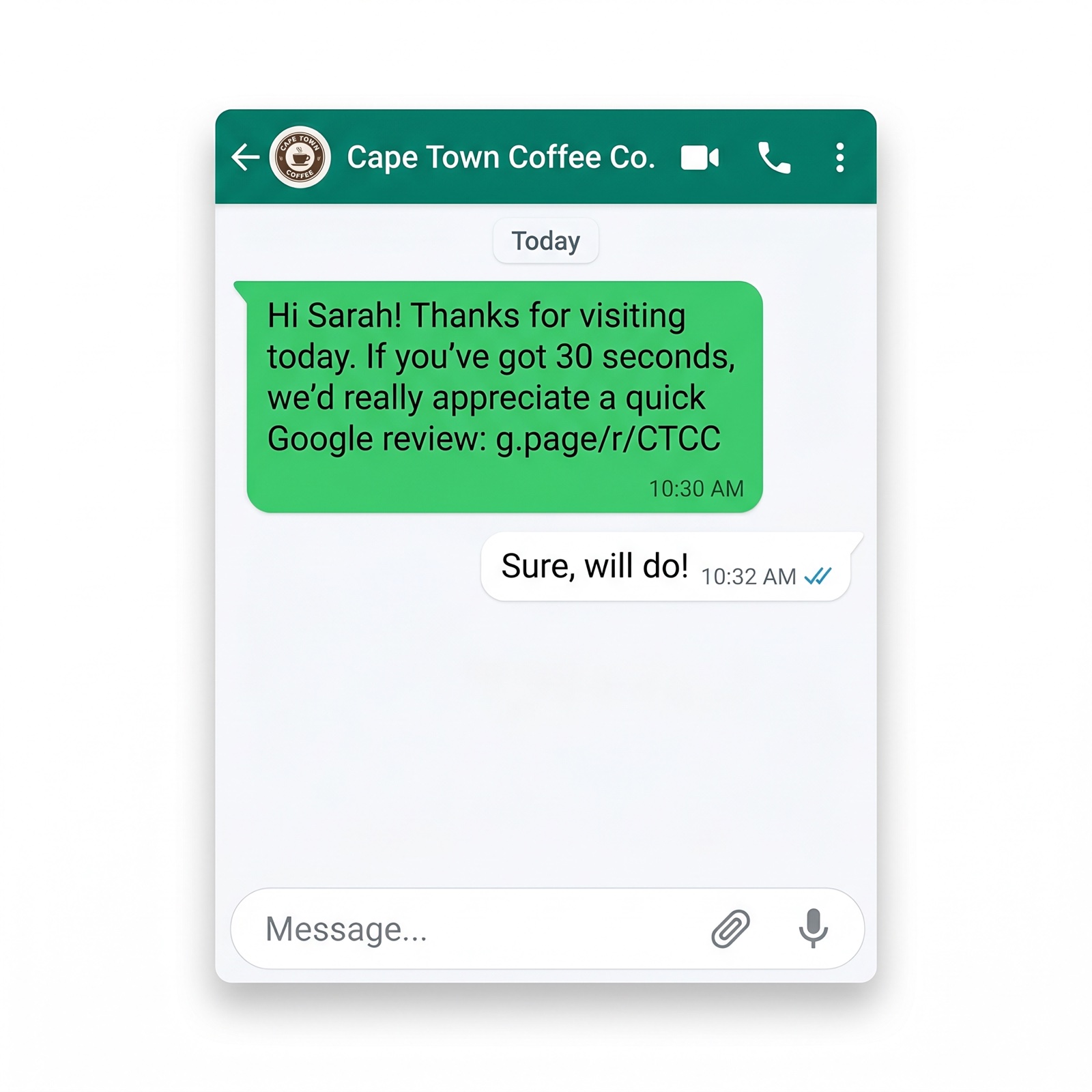
This is where most SA SMBs fail. They send “please review us” emails and get a 2% response rate. What works in South Africa:
- WhatsApp template message after every transaction. Open rate is 95%+ vs 20% for email. Use a one-line message: “Thanks for choosing [Business]! If you’ve got 30 seconds, a quick Google review would mean a lot: [link]”
- POPIA compliance: Get explicit consent at point of sale to send the message. A simple checkbox on the till slip or invoice is enough. Don’t auto-blast existing customer lists.
- QR code on physical receipts and business cards. Print the review short-link as a QR code. Customers in the carpark are 3× more likely to leave a review than customers at home.
- Train your front-of-house staff. “How was your experience today? If great, would you mind sharing it on Google?” — said face-to-face, this gets a 30%+ response rate.
Track weekly. Aim for 4–8 new reviews per month minimum to maintain velocity.
Phase 3: Sustainable scaling (month 3+)
Automate the asking. Stay involved in the responding.
- Integrate with your POS or booking system. Yoco, Shopify and most SA-friendly platforms have automation hooks. Trigger the WhatsApp/SMS after a successful transaction.
- Monthly review audit. 30 min/month — count new reviews, average rating, common complaints. Surface complaints to operations.
- Respond to every review within 48 hours. Templates are fine. Personalisation is better. Owner responses signal an active business — Google rewards that.
- Diversify gradually. Once you have 50+ Google reviews, start asking the same customers to review you on Hellopeter or industry directories.

What is the best Google Reviews alternative in South Africa?
Hellopeter is the closest thing South Africa has to a Google Reviews alternative — a local platform people genuinely check before they spend money, particularly on services. It does not replace Google, because only Google reviews feed the local pack. Treat it as the second opinion your customer goes looking for.
When somebody searches for an alternative they usually mean one of two things. Either Google feels like a walled garden and they want their reputation to live somewhere they control. Or their listing has been suspended, their reviews have disappeared overnight, and they are looking for a way out. Those are different problems, and only one of them has a platform as the answer.
- Hellopeter — South African, complaint-led, and prominent in branded search. Because it skews towards grievance, a business that answers well stands out more there than anywhere else.
- Facebook recommendations — still where a great deal of local discovery actually happens here, especially inside suburb and community groups.
- Sector platforms — hospitality, motor and property each have their own, and where one exists in your trade it carries weight with buyers who are already deep in the decision.
- Your own site — testimonials you own outright. They will never move the local pack, but they do a disproportionate amount of the closing.
Here is the part nobody selling you a reviews platform will say plainly: none of these is a substitute for Google if the goal is ranking. Google weighs its own reviews and nobody else’s. Spread yourself across four platforms and you will collect a thin scattering on each, which is worse than a steady stream on the one that counts. And if you landed here because your listing was suspended, no alternative platform fixes that either — reinstatement does, and the local SEO guide covers the route back.
SA-specific traps to avoid
POPIA: You can’t bulk-message existing customers without explicit opt-in for marketing communication. A review request via WhatsApp falls under the same rules as a marketing SMS. Get the opt-in at point of sale.
Review gating: Asking only happy customers for reviews while routing unhappy ones to a private feedback form violates Google’s policy and risks listing suspension. Ask everyone, then handle complaints publicly with grace.
Fake reviews: SA’s Consumer Protection Act and ASA rulings have started catching up with paid review schemes. Beyond Google’s own AI flagging fakes within hours, the reputational damage if discovered is permanent. Don’t.
Hellopeter complaints: Unlike Google, Hellopeter lets users post complaints without you replying. Set up alerts and respond within 24 hours — silence reads as guilt to prospects researching you.
FAQ
How long until reviews move my Google ranking?
2–6 weeks for the first signal change, longer if your category is competitive (e.g., “plumber Johannesburg”). Velocity matters more than total count in the short term.
How many reviews do I need to compete?
At least the median for your top 3 ranking competitors in your area. In dense Johannesburg/Cape Town suburbs, that’s typically 50–150 reviews. In smaller towns, 15–30 may be enough.
What about negative reviews?
A 4.7-star average with 100 reviews ranks better than a 5.0 with 12. A few honest negatives actually increase trust. Reply professionally and resolve where possible.
Are paid reviews legal in South Africa?
Paying for honest reviews from real customers (e.g., a discount voucher in exchange for an honest review) is a grey area but generally tolerated if disclosed. Paying for fake reviews is fraud and violates the CPA and Google’s TOS. Don’t risk it.
Hellopeter or Google — which matters more?
Google for ranking. Hellopeter for branded-search reputation (when someone searches your business name, Hellopeter often appears in results). Both matter, but Google moves the local pack.
Key takeaways
- Reviews are the third-most-weighted factor in Google’s local pack — and the easiest one for SA SMBs to influence.
- Velocity beats volume. Steady monthly reviews matter more than a one-time blast.
- WhatsApp asking + QR codes consistently outperform email in SA.
- POPIA compliance and Google’s anti-gating policy are non-negotiable.
- Build a 3-phase plan: Foundation → Velocity → Sustainable scaling.
Want a free 30-min audit of your current Google Business Profile and review velocity? Book a Zoom call. For the broader services we offer SA SMBs, see our Digital Marketing page.
About the author: David Watts is the founder of Watts Digital, a South African SEO and content agency working with SMBs across Gauteng and the Western Cape. He has 12+ years of experience in digital marketing and writes about local SEO, content strategy, and AI-augmented marketing for South African business owners.
Not sure how your local SEO stacks up? Get your free Local SEO audit — a 0–100 score, a live mobile-speed check and a tailored action plan, in under a minute.