
Free Guide
The Content Conquest
Turn content into customers — how to write pages and posts that actually convert, not just fill space.
Straight to your inbox. No spam, unsubscribe anytime.

In short
- Content marketing in South Africa is won on trust and local intent: suburb-level keywords, POPIA-compliant lead capture, and reviews on Hellopeter and Google Business Profile.
- AI Overviews now intercept informational searches — Pew Research found clicks nearly halve when a summary appears — so answer-first structure and named authors are the price of visibility in 2026.
- Budget realistically. A workable monthly content spend for most SA SMBs sits between R8,000 and R25,000 depending on whether you produce in-house, hybrid, or fully outsourced.
Most South African SMBs I audit are publishing content that nobody reads and Google refuses to index. The blogs are generic, the authors are anonymous, and the advice could apply to a plumber in Phoenix, Arizona just as easily as one in Phoenix, Durban. That is exactly why this guide to content marketing in South Africa is written for this market specifically — Joburg, Cape Town, Durban, and the smaller towns where competition is thinner but trust signals matter even more.
I have spent 12 years building content programmes for SMBs across Gauteng and the Western Cape. The pattern is consistent: businesses that treat content as a publishing volume game lose. Businesses that treat it as a trust-building system tied to local intent, POPIA-compliant data capture, and measurable revenue win — usually within six to nine months.
This guide is the playbook I hand to clients on day one. It covers strategy, production, distribution, measurement, and the SA-specific compliance traps that catch most agencies off-guard. No filler, no recycled American advice.
What’s in this guide
- What does content marketing actually mean for SA SMBs in 2026?
- How are AI Overviews changing content marketing in 2026?
- How is content marketing in South Africa different from the US and UK playbooks?
- Which five pillars does every SA content engine need?
- What does content marketing cost in South Africa?
- Which POPIA and ARB traps catch content marketers?
- Why is local SEO the SA content advantage?
- Where do South African audiences actually consume content?
- How do you measure content marketing revenue, not vanity metrics?
- Key takeaways
- FAQ
What does content marketing actually mean for SA SMBs in 2026?
Content marketing is the discipline of earning attention and trust by publishing genuinely useful material — articles, videos, guides, case studies — mapped to what your buyers actively search for. For an SA SMB, that means writing for someone typing ‘best geyser installer Randburg’ on a metered 4G connection at 19:00, not for a generic global audience.
Ask most SA SMBs what their content earned them last quarter and you get a shrug. Not because content cannot be measured — it can, precisely — but because conversion tracking was never set up properly in GA4, and blog posts get treated as one-off events rather than assets that compound.
The shift in 2026 is that Google’s helpful content systems and AI Overviews are aggressively filtering thin, anonymous, AI-spun content. If your site has no named author, no original data, and no first-hand experience markers, you are competing for scraps. The AI shift is big enough that it gets the next section to itself.
How are AI Overviews changing content marketing in 2026?
AI Overviews now answer many informational queries before anyone clicks. Pew Research Center found users clicked a traditional result in just 8% of searches showing an AI summary, against 15% without one. For South African SMBs the response is not panic — it is publishing answer-first content worth quoting, and owning the local intent AI cannot serve.
The numbers deserve a moment. Pew Research Center tracked the real browsing behaviour of 900 US adults across 68,879 Google searches in March 2025. When an AI summary appeared, users clicked a traditional result in 8% of visits, against 15% when it did not. Links inside the summaries themselves were clicked in just 1% of visits — and a search that ended in a summary was more likely to end the browsing session entirely.
In Search Console this shows up as a divergence you must learn to read: impressions climbing while clicks sag. That is not your content failing — it is the informational click evaporating. The queries that still deliver visitors are the ones with money or a location attached: ‘panel beater Edenvale’, comparisons, costs, anything where the reader needs more than a paragraph before they will part with a rand.
The adaptation is structural, and this article practises what it preaches. Give every question-shaped heading a direct 40 to 60 word answer an engine can lift whole. Publish under a named author with visible first-hand experience, because that is what these systems select for. And treat being quoted as the new ranking: the reader who meets your name inside an AI answer today is the branded search tomorrow. Informational content is not dead — it is now judged on impressions and mentions, not clicks alone.
How is content marketing in South Africa different from the US and UK playbooks?
Content marketing in South Africa runs on the same principles as anywhere else and almost none of the same assumptions. The imported playbooks — publish four times a week, gate everything, chase national head terms — were written for markets with cheap data, deep link ecosystems, and a single working language. Ours has none of those.
Four differences change the work in practice:
- Data costs money here. A 4MB hero image is not a performance nitpick, it is a cost your reader pays. Page weight is a content decision as much as a developer one — compress hard, drop autoplay video, and put the answer in the first hundred words for the reader who will not scroll on a metered connection.
- Language is not a single lane. South Africa has twelve official languages. Search still happens overwhelmingly in English, but product names, service phrases and brand terms get typed in Afrikaans and isiZulu too — and almost nobody publishes for them. That is thin air if your customers are in Bloemfontein, Nelspruit or the Cape Winelands.
- The competitive field is shallower. Ranking for a national term in the United States means outgunning hundreds of well-funded publishers. Here, a genuinely good page with a named author and first-hand experience can reach page one on terms that would be unwinnable elsewhere. The bar is lower and the reward is the same.
- Compliance is POPIA, not GDPR. The two rhyme, but they are not interchangeable, and a lead-capture flow copied from an American template will not satisfy the Information Regulator. That trap gets its own section further down.
There is a fifth difference that resists a bullet point: attention here is scarcer and more sceptical. South African buyers have been sold to badly for a long time. They check reviews, they ask in WhatsApp groups, and they trust a named person over a brand voice every time. Content that reads as though a committee in another hemisphere wrote it gets closed within seconds. The five pillars below are how I build content that does not.
Which five pillars does every SA content engine need?
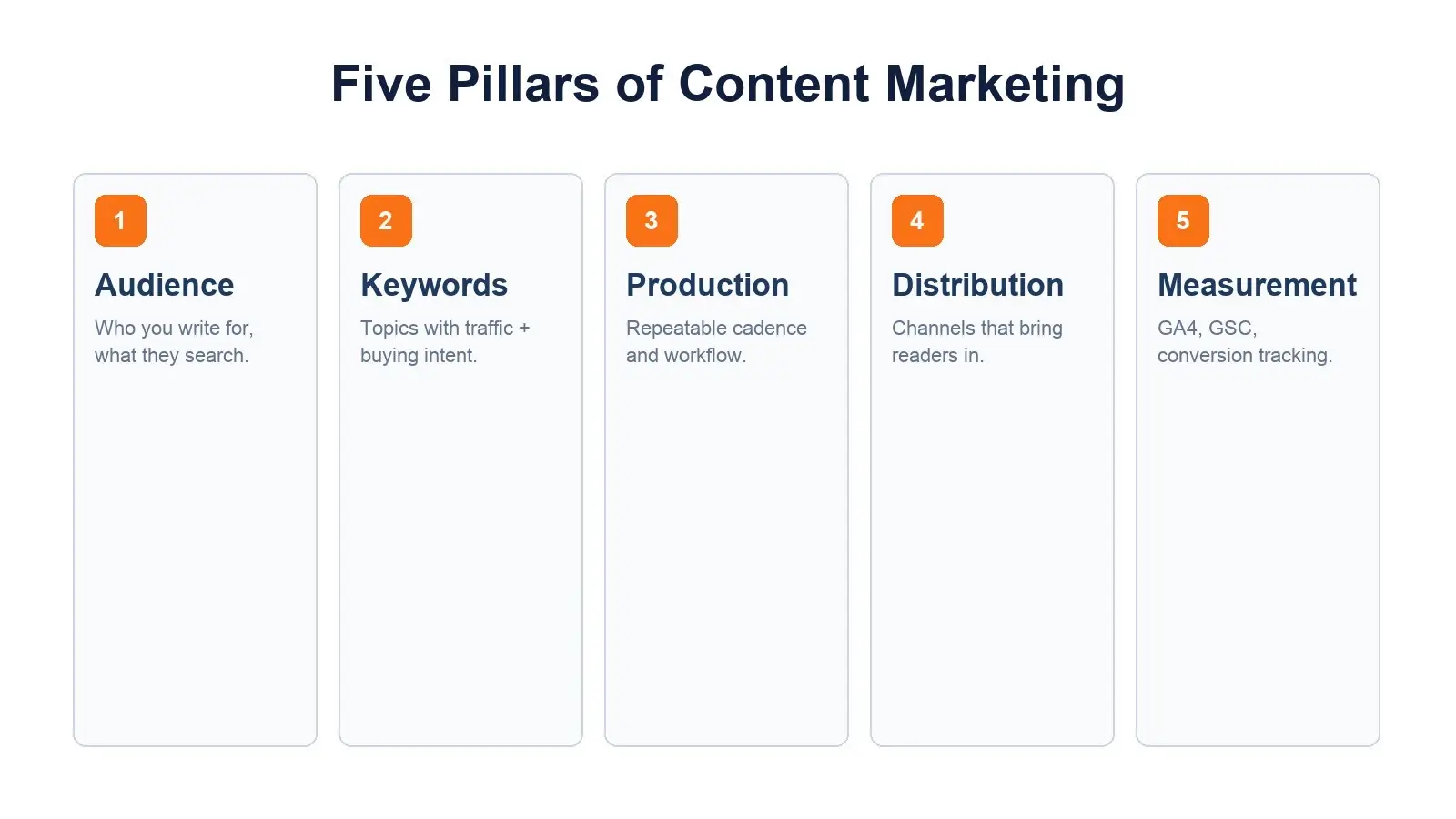
Every content engine I build for an SMB rests on five pillars. Skip one and the system leaks. The pillars are: audience clarity, keyword and intent mapping, production standards, distribution, and measurement. Most SA agencies sell pillar three only — they write articles and call it a strategy — which is why retainers die at month four.
Audience clarity for a Sandton accounting firm looks different to a Stellenbosch wine farm. You need named buyer personas tied to actual customers you have already served, not invented avatars. Keyword and intent mapping should use a tool like Ahrefs or Semrush combined with Google Search Console data to find the queries where you can realistically rank in 6 to 12 months.
- Audience clarity: 2 to 3 named personas drawn from your existing best customers, not stock templates.
- Keyword and intent mapping: 40 to 80 priority queries with monthly volume, difficulty, and intent classification.
- Production standards: a documented brief template, named author, editorial review, and primary-source citation rules.
- Distribution: an email list on a POPIA-configurable platform such as Mailchimp or Brevo, LinkedIn for B2B, WhatsApp Business for service SMBs, and Google Business Profile posts for local intent.
- Measurement: GA4 with conversion events, Search Console weekly review, and a quarterly revenue-attribution audit.
What does content marketing cost in South Africa?
Most South African SMBs get a working content programme for between R8,000 and R25,000 a month, depending on how much they produce in-house. Below that you can publish but not distribute or measure; above R45,000 you are funding original research and PR. The table below breaks the tiers down honestly.
These figures assume you already have a functional website. If your site is on a broken WordPress install with no schema and Core Web Vitals failing, spend the first R15,000 to R30,000 fixing that before publishing anything new. Content on a slow site is a wasted asset.
| Tier | Monthly Spend (ZAR) | Output | Best For |
|---|---|---|---|
| Lean in-house | R3,000 to R8,000 | 2 articles, 4 GBP posts, 1 email | Solo operators, micro SMBs |
| Hybrid | R8,000 to R18,000 | 4 articles, weekly email, monthly video | 10 to 50 employee SMBs |
| Full outsource | R18,000 to R45,000 | Full editorial calendar, video, distribution | Established SMBs scaling lead gen |
| Enterprise SMB | R45,000+ | Multi-channel, original research, PR | Market leaders defending share |

Which POPIA and ARB traps catch content marketers?
If your content collects so much as an email address, POPIA applies — and it has been fully enforceable since July 2021. You need explicit unticked consent, a linked privacy policy, a documented lawful basis, and a working unsubscribe. Superlative claims in your content also need substantiation on file under ARB rules.
This is the section most generic content marketing guides skip entirely, and it is where I see SMBs get fined or sued. The Information Regulator has been increasingly active. If your content marketing involves lead magnets, email signup forms, or comment sections, you are processing personal information — and Mailchimp and Brevo both support compliant capture if configured correctly. I have audited SA SMB sites where the signup form sends data to a Google Sheet with no consent record at all. That is a direct POPIA violation.
The Advertising Regulatory Board (ARB, the successor to ASA) also matters when your content makes claims. ‘South Africa’s number one’ or ‘leading provider’ statements need substantiation on file. Comparative claims about competitors carry legal risk under the Consumer Protection Act. I tell clients to keep a substantiation folder for every superlative they publish.
- Add a POPIA-compliant consent line under every form: explicit, unticked, with a privacy policy link.
- Maintain a substantiation file for every factual or comparative claim in your content.
- Honour Hellopeter and Google reviews with documented response SOPs — these are content too.
- Disclose affiliate relationships and sponsored content clearly, in line with ARB guidance.
Why is local SEO the SA content advantage?
Local intent is the one arena where a South African SMB beats any international publisher. A search like ‘panel beater Edenvale’ is won with suburb-level content, a complete Google Business Profile, and a steady flow of reviews — and, unlike informational queries, local searches still send real clicks in the AI Overviews era.
A search for ‘biokineticist Sea Point’ is not winnable by an Australian content farm. It is winnable by a properly optimised local site with neighbourhood-level content, embedded Google Maps, and a fully completed Google Business Profile.
BrightLocal’s latest Local Consumer Review Survey found that 97% of consumers read reviews for local businesses, and nearly half trust them as much as recommendations from people they know. In SA that translates directly into Hellopeter and Google reviews. Your content strategy must include a review-generation workflow — automated WhatsApp or email requests after every job, with a direct link to your Google review form.
Suburb-level landing pages work, but only if they contain genuinely different information. A page for ‘plumber Bryanston’ that is 90% identical to ‘plumber Sandton’ will get hit by Google’s spam systems. Each page needs local landmarks, suburb-specific pricing or response times, and ideally a case study from that area.
Where do South African audiences actually consume content?
Production is half the job; distribution is where most SA programmes collapse. The channels that move the needle here are WhatsApp broadcasts for service businesses, LinkedIn for B2B in Joburg and Cape Town, email for any list over 500 contacts, and Google Business Profile posts for local intent.
Context on scale: DataReportal’s Digital 2025 report counts 50.8 million South Africans online — 78.9% of the population — and 26.7 million active social media identities. WhatsApp remains the default messaging channel across every income band, which is why a permission-based broadcast list is the highest-intent channel a service SMB can own.
LinkedIn dominates B2B in Joburg and Cape Town, especially in financial services, legal, and tech. Facebook still matters for community-driven SMBs and older demographics in smaller towns. TikTok and Instagram Reels are eating short-form attention, particularly under 35. Email remains the highest-ROI channel for any SMB with a list over 500 contacts, provided you are POPIA-compliant.
Repurposing is non-negotiable at SMB budgets. One pillar article should produce: 4 LinkedIn posts, 2 short videos, 1 email newsletter, 3 GBP posts, and 1 WhatsApp broadcast. If your agency is not doing this, you are paying for one asset and getting one asset.
How do you measure content marketing revenue, not vanity metrics?
Content programmes get cancelled because nobody connects the work to revenue. Track three things per asset: organic impressions in Search Console, assisted conversions in GA4, and a manual revenue tag when a closed deal references the content. Pageviews and bounce rate are not business metrics — leads and rand are.
The third metric requires sales-team discipline, but it is what keeps the budget approved at year-end. And in the AI Overviews era, add a fourth reading: the impressions-to-clicks ratio per query. A widening gap on informational terms is the new normal, not a failure — judge those pages on visibility and branded-search growth instead.
Quarterly content audits are essential. Roughly 20% of any SMB’s existing content drives 80% of organic traffic. Identify the winners, refresh them, expand them, and prune or redirect the dead weight. This single discipline has lifted organic traffic by 40 to 90% within six months for several of my clients.

Key takeaways
- Generic, anonymous content does not rank in 2026 — named authors and first-hand SA experience are mandatory.
- AI Overviews have nearly halved clicks on informational queries. Write answer-first content that gets quoted, and own the local intent where clicks survive.
- Budget realistically: R8,000 to R25,000 per month is the working range for most SA SMBs.
- POPIA compliance is non-optional the moment you collect a single email address through your content.
- Local-intent queries are the easiest wins for SA SMBs — invest in suburb-level pages and Google Business Profile.
- Distribution and repurposing must match production effort, or you are paying for assets that no one sees.
- Measure revenue, not pageviews. GA4 conversion events and quarterly audits separate winners from cancelled retainers.
FAQ
How long before content marketing produces results for a South African SMB?
Expect early signals at month three and meaningful traffic and leads between months six and nine. Local-intent queries in less competitive suburbs can rank within eight weeks; competitive national terms take 12 to 18 months. The variables are publishing consistency, technical health, and backlinks. Anyone promising first-page rankings in 30 days is either scamming you or targeting a keyword nobody searches.
Will AI Overviews kill my organic traffic in South Africa?
Not if your content is built for it. Informational head terms will bleed clicks to AI summaries — Pew Research measured an 8% click-through when a summary appears against 15% without. But local and commercial queries still send visitors, and answer-first pages with named authors are what the AI engines quote. Judge informational content on impressions and mentions, not clicks alone.
Do I need to comply with POPIA if I only publish blog articles?
Yes — the moment your blog has any form collecting an email address, name, or phone number, you are processing personal information under POPIA. You need an explicit unticked consent checkbox, a linked privacy policy, a documented lawful basis, and a working unsubscribe mechanism. The Information Regulator has issued enforcement notices to SMBs, not just large corporates.
Should an SA SMB use AI to write content marketing articles?
AI is useful for research, outlining, and first drafts, but raw AI output is precisely what Google’s helpful content systems filter. The agencies I audit who publish unedited AI articles battle to get those pages indexed at all. Use AI as a research and structuring assistant, then have a named human expert add first-hand experience, local examples, and original analysis. That hybrid is what ranks in 2026.
How much does content marketing in South Africa cost each month?
For a typical SMB with 5 to 50 employees, a workable monthly budget sits between R8,000 and R25,000, depending on whether you produce in-house, hybrid, or fully outsourced. Below R8,000 you can publish but not distribute or measure; above R25,000 you start funding original research and PR. The commonest mistake is underspending for 18 months and then concluding content does not work.
Is Hellopeter relevant to my content marketing strategy?
Yes. Hellopeter is a major trust signal in SA consumer markets — retail, financial services, telecoms, and home services especially. Reviews and responses are content that shapes buying decisions and brand search. Request a review after every transaction and keep a documented response SOP for negative ones. Paired with Google reviews, that is a local trust moat no overseas competitor can copy.
If you want a content programme built around SA buyer behaviour, POPIA, and measurable revenue rather than vanity metrics, book a strategy call with Watts Digital and we will audit your current content and map a 90-day plan.
About the author: David Watts is the founder of Watts Digital, a South African SEO and content agency working with SMBs across Gauteng and the Western Cape. He has 12+ years of experience in digital marketing and writes about content strategy, local SEO, and POPIA-compliant marketing for South African business owners.
Get the FREE in-depth guide — The Content Conquest
Want the deeper playbook? Download our free guide and we’ll email you the PDF in 30 seconds. No spam, no jargon — just the practical material the article above builds on.
Related reading
- B2B vs B2C Content Marketing within 5 Steps
- Social Listening Tools: Analyse Your Audience
- Measuring Blog ROI: 8 Metrics South African SM
The South African SEO hub
This article is part of our South African SEO hub — a connected library on getting a South African business found. Start with the pillar, then go deeper:
- SEO in South Africa: the complete guide — the pillar — strategy, honest pricing, and how ranking really works here
- Local SEO for South African small businesses — the map pack, reviews and Google Business Profile, step by step
- Free SEO audit tool — a 60-second self-audit with a scored action plan
- AI search optimisation — being the answer when buyers ask ChatGPT, Gemini and AI Overviews
- Choosing an SEO agency in South Africa — the questions to ask and the red flags to walk away from
- Google Business Profile optimisation — the single biggest local ranking factor, done properly