
TL;DR
- Great website designers in Cape Town sell outcomes — leads and sales — not just pretty pages.
- Expect to pay R7,500–R25,000 for a professional business site; brochures and shops sit at different ends of that range.
- Vet on strategy, portfolio proof, ongoing support, and whether they build for search and conversion, not decoration.
What’s in this guide
- What do website designers in Cape Town actually do?
- How much do website designers in Cape Town cost?
- How do you choose the right web designer?
- Questions to ask before you sign anything
- Red flags that should stop you cold
- Why local matters (and when it doesn’t)
- Key takeaways
- Frequently asked questions
I once watched a Sea Point restaurant owner unveil her new website to me on a cracked laptop screen, hands trembling with pride. It was beautiful. Slow to load, invisible on Google, and it hadn’t produced a single booking in four months — but beautiful. She had paid a small fortune for a digital brochure nobody would ever find.
If you are searching for website designers in Cape Town, that story is your warning shot. A site is not decoration. It is a salesperson that works while you sleep — or an expensive photograph that gathers dust. The difference lies almost entirely in who you hire.
In this guide I will show you what good looks like, what fair pricing is in ZAR, and the questions that separate genuine partners from order-takers. Story first, then the plan.
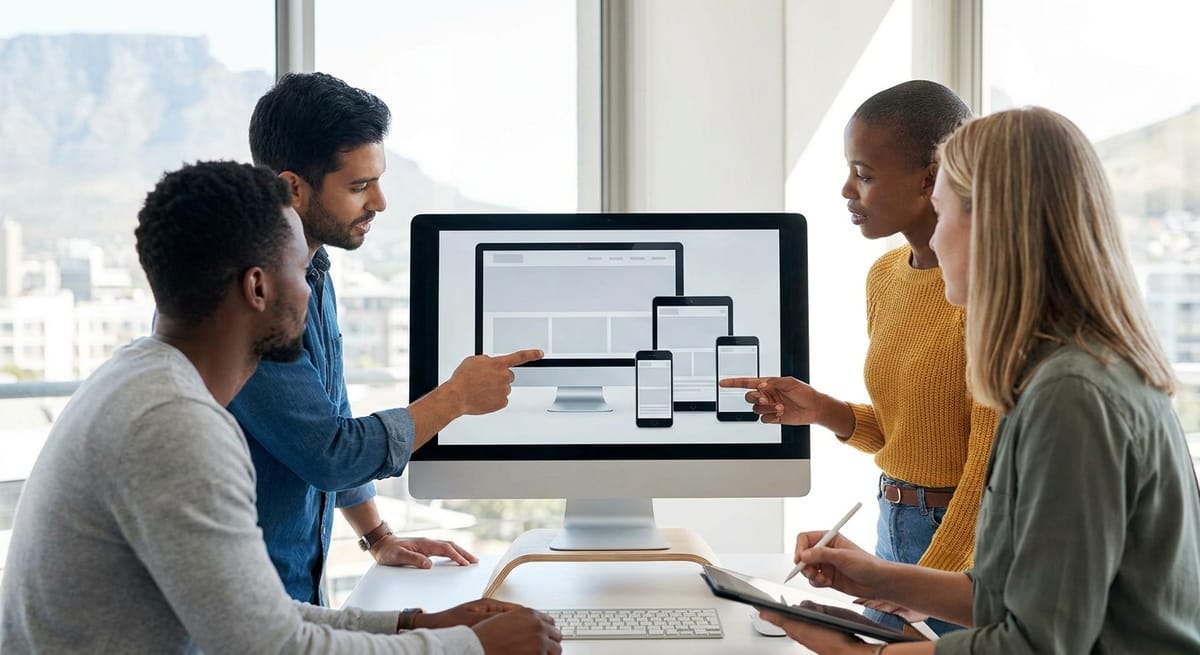
What do website designers in Cape Town actually do for website designers cape town?
Good website designers in Cape Town translate a business goal into a site that attracts the right people and moves them to act. That is the whole job — everything else is craft in service of it.
The label “designer” hides a spectrum. On one end sits the freelancer who makes things look lovely. On the other sits the strategist who asks who your customer is, what keeps them awake, and what one action your homepage should provoke. The visuals matter. But visuals without strategy are lipstick on a shopfront nobody walks past.
A full-service partner typically covers:
- Discovery and strategy — understanding your market, offer, and the single most valuable action a visitor can take.
- UX and UI design — the layout, flow, and feel that guide a stranger from curiosity to conversion.
- Development — building it on a platform you can actually maintain, usually WordPress or WooCommerce.
- SEO foundations — clean code, fast loading, and structure that search engines and AI answer engines can read.
- Support — the unglamorous ongoing care that keeps a site secure and current.
If a proposal skips discovery and jumps straight to “how many pages do you want?”, you are buying a brochure. There is a place for that. Just know what you are getting.
How much do website designers in Cape Town cost for website designers cape town?
Professional website design in Cape Town generally ranges from around R15,000 for a small business site to R80,000 or more for a custom e-commerce build. Price tracks scope, complexity, and the strategy behind the work — not the number of pages.
Here is a realistic breakdown of what South African SMBs pay in 2026. I have kept it honest rather than flattering.
| Project type | Typical range (ZAR) | Best for |
|---|---|---|
| Basic brochure site (3–5 pages) | R8,000 – R20,000 | Sole traders, early-stage startups |
| Professional business site | R7,500 – R25,000 | Established SMBs needing lead generation |
| E-commerce / WooCommerce store | R35,000 – R90,000+ | Retailers selling online |
| Custom / large-scale platform | R90,000+ | Complex functionality, integrations |
| Monthly care & hosting | R500 – R3,500/mo | Ongoing security, updates, edits |
Beware the R2,000 quote. Someone always undercuts the market, and the site they deliver usually needs replacing within a year — costing you more than doing it properly the first time. For a fuller picture of what drives the numbers, I have written a detailed guide to website costs in South Africa.
One principle worth holding onto, echoing direct-response pioneer Dan Kennedy: judge the offer, not the price tag. A R40,000 site that returns R400,000 in leads is cheap. A R5,000 site that returns nothing is the most expensive thing you will ever buy.
How do you choose the right web designer?
Choose a web designer the way you would choose a business partner: by evidence, communication, and shared understanding of your goals — not by the flashiest portfolio image.
The prettiest work in a designer’s showcase tells you they can make things look good. It does not tell you those sites earn money. So dig past the surface.
Look for proof, not promises
Ask for results, not just screenshots. Did traffic grow? Did enquiries rise? A designer who thinks about outcomes will have case studies that mention numbers, not just adjectives. Our twelve-year relationship with Doc Scientia exists precisely because the work kept delivering.
Check they build for being found
A gorgeous site that Google cannot read is a lighthouse with the lamp switched off. Solid design and search engine optimisation are inseparable now. Ask how they handle site speed, mobile performance, and structured content — the same foundations that also help you appear in AI answer engines.
Test how they communicate
Notice how they respond before you have paid a cent. Slow, vague, or defensive now means worse later. The best relationships, as one of our clients put it, are ones where the partner is “professional, communicative, and patient” — read the Rare Moon story for what that feels like in practice.

Questions to ask before you sign anything
The right questions expose a designer’s thinking in minutes. Ask these before any contract, and listen for depth, not deflection.
- What is the single most important action a visitor should take? If they cannot answer, they haven’t thought about your business.
- Will I own the site and the domain outright? You should. Always.
- What platform will you build on, and can I edit it myself? WordPress keeps you in control; proprietary systems can trap you.
- How do you handle mobile and page speed? More than 70% of South African web traffic is mobile, per DataReportal’s Digital 2024 South Africa report.
- What happens after launch? Sites need care. Ask about updates, backups, and support terms.
- Can you show me results, not just designs? Beauty is table stakes. Performance is the point.
A designer who welcomes these questions is one you can trust. A designer who bristles at them has told you everything you need to know.
Red flags that should stop you cold
Certain warning signs reliably predict a painful project. Spot them early and walk away — the cheapest problem is the one you never bought.
- No discovery process. Straight to pricing means straight to a template.
- Refusal to share references or live client sites. Real work speaks for itself.
- Vague ownership terms. If you don’t own it, you are renting your own front door.
- All design, no strategy. “It’ll look amazing” is not a plan for getting customers.
- No mention of SEO or mobile. In 2026 that is like building a shop with no address.
- Prices that seem impossibly low. Someone always pays the real cost — usually you, later.
According to Nielsen Norman Group, users form judgments about a site’s credibility in fractions of a second. A rushed, strategy-free build squanders that first impression — and you rarely get a second one.
Why local matters (and when it doesn’t)
Hiring website designers in Cape Town gives you shared context, aligned time zones, and someone who understands the South African market and payment landscape. But the real question is competence, not postcode.
A local designer knows that your customers pay via PayFast or Ozow, that load-shedding shapes user behaviour, and that ZAR pricing needs to feel right to a local audience. That fluency saves you hours of explanation. If you sell online, understanding the South African payment stack alone can make or break your store.
That said, proximity is not a substitute for skill. I have seen international teams outperform local ones and vice versa. Whether your designer sits in Woodstock or works remotely from abroad, judge them on the same three things: strategic thinking, proven results, and honest communication.
If Cape Town is not your only market, it is worth comparing notes across cities — our guide to finding the right web design partner in Johannesburg applies the same principles a few hundred kilometres north.
Key takeaways
- Great website designers in Cape Town sell business outcomes — beauty is the minimum, not the goal.
- Budget honestly: R7,500–R25,000 for a strong business site, more for e-commerce; treat suspiciously cheap quotes as a warning.
- Choose on evidence — case studies with numbers, clear communication, and a real discovery process.
- Insist on ownership, mobile performance, SEO foundations, and post-launch support.
- Local context helps, but competence and proven results always trump geography.
Frequently asked questions
How do I find the best website designers in Cape Town?
Start with evidence. Look for website designers in Cape Town who show results-driven case studies, own a clear discovery process, and communicate promptly before you pay. Ask what action their sites are built to drive, whether you’ll own everything outright, and how they handle SEO and mobile speed. The best partners talk about your customers and your goals long before they mention colours.
How much should a small business website cost in Cape Town?
A professional small business site in Cape Town typically costs between R7,500 and R25,000, depending on scope and functionality. Basic brochure sites start around R8,000, while custom e-commerce builds can exceed R90,000. Factor in ongoing care and hosting of roughly R500–R3,500 per month. Judge value by return on investment, not the headline figure alone.
Do I need a local designer or can I hire remotely?
Both can work. A local Cape Town designer understands ZAR pricing, South African payment gateways, and local buyer behaviour, which saves explanation time. But competence matters more than location. Whether local or remote, judge every candidate on strategic thinking, proven results, and clear communication rather than their postcode.
What platform should my website be built on?
For most South African SMBs, WordPress is the safest choice — flexible, widely supported, and easy to maintain in-house. WooCommerce extends it for online stores. Avoid proprietary systems that lock you in and make future changes expensive. Always confirm you’ll own the site, domain, and hosting outright before signing.
How long does it take to build a website?
A typical business website takes four to eight weeks from discovery to launch. Brochure sites can be faster; complex e-commerce or custom platforms take longer. Delays usually stem from slow content and feedback from the client’s side, so preparing your copy, images, and approvals in advance keeps the project moving.
Ready to build a site that sells rather than sits pretty? Explore our website design services or get in touch for an honest conversation about your goals — no jargon, no pressure, just a clear plan and a fair offer. A beautiful website is easy. A profitable one takes a partner who asks the right questions first.