
TL;DR:
- Pick your payment gateway before your platform — Payfast, Yoco and Peach Payments each suit different SA business models, and switching later is painful.
- Mobile-first is not optional. Over 70% of SA ecommerce traffic is mobile, and most of it is on capped data — your checkout must work on a 3G connection in load-shedding.
- POPIA compliance, courier API integration (Bob Go, Courier Guy, PUDO) and a Hellopeter strategy matter more than any 2026 design trend you’ll read about overseas.
Most ecommerce website development South Africa guides are rewritten Shopify blog posts with the dollar signs swapped for rands. They tell you to A/B test your hero banner and add a chatbot. Useful in Austin, Texas. Less useful when your customer is checking out on a Huawei in Tembisa during stage 4 load-shedding and your Payfast redirect just timed out.
I’ve spent the last decade building and auditing online stores for SMBs across Joburg, Cape Town and Durban — from a single-product skincare brand in Sea Point doing R180k a month to a B2B parts distributor in Edenvale wiring WooCommerce into Sage. The patterns that matter here are not the patterns trending on US ecommerce Twitter.
This is what actually works for ecommerce website development in South Africa heading into 2026: the platform decisions, the payment stack, the courier integrations, the POPIA basics, and the mobile checkout discipline that separates stores doing real revenue from stores burning Meta ad spend.
What ecommerce website development in South Africa actually requires
South African ecommerce sits in an awkward middle ground. We have first-world consumer expectations — same-day delivery, instant EFT, slick mobile UX — running on infrastructure that is patchy at best. Your store has to handle a customer on uncapped fibre in Bryanston and a customer on 1GB prepaid data in Mthatha with the same grace.
That reality shapes every technical decision. Page weight matters more here than in Europe. Checkout abandonment is brutal because of payment redirects. Returns logistics are expensive and complicated by the courier you chose on day one. And every byte of personal data you collect now sits under POPIA, with the Information Regulator becoming noticeably more active in 2024 and 2025.
Before you pick a theme or argue about hero video, get the foundation right: platform choice, payment stack, courier API, mobile performance budget and a privacy policy that an actual lawyer has read.
Choosing your platform: Shopify, WooCommerce or Wix in SA
There are three platforms that account for the overwhelming majority of SA ecommerce builds I see in audits: Shopify, WooCommerce and Wix. Magento and BigCommerce show up at the enterprise end. Headless setups are growing but still rare for SMBs — if you’re doing under R5 million a year online, headless is almost certainly overkill.
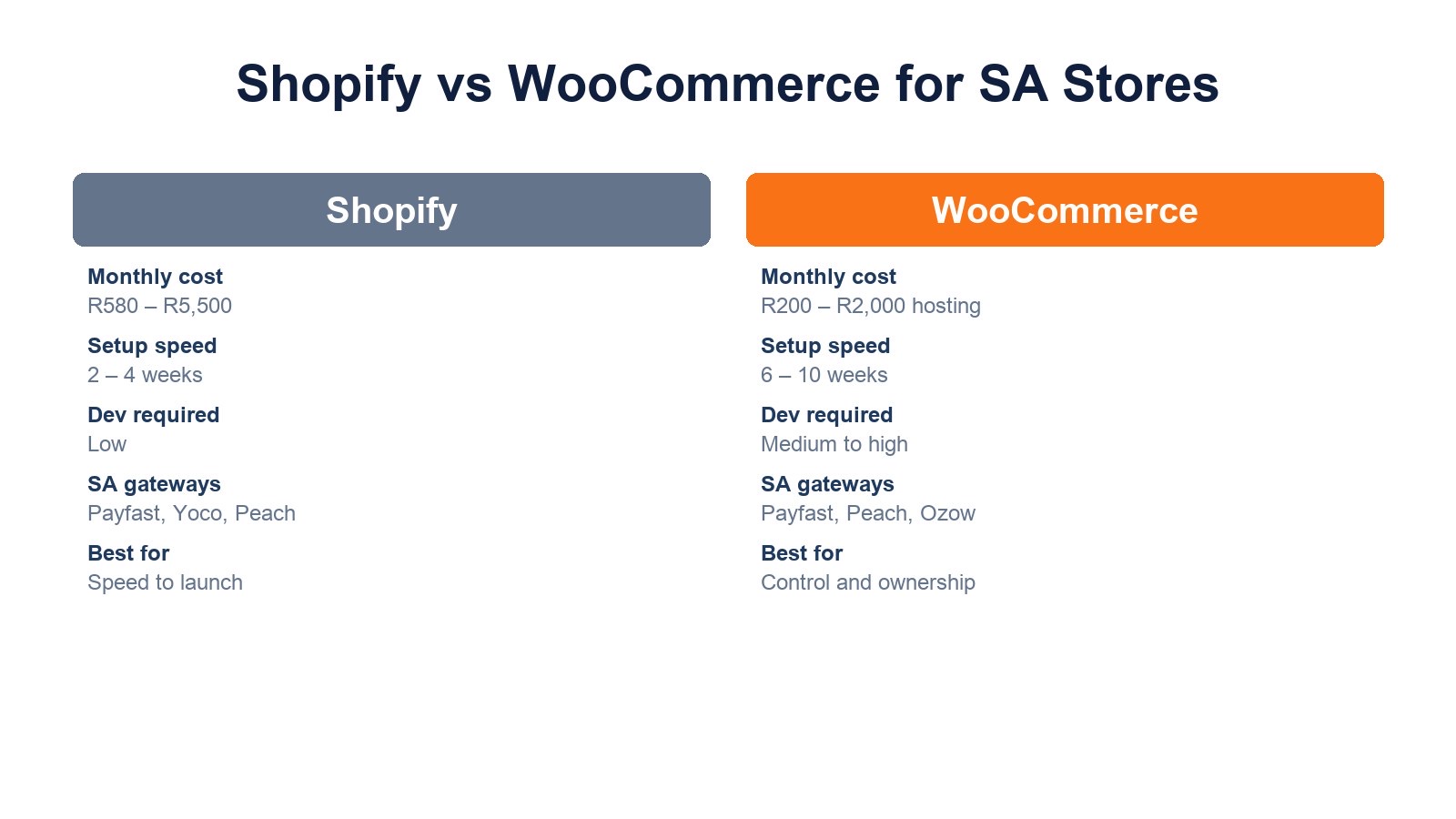
Shopify is the path of least resistance. Native Payfast, Yoco and Peach Payments integrations exist. Bob Go (formerly uAfrica) plugs in cleanly. The monthly cost in ZAR stings — Basic Shopify is roughly R580 a month at current exchange rates plus transaction fees if you don’t use Shopify Payments — but you stop paying developers to fix things that should just work.
WooCommerce remains the SA favourite for businesses that want to own their stack and avoid recurring SaaS fees. The Payfast and Peach Payments plugins are mature. You’ll pay for hosting (Xneelo or a managed WP host like Cloudways), an SSL, and a developer on retainer. Total cost of ownership is usually lower than Shopify if your dev support is in-house, higher if it isn’t.
Wix and Shopstar are fine for very small operations — under 50 SKUs, under R50k a month — but I would not build a serious catalogue on Wix. The SEO ceiling is real, and migrating off it later is a project nobody enjoys.
| Platform | Best for | Monthly cost (ZAR) | SA payment integrations |
|---|---|---|---|
| Shopify | Brands wanting speed-to-launch and minimal dev | R580–R5,500 | Payfast, Yoco, Peach, Stripe |
| WooCommerce | Owners who want full control and lower long-term cost | R200–R2,000 hosting | Payfast, Peach, Yoco, Ozow |
| Wix | Tiny catalogues, hobby stores | R200–R600 | Payfast (limited), PayPal |
| Magento / Adobe Commerce | Enterprise, complex B2B catalogues | R15,000+ | All major SA gateways via extension |
The South African payment stack: Payfast, Yoco, Peach and friends
Payment gateway choice will affect your conversion rate more than your homepage design. I’ve watched stores lift checkout completion by 12–18% just by adding instant EFT alongside card payments, because a meaningful slice of SA shoppers either don’t have credit cards or won’t use them online.
Payfast (now part of Network International) is the default for many SMBs. It supports cards, instant EFT, Masterpass, Mobicred, SnapScan and Zapper out of one integration. Fees sit around 3.5% + R2 per transaction for cards, lower for EFT. The redirect-based checkout is its weakness — you’re sending the customer off-site, which adds friction and some load-shedding fragility.
Yoco moved aggressively into online payments after years of dominating in-person card machines. Their online checkout is hosted but cleaner than Payfast’s, fees are competitive, and if you already use Yoco card machines in a physical store, the unified dashboard is genuinely useful. Good fit for omnichannel retailers — think a clothing boutique in Greenside with a physical shop and a Shopify store.
Peach Payments is the choice when you need more control: embedded checkouts, recurring billing, marketplace splits, and better support for higher-volume merchants. Their integration is more developer-heavy but the checkout stays on your domain, which helps both conversion and trust. For SaaS or subscription ecommerce, Peach is usually the right answer.
Add Ozow for instant EFT as a secondary option, offer cash on delivery if your courier supports it (Courier Guy and PUDO both do), and you’ve covered roughly 95% of how South Africans want to pay online. Don’t bother with crypto. Don’t make Bitcoin your fourth checkout option in 2026.

Courier and fulfilment integration is half the battle
Shipping is where SA ecommerce stores quietly haemorrhage money and reviews. A bad courier experience generates a Hellopeter complaint within 48 hours, and Hellopeter complaints rank — sometimes outranking your own homepage for branded searches. Get this right at build time.
Bob Go (formerly uAfrica Shiplogic) is the aggregator most SMBs end up on. One integration gives you live rates and label printing for The Courier Guy, Fastway, DSV, Aramex, Pargo and PUDO lockers. Plug it into Shopify or WooCommerce and your customer sees real shipping costs at checkout instead of a flat R99 that loses you money on every Cape Town delivery.
PUDO lockers have changed the economics for low-value parcels. Door-to-locker rates can be under R60 against R110+ for door-to-door, and the customer collects on their schedule — useful for buyers in complexes with strict access rules or office workers who are never home. Offer it as a default option, not an afterthought.
If you ship anything heavy, fragile or oversized, build a separate logic path. The number of stores I’ve audited that promise free shipping nationally on a R450 average order, then pay R280 to ship a 4kg item to George, is depressing.
- Quote live shipping rates at checkout via Bob Go or a similar aggregator — never a flat fee for a national catalogue.
- Offer at least three options: economy door-to-door, express, and PUDO/locker collection.
- Surface delivery ETAs prominently. ‘Delivered in 2–4 working days’ converts better than just a price.
- Build a returns workflow before launch, not after the first complaint. Courier Guy and Aramex both offer reverse-collection APIs.
POPIA, trust signals and the legal layer
POPIA has been fully enforceable since July 2021, but the Information Regulator has only really started flexing in the last 18 months. Fines for non-compliance can reach R10 million, and complaints from customers are now a legitimate vector. Treat POPIA as a baseline, not an aspiration.
The basics most SA ecommerce sites still get wrong: a privacy policy that names your Information Officer with contact details, an explicit opt-in for marketing (not a pre-ticked box), a cookie consent banner that actually blocks tracking until consent is given, and a data retention policy you can defend. Generic privacy policies copied from a US Shopify template will not save you.
Trust signals matter beyond compliance. South African shoppers look for: a physical address (not a PO Box), a working landline or WhatsApp number, real product photography rather than supplier stock images, a returns policy that doesn’t read like a hostage note, and visible Hellopeter or Google reviews. The CPA gives consumers a 7-day cooling-off right on most online purchases — say so explicitly. Buyers who feel protected convert better.

Mobile-first development for the South African reality
Statista’s 2024 South Africa ecommerce data put mobile share of online retail traffic above 70%, with mobile checkout completion lagging desktop by a meaningful margin. The gap is almost always a development problem, not a customer problem. Heavy hero images, render-blocking scripts, an off-screen sticky banner that hijacks the tap target — these kill mobile checkouts.
Set a performance budget and enforce it. I aim for a Largest Contentful Paint under 2.5 seconds on a throttled 3G connection, a total page weight under 1.5MB on product pages, and a Cumulative Layout Shift under 0.1. Google’s Core Web Vitals data sits inside Search Console — check it monthly, not annually.
Practical mobile wins I push on every build: lazy-load anything below the fold, serve WebP images with proper srcset, defer non-critical JavaScript, kill any chat widget that loads more than 100KB on initial page load, and test the full checkout on a real mid-range Android — not your iPhone 15 Pro. The Samsung A-series is closer to what your customer is using than anything in the Apple Store.
If you’re serious about understanding how mobile users actually behave on your site, journey mapping is the exercise that pays back. Our user journey mapping guide walks through the steps I use with clients before a redesign brief is written.
What’s actually changing in 2026 (and what isn’t)
AI search is the genuine shift. Google’s AI Overviews and the rise of ChatGPT shopping queries mean product pages now compete to be cited, not just ranked. Structured data (Product, Offer, AggregateRating, Review schema) is no longer optional — it’s how you get pulled into AI-generated answers. Stores I’ve watched gain visibility in 2025 are the ones with disciplined schema and depth in product copy, not the ones chasing the latest theme.
Headless commerce is becoming more accessible. Shopify Hydrogen and WooCommerce headless via Next.js are viable for mid-market SA brands now. If you’re hitting performance ceilings on a traditional theme, it’s worth a conversation — see our headless commerce overview for the trade-offs.
What isn’t changing: the fundamentals. Fast, secure, mobile-friendly stores with honest delivery promises and a payment stack that matches how SA customers actually want to pay will keep winning. Most of the ‘trends’ you’ll read about in 2026 — AR try-on, voice commerce, the metaverse storefront — are not where SA SMBs should spend their first R200,000.
FAQ
How much does ecommerce website development cost in South Africa?
For an SMB store with 50–500 SKUs, expect R45,000 to R180,000 for a competent build on Shopify or WooCommerce, including payment integration, courier setup, basic content and POPIA-compliant policies. Below R30,000 you’re getting a templated job with little customisation. Above R250,000 you should be getting headless architecture, a proper UX phase or complex ERP integration. Ongoing costs include hosting (R200–R2,000/month for WooCommerce, R580+ for Shopify), payment processing fees of around 3–3.5% per transaction, and a developer retainer if you don’t have in-house skills.
Which is better for SA businesses: Shopify or WooCommerce?
Shopify wins on speed-to-launch, reliability and reduced developer dependency — pay your monthly fee, get a stable store. WooCommerce wins on long-term cost, flexibility and ownership of your data and stack. My rule of thumb: if you have no technical team and want to focus purely on selling, choose Shopify. If you have an existing WordPress site, want full control over hosting, or expect heavy customisation (custom B2B pricing, complex shipping logic, ERP integration), choose WooCommerce. Both integrate cleanly with Payfast, Peach Payments, Yoco and Bob Go.
Do I need to be POPIA compliant if I only sell to South Africans?
Yes — POPIA applies to any business processing personal information of people in South Africa, regardless of where the business is based. At minimum you need a published privacy policy naming your Information Officer, lawful grounds for processing data, an opt-in (not pre-ticked) consent for marketing, a cookie consent mechanism, secure storage of customer data, and a documented process for handling data subject access requests. Fines for non-compliance reach R10 million. Don’t copy a US privacy policy template — get one written or reviewed for the SA legal context.
What payment methods should a South African ecommerce store offer?
At minimum: credit and debit cards via Visa and Mastercard, instant EFT (through Ozow, Payfast or Peach), and ideally one buy-now-pay-later option like Mobicred or PayJustNow for higher-ticket items. SnapScan and Zapper add value for younger demographics. Cash on delivery is worth offering if your courier supports it — it still converts hesitant first-time buyers, especially in lower-LSM segments. Skip cryptocurrency unless your audience specifically demands it. Most SA stores cover their bases with one Payfast or Peach integration plus Ozow as a secondary EFT option.
How long does it take to build an ecommerce site in South Africa?
A focused Shopify build with 50–100 SKUs, payment and courier integration, and migrated content typically takes 4–6 weeks from kick-off to launch. WooCommerce projects of similar scope run 6–10 weeks because hosting, security and customisation eat more time. Custom or headless builds run 12–20 weeks. The biggest delay on every project I run is client-side: product photography, copywriting and decisions about shipping policies. Get those locked before development starts and you’ll cut your timeline by a third.
Key takeaways
- Choose your payment gateway before your platform — Payfast for breadth, Peach for control, Yoco for omnichannel.
- Integrate a courier aggregator like Bob Go from day one and offer PUDO as a default option, not a hidden alternative.
- Treat POPIA as a launch requirement, not a follow-up task. A proper privacy policy and cookie consent are non-negotiable.
- Build mobile-first against a real performance budget tested on a mid-range Android, not your latest iPhone.
- Use Product, Offer and Review schema religiously — AI search and Google Overviews now decide which SA stores get cited.
- Skip the trends that aren’t validated in SA. AR try-ons and voice commerce are not where your first R200k of dev budget should go.
If you’re planning a new build or rescuing a store that isn’t converting, get in touch with Watts Digital for an ecommerce audit grounded in what actually works for South African SMBs.
About the author: David Watts is the founder of Watts Digital, a South African SEO and content agency working with SMBs across Gauteng and the Western Cape. He has 12+ years of experience in digital marketing and writes about ecommerce strategy, SEO and conversion optimisation for South African business owners.