
TL;DR
- Search engine optimization South Africa rewards local intent — think suburb-level keywords, Google Business Profile, and ZAR-priced services.
- Content depth, site speed, and genuine authority now outrank keyword stuffing after Google’s recent core updates.
- Expect meaningful movement in three to six months; budget R5,000–R25,000+ monthly depending on competition.
What’s in this guide
- What is search engine optimization in South Africa?
- Why does local SEO matter so much here?
- The four pillars that actually move rankings
- How much does SEO cost in South Africa?
- What does a search engine optimisation package include?
- How do you choose an SEO partner?
- How long until you see results?
- Key takeaways
- Frequently asked questions
A friend of mine — a plumber in Randburg — once told me he’d spent R40,000 on a website that no one ever found. It sat there, gleaming and invisible, like a shop with its lights off in a back alley. He’d built the shop but forgotten to build the road that led to it.
Search engine optimization South Africa is, at heart, the art of building that road. It’s the difference between existing online and being discovered online — between a website that decorates the internet and one that quietly feeds you customers while you sleep.
I’ve spent years watching how attention moves, how a single search query becomes a decision, and how the right words in the right place reshape a business. Let me show you what actually works in this market — not the jargon, the mechanics.
What SEO in South Africa actually means
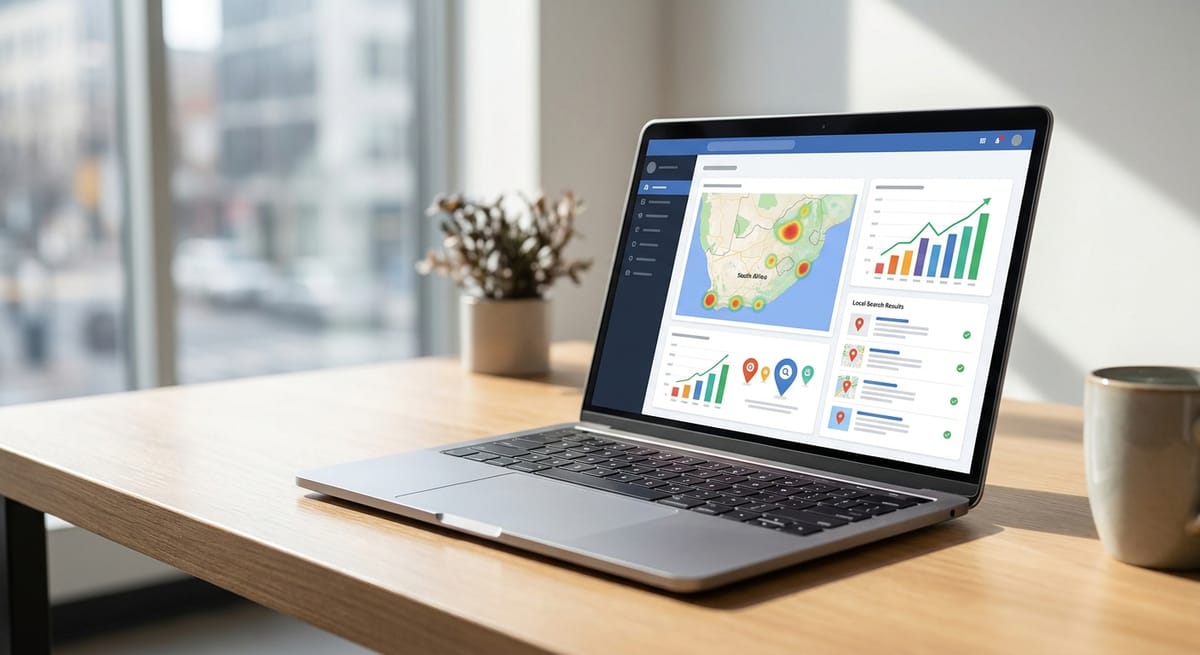
Search engine optimization is the practice of improving a website so it ranks higher on Google for the searches your customers actually type. In South Africa, that means optimising for local intent, mobile-first browsing, and often data-conscious users on slower connections.
The fundamentals are universal — relevant content, technical health, and earned authority. But the terrain is local. A Cape Town coffee roaster and a Johannesburg law firm compete on entirely different keywords, and both must speak the language of a South African searcher who half the time is on a phone, on the move, and impatient.
Google still commands well over 90% of the search market here, according to StatCounter’s South Africa data (2024). So when we talk SEO, we are, for practical purposes, talking about Google — its rules, its updates, and its ever-sharpening appetite for genuinely useful pages.
Why local SEO matters so much here
Local SEO matters because most South African searches carry geographic intent — people want a service near them, right now. Winning locally often beats competing nationally, and it’s far cheaper.
Consider the phrase “emergency electrician Sandton”. The person typing it isn’t browsing. They’re standing in the dark with a tripped board and a rising sense of dread. They will call the first credible business they see. That is the raw, urgent power of local intent — and it’s where small businesses can outrank far larger competitors.
Google’s Business Profile is your single most valuable local asset. According to BrightLocal’s Local Consumer Review Survey (2024), the vast majority of consumers read online reviews before choosing a local business — and those reviews feed directly into your local rankings.
- Claim and complete your Google Business Profile with accurate hours, categories, and photos.
- Gather reviews consistently — a steady trickle beats a one-off flood.
- Use suburb-level keywords like “web design Durban North” rather than only “web design South Africa”.
- Keep your name, address, and phone number identical across every directory.
I’ve seen a modest guesthouse in Hermanus outrank national booking sites for its own town simply by doing these four things well. Small, local, and specific beats big, broad, and vague more often than people expect.
The four pillars that actually move rankings
Sustainable SEO rests on four pillars: technical health, relevant content, on-page optimisation, and earned authority. Neglect any one and the whole structure wobbles.
Think of it like building a house on the Highveld. The foundation is your technical setup. The rooms are your content. The address on the gate is your on-page tagging. And the neighbourhood’s reputation — how others speak of you — is your authority. All four, or none of it holds.
1. Technical health
Your site must load fast, work flawlessly on mobile, and be easy for Google to crawl. In a country where mobile data is expensive and connections vary wildly, a heavy, sluggish site actively repels visitors. Google’s Core Web Vitals are now a genuine ranking factor — measure them and fix what’s slow.
2. Relevant content
Write pages that answer real questions in real depth. A single thorough guide often outperforms ten thin pages. This is where first-hand expertise wins — after Google’s helpful-content refinements, generic filler sinks and lived experience floats.
3. On-page optimisation
Titles, headings, meta descriptions, image alt text, and internal links tell Google what each page is about. Our own website SEO checklist walks through this step by step.
4. Earned authority
Links from respected South African sites, mentions in local press, and quality citations still carry enormous weight. As Moz’s Beginner’s Guide to SEO puts it, links remain among the strongest signals of trust. Earn them honestly — bought links are a slow poison.

How much does SEO cost in South Africa?
SEO in South Africa typically costs between R5,000 and R25,000 or more per month, depending on your industry’s competitiveness, your location, and the depth of work required. One-off audits and project fees sit outside this range.
Beware the R1,500-a-month promise. Real SEO is skilled, ongoing labour — strategy, writing, technical work, and analysis. When someone offers it for the price of a weekly grocery shop, they are usually selling automated links that will one day cost you a penalty.
| Service tier | Typical monthly (ZAR) | Best for |
|---|---|---|
| Local / starter | R5,000–R9,000 | Single-location SMBs, low competition |
| Growth | R10,000–R18,000 | Multi-service or regional businesses |
| Competitive / national | R20,000+ | E-commerce, finance, high-value leads |
The right question is never “what’s the cheapest?” — it’s “what’s a customer worth to me?” If a single new client is worth R30,000, a R12,000 monthly spend that delivers three of them a month is not a cost. It’s an engine.
What does a search engine optimisation package in South Africa actually include?
A monthly search engine optimisation package in South Africa should cover four streams of work — technical fixes, content, local signals and authority — with a named deliverable in each, every month. If a proposal cannot tell you what lands on your desk in month one, it is a subscription, not a service.
This is the question I wish more business owners asked before signing. Agencies quote a rand figure and a vague promise of “ongoing optimisation”. Push for the list. A credible retainer at the growth tier above typically contains:
- A technical audit up front, then monthly monitoring — crawl errors, broken redirects, Core Web Vitals measured on a mobile connection, and indexation coverage in Search Console.
- A keyword and intent map tied to your real services and suburbs, with honest difficulty scores — not a spreadsheet of 500 terms nobody searches.
- Two to four published pages a month, written by a named human, each linked internally back to the service page it supports.
- Google Business Profile management — categories, services, weekly posts, fresh photos, and replies to every review. It is astonishing how often this is quietly excluded.
- Citation and NAP cleanup across Brabys, Snupit, Yellosa, Hellopeter and your industry body, then quarterly re-checks.
- Link earning you can see — a small number of genuinely earned mentions on South African sites, with the outreach shown to you rather than described.
- A monthly report you can read in five minutes, covering rankings, organic sessions and conversions — and what changed because of the work, not merely what changed.
Two things do not belong inside an SEO retainer: your hosting, and your Google Ads spend. Both get bundled in to make a quote look generous, and both blur the only question that matters — whether the SEO itself is earning its keep. Ask for them priced separately. Once you know what you are buying, the harder judgement is who you buy it from.
How do you choose an SEO partner?
Choose an SEO partner who explains their reasoning, reports transparently, and never guarantees a #1 ranking — because no honest professional can. Look for evidence, not promises.
The tell-tale sign of a trustworthy agency is the way they talk about failure. Amateurs promise the moon. Professionals tell you what they’ll try, how they’ll measure it, and what they’ll do if it doesn’t work. That candour is the whole game.
- Ask for South African case studies with real before-and-after data.
- Demand clarity on tactics — if they won’t explain their link strategy, walk away.
- Check reporting — you should see rankings, traffic, and conversions monthly.
- Beware guarantees — Google itself warns against anyone promising rankings.
If you’d rather learn the ropes first, our SEO services guide lays out how we approach each of these steps for South African businesses.
How long until you see results?
Most South African businesses see meaningful movement in three to six months, with substantial results often taking six to twelve months for competitive terms. SEO is compounding, not instant.
I think of it like planting a stone-fruit orchard. You water and prune for a season or two and see nothing but leaves. Then one spring the branches bend under fruit — and they keep bending, year after year, for a fraction of the ongoing effort. Paid ads are cut flowers; SEO is the orchard.
Newer domains and fiercely contested industries — legal, medical, finance — take longer. A local plumber may see leads within weeks. A national insurance comparison site may grind for a year. Patience isn’t a virtue here; it’s the strategy.
Key takeaways
- Search engine optimization South Africa is fundamentally about local intent — win your suburb before you chase the country.
- A complete, well-reviewed Google Business Profile is the single highest-leverage local asset you own.
- Rankings rest on four pillars: technical health, relevant content, on-page optimisation, and earned authority.
- Budget R5,000–R25,000+ monthly and judge spend against the value of a customer, not the size of the invoice.
- Choose partners who explain, report, and never guarantee — and expect real results in three to six months.
Frequently asked questions
Is search engine optimization South Africa worth it for small businesses?
Yes — often more so than for large firms. Search engine optimization South Africa lets a small, local business dominate suburb-level searches where big national competitors barely bother to compete. A well-optimised Google Business Profile and a handful of strong local pages can deliver steady, high-intent leads at a fraction of the cost of paid advertising.
Can I do SEO myself?
You can handle the basics — claiming your Google Business Profile, gathering reviews, and writing helpful content. These alone move the needle for many local businesses. Technical fixes, link earning, and competitive strategy usually benefit from a professional, but starting yourself teaches you enough to hire wisely later.
How is SEO different from Google Ads?
Google Ads buys instant visibility that vanishes the moment you stop paying. SEO builds visibility that compounds and largely persists over time. Ads are ideal for immediate results and testing; SEO is the long-term asset. Most successful South African businesses run both, using ads while their organic rankings mature.
Which cities are most competitive for SEO in South Africa?
Johannesburg, Cape Town, and Durban are the most competitive markets, with dense clusters of businesses fighting for the same terms. Smaller centres like Bloemfontein, Nelspruit, and Port Elizabeth offer easier wins. The narrower and more local your keyword, the faster you can realistically rank.
Does Google penalise bad SEO?
Yes. Manipulative tactics — bought links, hidden text, spun content — can trigger manual actions or algorithmic suppression that devastate traffic. Recovery is slow and painful. Google’s guidelines are clear about what counts as spam, which is precisely why sustainable, honest SEO always outperforms shortcuts in the long run.
Ready to build the road to your business? Let’s map out where your South African customers are searching — and how to meet them there. Book a free SEO consultation with Watts Digital and we’ll show you exactly what’s holding your rankings back. No jargon, no empty guarantees — just a clear plan you can act on.
Written by David Watts, founder of Watts Digital, who has spent years studying how attention, language, and search behaviour shape the choices customers make.