
TL;DR: Local citation sites — directories like Google Business Profile, Yelp and Bing Places that list your name, address and phone — are a direct lever on your local search rankings and the map pack. The non-negotiable is consistency: identical NAP details everywhere, because mismatched info makes Google (and customers) wonder if you’ve closed. Get listed on the right sites, keep them clean, and you build both ranking and credibility.
A plumber in Centurion phoned me last year, frustrated. He did good work, his customers liked him, and yet the calls weren’t coming. When we looked him up, the problem was sitting in plain sight. His old Pretoria address was still listed on three directories, his shop name appeared four different ways across the web, and Google had quietly stopped trusting any of it. He wasn’t losing to better plumbers. He was losing to tidier listings.
That is the whole story of local citation sites in one phone call. They are the online directories and business listings that carry your Name, Address and Phone number — the NAP that search engines cross-check to decide whether you’re real, open, and worth showing. Get them right and you climb the map pack. Get them wrong and you vanish, quietly, while you’re busy doing the actual work.
Why local citation sites matter for SA businesses
Local citation sites are online directories where your company information lives publicly. Search engines crawl them constantly, and customers check them before they ever pick up the phone. Three things happen when those listings are right.
1. They lift your local SEO
Google treats every citation as a small vote that your business exists where it says it does. Enough consistent votes, from sites Google respects, and you start to surface in the local map pack — those top three results that appear when someone searches “electrician near me” or “coffee shop in Sandton.” High-quality citations for local SEO are how you earn that spot.
2. They build credibility
People are quietly suspicious. Before they trust you with their money, they check — Yelp, Google, sometimes Bing Places — and they want to see the same details every time. The moment your phone number differs from one listing to the next, a small doubt creeps in. Has this place closed? Did they move? Are they sloppy? Consistency answers all three questions before they’re even asked.
3. They bring in calls and walk-ins
Why do some businesses get all the enquiries while a better one down the road sits quiet? It is rarely about the product. It is about being found at the exact moment someone is ready to buy. List yourself on the top citation websites and you’re in front of that customer when it counts.
Learn more about optimising your Google Business Profile
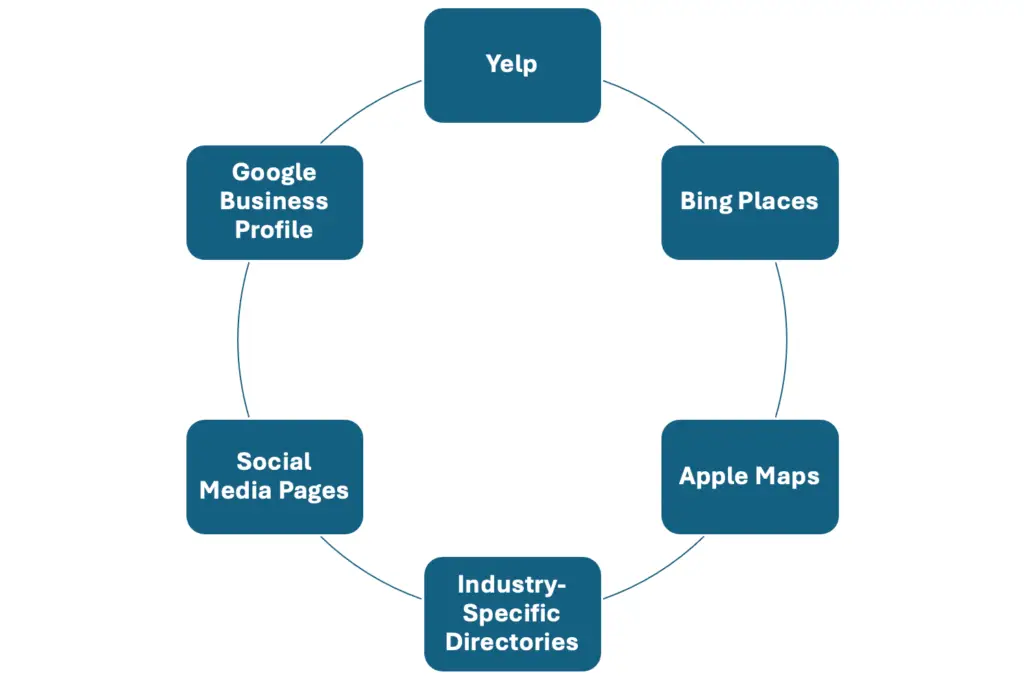
Top citation websites you can’t afford to miss
By “top citation websites” I mean directories with real domain authority, a large audience, and credibility that search engines already trust. Being present on these gives you an instant stamp of legitimacy. Start here.
1. Google Business Profile
- Why it’s essential: This is the single most important listing for local SEO. Landing in Google’s map pack — the “3-Pack” — can put you above businesses with far bigger budgets.
- Key features:
- Add photos, posts, and offers
- Collect and respond to reviews
- Track calls, directions, and website visits
2. Yelp
- Credibility factor: Yelp carries weight, and plenty of customers still check it for honest feedback before trying somewhere new.
- Action step: Ask happy customers to leave a review — more reviews lift your visibility inside Yelp’s own search.
3. Bing Places
- Don’t overlook Bing: Google dominates, but Bing still claims a real slice of searches, often an older and more affluent one. Worth the ten minutes.
- Make it count: Connect your social profiles, write a proper description, and keep the listing current.
4. Apple Maps
- For iPhone users: A large chunk of South Africans navigate with Apple Maps. If you’re not on it, you’re invisible to all of them.
- Profile completeness: Get your hours, address, and phone number exactly right. Apple Maps quietly punishes incomplete profiles with lower visibility.
5. Industry-specific directories
- Niche trust: Run a dental practice and a site like Healthgrades earns its keep. A contractor might do better on Houzz. The principle holds for SA too — find the directory your customers actually use.
- Extra relevance: A niche listing often carries more weight in your field than a generic one, because it signals specialised credibility.
6. Social media pages
- Yes, they count: Facebook and LinkedIn act as citation sources too. Your business details must match exactly across all of them.
- One discipline: Update your social media pages the moment your address or phone number changes — especially if you relocate or open a second branch.
Moz Local is a solid option for advanced citation tracking and management.
How to keep your citations consistent
Consistency is the whole game. A mismatched business name or an old address confuses your customers and your search engine crawlers in equal measure. Three habits keep you clean.
- Create a master document
- Keep one spreadsheet with your official business name, address, and phone number — the single source of truth you copy from every time.
- Include your business category, website URL, and hours of operation.
- Use an aggregator
- Services like BrightLocal or Yext push your data to dozens of directories at once, saving hours and cutting out typos.
- When you move or change a number, the aggregator updates every connected listing in one go. That alone is worth the fee.
- Check in regularly
- Listings drift. Put a quarterly review in your diary and confirm everything is still accurate.
- Watch for user-generated edits — on Google Business Profile, anyone can suggest a change, and some go live without your say-so.
For the latest local SEO research, Search Engine Journal is worth a regular read.
Common mistakes that hurt your local rankings
You can be listed on every local citation site going and still sink your own local SEO efforts with a handful of avoidable mistakes. These are the ones I see most.
1. Inconsistent NAP info
Problem: A small variation — “St.” on one site, “Street” on another — reads as untrustworthiness to a search engine.
Solution: Standardise your address format and company name once, then keep it identical everywhere.
2. Ignoring reviews and ratings
Problem: A review lands on Yelp or Google and you never reply. That silence reads as a business that has stopped paying attention.
Solution: Respond to every review, good or bad. It shows you care, and a thoughtful reply can turn an unhappy customer into a returning one.
3. Stuffing keywords into your business name
Problem: Padding your name — “Bob’s Plumbing — Best Plumbers in Pretoria” — invites a ranking penalty rather than a boost.
Solution: Use your name exactly as it appears in real life. If “Plumbers” is genuinely part of your registered name, fine. Otherwise, leave the extra words off.
4. Letting old listings rot
Problem: Expired or outdated listings contradict your current details and confuse everyone, Google included.
Solution: Run a citation audit at least once a year. Clear out old addresses, dead phone numbers, and references to services you no longer offer.

Best practices for managing your listings
If you want high-quality citations for local SEO, treat your listings like an asset, not a chore you did once in 2022.
- Claim your listings. An unclaimed or unverified profile can be edited by anyone. Verifying it is how you protect your own brand.
- Fill out the full description. Complete every field — category, services, hours, photos. A full profile routinely outranks a half-finished one.
- Use keywords naturally. Keep them out of your business name, but work them into the description. “We offer residential and commercial plumbing across Pretoria” reads far better, and ranks better, than “plumbing, best plumbing, local plumbing.”
- Add photos and video. Listings with images get more engagement. Pictures of your storefront, your team, and the work in progress all build trust.
For the rules straight from the source, read Google’s official Business Profile guidelines.

A worked example: how clean citations rebuilt visibility
Picture a small bakery — call it Sweet Treats on Main — with lovely pastries and a dead-quiet weekday counter. The product was never the problem. The listings were. Here’s the before and after.
- Before:
- Inconsistent NAP across Yelp, Google, and Bing.
- An old address on Apple Maps sending customers to a shop that had closed.
- Thin or missing descriptions on most directories.
- After:
- Every major listing claimed and verified.
- One standard address format, every mismatch corrected.
- Proper photos — cupcakes, pies, staff mid-shift.
The result? Within three months, weekday foot traffic rose by roughly 45% and phone orders climbed with it. The line they kept hearing at the counter: “We saw you on Google and thought we’d try you.” That sentence is what a clean citation profile actually buys you.
Quick wins for busy owners
You’re busy and you want movement today, not a six-week project. Start with these.
- Verify your Google Business Profile. If you haven’t claimed and verified it, do that first, then add fresh photos.
- Spot-check your top five directories. Confirm your name, address, and phone match on Google, Yelp, Bing, Apple Maps, and Facebook.
- Ask for five reviews this week. A handful of loyal customers can shift your ranking. Just ask them, on whichever platform they prefer.
- Track your positions. Use a local rank tracker so you can actually see whether the work moved the needle.
FAQ (snippet-friendly answers)
How do I find the best local citation sites for my specific industry?
Start with the universal platforms — Google and Yelp — then add the directories your industry actually uses. A dentist should be on Healthgrades; a contractor might do better on Houzz.
Do local citations still matter if I already have a strong social media presence?
Yes. Social media drives engagement, but search engines want consistent business details across reputable directories. Citations reinforce your legitimacy and help you rank higher.
How often should I update my citations?
Review them quarterly. If something big changes — a move or a rebrand — update your listings straight away.
Can I just hire someone to manage my citations for me?
Yes, and plenty of owners do, to free up their own time. An agency like Watts Digital handles the lot — listing updates, corrections, review monitoring — so nothing slips through.
Is paying for premium directory listings worth it?
It depends on the directory’s credibility and audience. Paid features can lift visibility on some platforms, but weigh the return and the relevance to your business before you commit.
Key takeaways
- Consistency is everything: your Name, Address, and Phone must be identical across every local citation site.
- Don’t neglect reviews: they’re both a ranking factor and a trust signal.
- Aim for high-quality citations: choose reputable sites with real domain authority.
- Audit regularly: a quarterly check keeps your listings accurate and your rankings safe.
None of this is complicated. It is just fiddly, and it rewards the businesses patient enough to keep it tidy. Sort your citations once, build the quarterly habit, and you stop losing customers to nothing more than an old address.
Related reading
- Local SEO for Small Businesses: A 2026 Step-by
- Google Ads landing page best practices for Sou
- Google Ads Agency in South Africa | ROI-Focuse
- Do Reviews Improve Local SEO Rankings? Yes — H
Ready to put this into action?
If you’d rather have a team that does this every day, we’re here. Book a free 20-minute consult and we’ll give you the three highest-impact next steps for your business — no obligation.