
TL;DR
- Google Ads for small business South Africa works best with tight local targeting, a single clear offer, and a budget of R3,000–R15,000 a month to start.
- Search campaigns aimed at high-intent keywords beat broad display blasts every time for SMBs counting every rand.
- Track conversions, not clicks — a campaign that costs R40 a lead and closes one in four is worth more than cheap traffic that never buys.
What’s in this guide
- Why does Google Ads work for small businesses in South Africa?
- How much should a small business spend on Google Ads?
- How much do Google Ads cost in South Africa?
- Which Google Ads campaign types should you use?
- How do you choose the right keywords?
- Setting up your first campaign: a step-by-step walkthrough
- Common mistakes that drain your budget
- How do you know if it’s actually working?
- Key takeaways
- Frequently asked questions
A plumber in Pretoria once told me he’d burned R8,000 on Google Ads in a single month and got nothing — not one phone call he could trace back to it. He showed me his account on a cracked laptop screen, shaking his head. Within twenty minutes I found the leak: he was bidding on “plumbing” across the whole country, paying for clicks from Cape Town to Polokwane, none of whom would ever drive to his workshop in Centurion.
Google Ads for small business South Africa is not broken. It is misunderstood. The platform is ruthlessly fair — it rewards clarity and punishes vagueness — and most SMB owners arrive without the clarity it demands. That plumber didn’t have a traffic problem. He had a targeting problem, an offer problem, and a tracking problem, all wearing the same disguise.
This guide is the map I wish he’d had. We’ll cover budgets in rand, the campaign types that suit a small operation, the keywords that bring buyers rather than browsers, and the quiet mistakes that bleed accounts dry. By the end, you’ll know whether to run ads yourself or hand them to someone who does this all day — and how to tell the difference between progress and expensive noise.
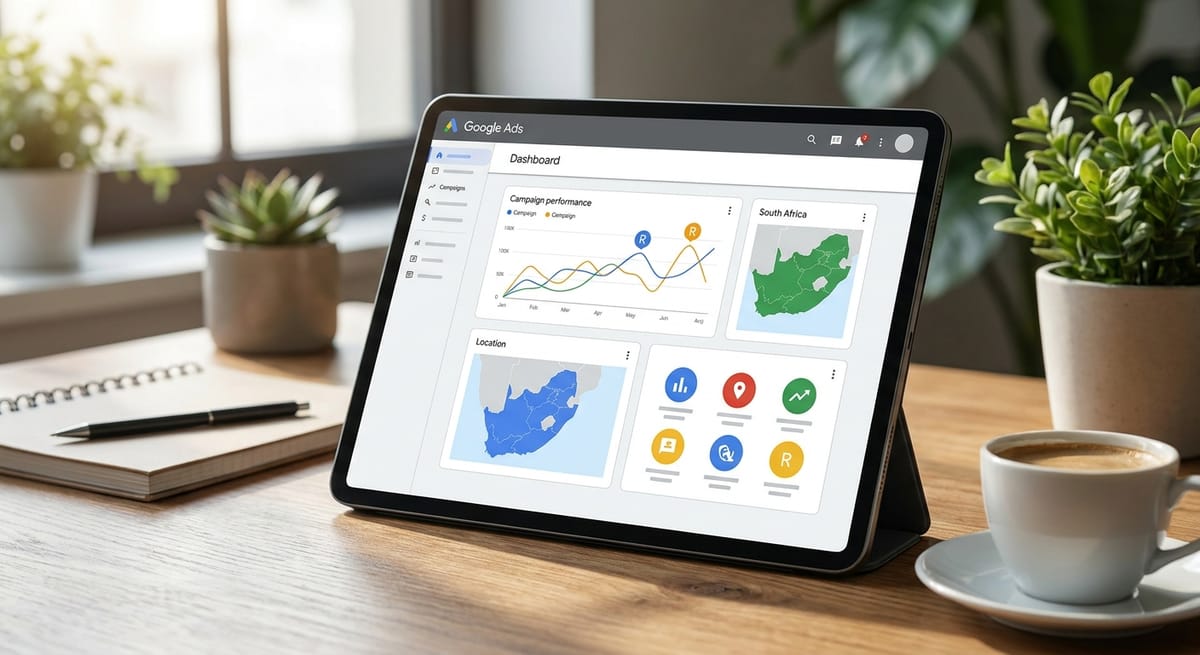
Why does Google Ads work for small businesses in South Africa for google ads for small business south africa?
Google Ads works because it catches people at the exact moment they’re looking to buy. Unlike a billboard hoping to be noticed, your ad appears only when someone in your area types what you sell — which means you’re paying for intent, not attention.
Consider the difference. A Facebook ad interrupts someone scrolling through holiday photos. A Google search ad answers a question they typed seconds ago: “emergency electrician Sandton,” “affordable accountant Durban,” “wedding photographer Stellenbosch.” That person isn’t browsing. They have a problem and a wallet, in that order.
South Africa’s digital landscape makes this especially powerful. According to DataReportal’s Digital 2024 South Africa report, the country had over 45 million internet users, with Google commanding the overwhelming share of search. Your customers are already searching. The only question is whether they find you or your competitor.
There’s a deeper reason it suits small businesses, though, and it’s psychological. Robert Cialdini wrote about the principle of timing — the right message at the wrong moment fails, while a modest message at the right moment converts. Search advertising is timing made mechanical. You don’t have to be the loudest voice in the room. You only have to be present when the question is asked.
The local advantage SMBs hold
Big national brands often run clumsy, broad campaigns. A small business can do something they cannot: speak directly to one suburb, one need, one customer. “Same-day battery delivery in Roodepoort” will out-convert “automotive solutions” every time, because specificity feels like it was written for you. And it was.
How much should a small business spend on Google Ads for google ads for small business south africa?
Most South African small businesses should start with a monthly budget of R3,000 to R15,000, depending on industry competitiveness and how many leads they can realistically handle. The goal at the start isn’t scale — it’s learning what a customer actually costs you.
Budget panic is the most common reason SMB owners abandon Google Ads too early. They expect to switch it on like a tap and watch sales pour out. Real spending discipline looks different — it looks like patience with small numbers until the data tells you where to pour more.
Here’s a rough sense of what different sectors pay per click in the South African market, drawn from agency benchmarks and our own client accounts. Treat these as directional, not gospel — costs shift constantly.
| Industry | Typical cost per click (ZAR) | Sensible starting monthly budget |
|---|---|---|
| Trades (plumbing, electrical) | R8 – R25 | R4,000 – R8,000 |
| Legal & financial services | R20 – R60 | R8,000 – R15,000 |
| Health & dental | R12 – R35 | R5,000 – R10,000 |
| Home services & cleaning | R6 – R18 | R3,000 – R6,000 |
| E-commerce (general) | R3 – R12 | R5,000 – R12,000 |
Notice the legal and financial rows. Those high costs aren’t a rip-off — they reflect how much a single client is worth. A conveyancing attorney who pays R50 a click but lands a R15,000 transfer fee from every fortieth click is doing brilliantly. Cost per click means nothing in isolation. Cost per customer is the only number that pays your rent.
The 90-day rule
Commit to a fixed budget for at least 90 days before judging the channel. The first month is messy — Google’s algorithm is still learning, you’re still refining keywords and ad copy. By month three, a well-managed account should be giving you a stable, repeatable cost per lead. If you quit in week three, you’re judging a half-baked cake.
How much do Google Ads cost in South Africa? The full price breakdown
Google charges nothing to open an account and sets no minimum spend — you pay only when someone clicks, and in South Africa that click typically costs between R3 and R60 depending on your industry, as the table above shows. What surprises people is everything wrapped around the click.
Google Ads pricing in South Africa is really three questions bundled into one. Separate them and the budgeting becomes simple:
- Media spend — what Google bills you. Set in rand, capped by your daily budget, entirely under your control. Google may spend up to double your daily cap on a busy day, but it balances back so your monthly charge stays within your daily budget multiplied by an average month. Budget by the month, not the day.
- VAT — South African advertisers are charged VAT at 15% on top of click spend. Check your invoice, because a R10,000 media budget leaves your bank account as R11,500, and plenty of first-time advertisers only discover this in month two.
- Management — hand the account to an agency and you will pay either a monthly retainer or a percentage of spend, most commonly in the 10–20% band. Below roughly R10,000 a month in media, a percentage never covers the real work, so most South African agencies set a floor retainer instead.
- Setup and infrastructure — conversion tracking, a landing page built to convert, and call tracking for service businesses. These are one-off costs, not optional ones. Running ads without them is the most expensive way to save money.
Put that together for a typical Pretoria or Durban service business: R6,000 of media, R900 of VAT and R3,500 of management comes to roughly R10,400 a month, all in. Whether that reads as cheap or ruinous depends on a single number — what one customer is worth to you — and the arithmetic further down settles it. First, though, you have to spend that money in the right place, which starts with choosing the right campaign type.
Which Google Ads campaign types should you use?
For most small businesses, Search campaigns are where to begin and where most of your budget should live. They show text ads to people actively searching, which means the highest intent and the clearest path to a sale.
Google offers a confusing buffet of campaign types, and salespeople will push you toward the fancy ones. Resist. Here’s how the main options actually serve a small business.
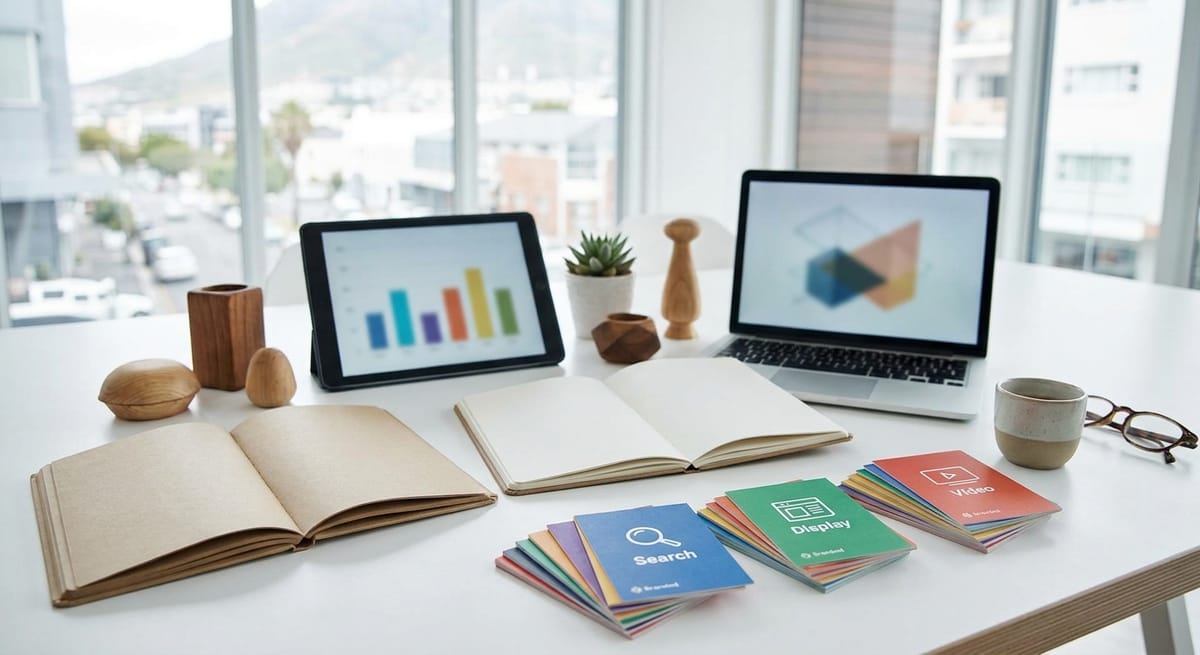
- Search campaigns — Text ads on Google’s results page. The workhorse for SMBs. Start here, almost always.
- Performance Max — Google’s automated, everywhere-at-once campaign. Powerful but a black box; best once you have conversion data and a healthy budget, not on day one.
- Display campaigns — Banner ads across millions of websites. Cheap clicks, low intent. Useful for remarketing, dangerous for cold traffic.
- Shopping campaigns — Product listings with images and prices. Essential for e-commerce, irrelevant for service businesses.
- Video (YouTube) — Brand-building, not direct response. Skip until you have budget to spare.
One exception deserves a mention: remarketing. After someone visits your website without buying, a small Display or Performance Max remarketing budget can gently follow them around the web for a few rand a day. It’s cheap, it’s effective, and it works because of a psychological quirk — the mere-exposure effect. We trust what feels familiar. A brand we’ve seen five times feels safer than one we’ve seen once.
How do you choose the right keywords?
Choose keywords that match buying intent and local relevance — words a customer types when they’re ready to act, not just curious. “Buy office chairs Johannesburg” beats “types of office chairs” because one is shopping and the other is reading.
Keywords are the bones of a Search campaign. Get them wrong and nothing else matters — you’ll pay for the wrong audience all day long. The plumber from my opening story wasn’t failing because his ads were bad. He was failing because his keywords invited the whole country to a party meant for one suburb.
The four intent levels
Think of search intent as a ladder, with money at the top:
- Transactional — “emergency plumber Centurion,” “book dental cleaning Sandton.” Ready to buy. Bid hard.
- Commercial — “best accountant for small business,” “cheapest geyser installation.” Comparing options. Worth pursuing.
- Informational — “how to unblock a drain,” “what does a conveyancer do.” Learning, not buying. Usually a budget drain in ads.
- Navigational — “Discovery login,” “Takealot contact.” Looking for a specific brand. Irrelevant unless it’s yours.
Small budgets belong at the top of that ladder. Let your blog and SEO catch the informational searches for free — that’s exactly what a content strategy is for. Reserve paid clicks for people whose fingers are hovering over the phone.
Negative keywords: the unsung hero
Negative keywords tell Google what not to show your ad for, and they’re the single biggest budget-saver most SMBs ignore. If you sell new furniture, add “used,” “second hand,” “free,” and “DIY” as negatives. If you’re a premium service, block “cheap” and “affordable.” Google’s own guidance, in its support documentation on negative keywords, treats this as fundamental — yet I’ve audited dozens of accounts where the negative list was completely empty. That’s like fishing with a net that has no edges.
Setting up your first campaign: a step-by-step walkthrough
Setting up a profitable campaign comes down to seven decisions made in the right order. Rush them and you’ll spend the next month untangling mistakes; make them carefully and the account practically runs itself.
Here is the sequence I follow for every new account, whether it’s a Cape Town café or a Durban law firm:
- Define one clear offer. Not “we do everything.” One service, one promise. “Free 15-minute consultation” or “R499 boiler service this month.” A muddy offer makes for muddy results.
- Set up conversion tracking first. Before a single ad runs, install tracking for calls, form submissions, and purchases. Without this you’re flying blind, and blind pilots crash.
- Pick tight geographic targeting. Choose your real service radius — the suburbs you’d actually drive to or ship to — not the whole province out of optimism.
- Build small, themed ad groups. Group keywords by theme so the ad matches the search. One ad group per service, not fifty keywords in a heap.
- Write ads that mirror the search. If someone searched “emergency electrician,” the headline should say “Emergency Electrician — On Call 24/7.” Echoing the query lifts your relevance and lowers your cost.
- Send clicks to a focused landing page. Never dump paid traffic on your homepage. Send it to a page about the one thing they searched for, with one obvious next step.
- Add negative keywords and a daily budget cap. Set the guardrails before you switch on, then watch closely for the first fortnight.
The landing page step is where most small businesses quietly fail. They craft beautiful ads, then send the click to a cluttered homepage with seven menu options and no clear instruction. The visitor, faced with too many choices, makes the easiest one — they leave. A study of consumer behaviour by Sheena Iyengar found that more options often reduce action rather than increase it. One page, one offer, one button. That’s the whole secret.
Common mistakes that drain your budget
The fastest way to lose money on Google Ads is to set it up once and never look at it again. Accounts are gardens, not statues — they need weeding, watering, and the occasional hard prune.
Over years of auditing small business accounts, the same handful of errors appear again and again. Avoid these and you’re already ahead of most:
- Using broad match without negatives. Broad match invites Google to interpret your keywords loosely. Combined with no negative list, it’s how a wedding photographer ends up paying for “free wedding venue ideas.”
- Ignoring mobile. The majority of South African searches happen on phones. If your landing page loads slowly or looks broken on mobile, you’re paying for clicks that bounce in three seconds.
- Not tracking phone calls. For service businesses, the call is the conversion. If you only track form fills, you’re missing most of your wins and might kill a campaign that’s actually working.
- Pausing too soon. Three quiet days is not a trend. The algorithm needs data; impatience starves it.
- Competing on price alone. “Cheapest” attracts the worst customers — the ones who haggle, complain, and never come back. Sell value, reason-why, and risk reversal instead.
That last point matters more than it looks. Dan Kennedy built a career on a simple idea: a strong offer with a guarantee outsells a low price every time. “R200 cheaper” invites comparison. “We’ll redo it free if you’re not delighted” removes the fear that stops people buying. Risk reversal is the most underused weapon in small business advertising, and it costs nothing to add.
How do you know if it’s actually working?
You know it’s working when you can state, with confidence, what one new customer costs you in ad spend — and that number is comfortably below what that customer is worth. Everything else is vanity.
Clicks, impressions, and click-through rates feel important. They are not the point. They are the ingredients, not the meal. The metrics that decide whether Google Ads survives in your business are these:
| Metric | What it tells you | Why it matters |
|---|---|---|
| Cost per conversion | What you pay for one lead or sale | The headline number — judge campaigns by this |
| Conversion rate | % of clicks that take action | Reveals landing page and offer quality |
| Customer lifetime value | Total profit from one customer over time | Sets how much you can afford to spend |
| Return on ad spend (ROAS) | Revenue earned per rand spent | The bottom-line verdict for e-commerce |
Here’s the calculation that changes everything. Suppose a click costs R20, and one in twenty clicks becomes a lead — that’s R400 per lead. If one in four leads becomes a customer, each customer costs R1,600 in ad spend. If that customer is worth R8,000 over their relationship with you, you’d be foolish not to spend more. The numbers, once you see them clearly, make the decision for you.
This is why conversion tracking, set up on day one, is non-negotiable. Without it, you’re guessing — and guessing is the most expensive habit in advertising. For a deeper look at turning visitors into buyers, our guide on conversion rate optimisation pairs naturally with anything you run on Google. And if you’d rather understand the wider picture first, our overview of building a digital marketing strategy shows where paid search fits alongside SEO and content.

Do I Need SEO or Google Ads for My South African Business?
This is the most common question small business owners ask me, and the honest answer is: it depends on your timeline and your budget.
Choose Google Ads if:
- You need leads or sales within days, not months
- You’re launching a new site with zero organic authority
- You’re in a competitive niche (attorneys, plumbers, real estate) where the top organic spots are locked down by established players
- You have a specific promotion or seasonal push with a defined end date
Google Ads puts you at the top of search results almost immediately. You pay per click, but you control exactly when the ads run, who sees them, and what budget you spend. For a South African small business where cash flow matters, that control is valuable.
Choose SEO if:
- You’re playing a longer game and can wait 3–6 months for traction
- You want compounding returns — a well-ranked page keeps sending traffic without an ongoing cost-per-click
- Your competitors are running ads but have weak organic presence, which is actually common in South Africa outside the major metros
The honest truth about do I need SEO or Google Ads in South Africa: most small businesses benefit from running both, but in sequence. Start with Google Ads to get immediate visibility and learn which keywords actually convert for your specific audience. Use that data to inform your SEO strategy. Once your organic rankings build, you can scale back ad spend on terms you already rank for and redirect that budget to new targets.
The worst move is doing neither because you can’t decide. Every month without visibility is a month your competitor is getting the click.
If your monthly budget is tight — say under R5,000 — start with Google Ads on a narrow, high-intent keyword set. If you have more runway, run both in parallel from day one.
Do I Need SEO or Google Ads for My South African Business?
This is the question every small business owner in South Africa wrestles with, and the honest answer is: it depends on your timeline and your budget.
Google Ads delivers results fast. Switch on a campaign today and your business can appear at the top of search results tomorrow. That speed matters enormously if you’re launching a new business, running a seasonal promotion, or operating in a competitive space where organic rankings take time to build. The trade-off is that you pay for every click, and the moment your budget runs out, the traffic stops.
SEO is the slower burn. It typically takes three to six months before you see meaningful movement in rankings, sometimes longer in competitive niches. But once you rank, the traffic is effectively free, and it compounds over time. A page that ranks well for “plumber in Johannesburg” or “accountant Cape Town” can generate leads month after month without ongoing ad spend.
So when business owners ask whether they need SEO or Google Ads in South Africa, the practical answer is usually: start with Google Ads to generate immediate revenue, then invest that revenue into SEO for long-term stability. Run them in parallel if the budget allows — the keyword data from your Ads campaigns tells you exactly which search terms convert, which makes your SEO targeting sharper and cheaper.
Where the decision tips firmly towards one or the other:
- New business, limited brand awareness → Google Ads first
- Established business, tight monthly budget → SEO is the better long-term return
- High-intent local searches (trades, professional services) → both channels reward you well
- Very niche product, low search volume → Ads may be wasteful; content-led SEO often works better
If you’re still unsure which makes sense for your specific situation, Watts Digital offers a no-obligation consultation to map out the right approach for your market.
Key takeaways
- Google Ads for small business South Africa rewards specificity — tight local targeting and a single clear offer beat broad, ambitious campaigns every time.
- Start with a R3,000–R15,000 monthly budget, commit for at least 90 days, and judge by cost per customer, not cost per click.
- Search campaigns aimed at transactional keywords deserve most of your budget; use remarketing as a cheap, psychologically powerful follow-up.
- Install conversion tracking before you spend a single rand — including phone calls for service businesses.
- Negative keywords and a focused landing page are the two cheapest, most overlooked ways to stop your budget leaking.
- Sell value and reverse risk with a guarantee. Competing on price alone attracts the customers you least want.
Frequently asked questions
Is Google Ads for small business South Africa worth the cost?
Yes, for most small businesses Google Ads for small business South Africa pays off — provided you target locally, track conversions, and judge results by cost per customer rather than clicks. A service business landing one R8,000 client for R1,600 in ad spend is profiting handsomely. The channel fails only when it’s set up loosely and left unmanaged.
How much does it cost to start Google Ads in South Africa?
You can technically start with any amount, but a realistic minimum is around R3,000 a month. Below that, there’s rarely enough data for the algorithm to optimise or for you to learn what works. Most SMBs find R5,000–R10,000 a month gives meaningful, trustworthy results within the first 90 days.
Should I run Google Ads myself or hire an agency?
If you have time to learn and a simple offer, running it yourself is entirely doable. Hire help when the account grows complex, when you’re spending over R10,000 a month, or when your time is worth more elsewhere. A good agency should pay for itself by lowering your cost per customer, not just managing buttons.
How long before Google Ads starts working?
Expect a messy first two to four weeks while Google’s algorithm learns and you refine keywords and ad copy. By month two or three, a well-managed account should produce a stable, predictable cost per lead. Judging the channel before 90 days is like tasting bread halfway through baking.
What’s the difference between Google Ads and SEO?
Google Ads buys you instant visibility at the top of search results for as long as you pay. SEO earns visibility over months through content and authority, but the traffic is free once you rank. The smartest small businesses run both — ads for immediate leads, SEO for long-term, compounding value.
That plumber in Pretoria? We rebuilt his account in an afternoon — one suburb, one offer, conversion tracking switched on. Six weeks later he rang me, slightly stunned, to say he’d booked more jobs than he could comfortably handle. The platform hadn’t changed. The clarity had. If you’d like that same clarity for your business, book a free Google Ads review with our team — we’ll tell you honestly whether it’s right for you, and exactly where your money should go.
Written by David Watts, founder of Watts Digital. I’ve spent years studying how words and timing reshape decisions — and helping South African small businesses turn that understanding into customers.