
TL;DR:
- Restaurant rendering services in South Africa typically range from R4,500 for a single still to R45,000+ for a full walkthrough — pricing depends on detail, not studio size.
- The brief is where most projects fail: lock down menu identity, lighting mood, materiality and camera angles before the studio touches a polygon.
- CGI now earns its keep beyond pitch decks — landlord approvals at Sandton City and the V&A Waterfront, POPIA-friendly social teasers, and pre-launch Google Business Profile imagery.
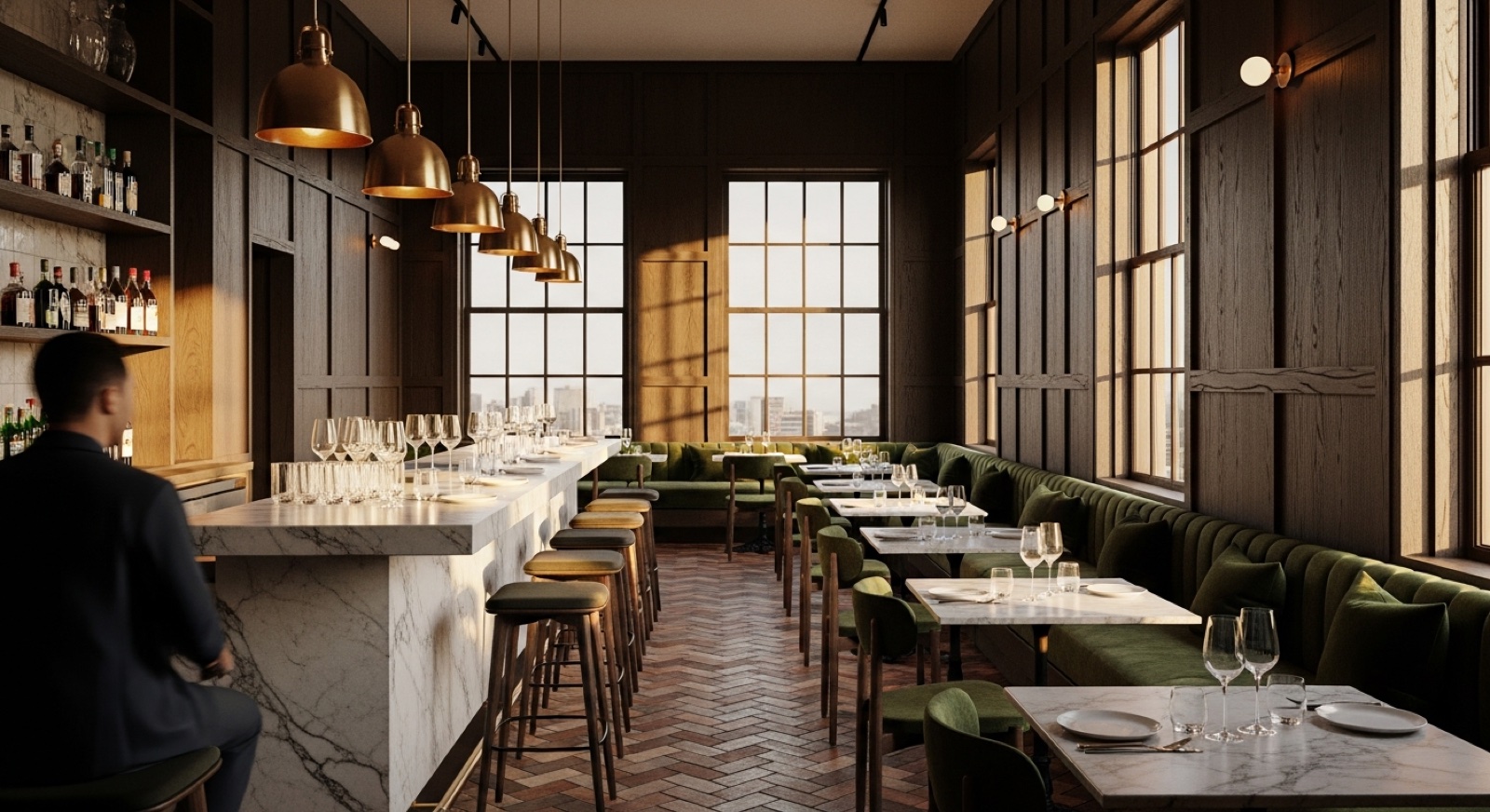
If you are opening, refurbishing or franchising a restaurant in 2026, you are competing for landlord slots, investor cheques and Instagram saves before a single brick is laid. Utilising rendering services for restaurants in South Africa have shifted from a nice-to-have pitch tool to a core part of the fit-out and marketing budget — and the agencies and studios producing this work have multiplied accordingly.
I work with F&B clients across Sandton, Bryanston, Sea Point and Umhlanga, and the pattern is consistent: the operators who brief CGI properly land their preferred shopping-centre slots, get faster council sign-off, and open with a waiting list because their pre-launch content actually looks like the venue. The ones who treat rendering as a commodity get generic, plasticky visuals that erode trust the moment a diner walks in and the room does not match the picture.
This is the practical guide I wish more restaurateurs had before they sign with a rendering studio. Pricing in rand, brief templates that work, the SA-specific traps around POPIA and ASA when you publish CGI as marketing, and how to use the assets long after the doors open.
What restaurant rendering services South Africa operators actually buy in 2026
The phrase covers more than a single hero image. A typical hospitality CGI engagement bundles interior stills, exterior facade shots, a top-down floor plan render, and increasingly a 30-to-60-second 3D walkthrough or VR file. For franchise concepts — think the Life Grand Cafe group, Tasha’s, Ocean Basket new-format stores, or Hudsons — the deliverable also includes a ‘kit of parts’ so the same render can be re-skinned per location.
According to Grand View Research (2024), the global architectural rendering market reached USD 2.5 billion and is forecast to grow at 23%+ CAGR through 2030, driven heavily by hospitality and retail fit-out demand. South African studios I audit are riding that wave: turnaround times have dropped from three weeks to seven to ten working days for a four-image set, and real-time engines like Unreal 5 and D5 Render are pushing photoreal output that used to require V-Ray and a render farm.
For an independent operator opening one site in Parkhurst or De Waterkant, you do not need the full Unreal pipeline. You need two strong stills, a plan view, and a short turntable. For a group rolling out across malls, you need a flexible asset library.
If a quote only covers stills, you’re paying for a fraction of what a full hospitality CGI engagement should deliver. Here’s what a competent SA studio should put on the table:
- Interior CGI — dining room, bar, private rooms, kitchen pass, banquette zones, lighting variants (lunch, dinner, private events).
- Exterior CGI — façade, signage, pavement seating, dusk vs daylight, wet-weather scenes for outdoor venues.
- Hero shots and lifestyle scenes with diffused or stylised people, drinks on tables, and steam or condensation detail to sell the atmosphere.
- Walkthrough animations and 360° tours for landing pages, investor decks and Google Business Profile uploads.
- VR previews for stakeholder approvals and investor pitches before construction starts.
- Material and finish swap-outs — render once, regenerate the scene with alternative tiles, joinery or upholstery for fast client decisions.
- Menu, signage and brand placement integrated directly into the renders for franchise rollouts and group-restaurant standardisation.
- Post-production retouching — final colour grade, lens flare, depth-of-field, and asset library exports for marketing reuse.
Pricing: what hospitality CGI really costs in rand
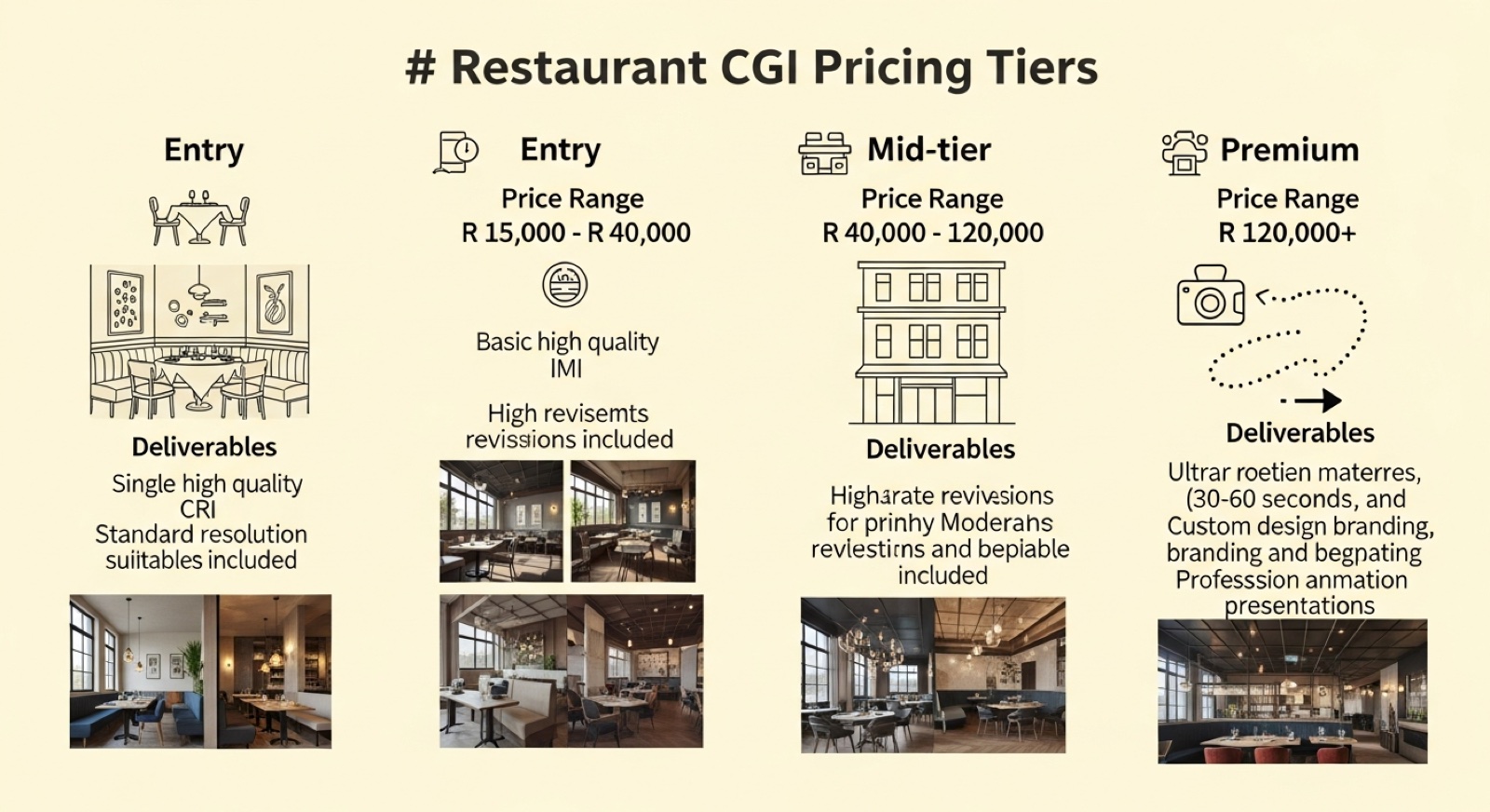
South African studios price by image complexity and revision rounds, not by studio prestige. I have seen identical briefs quoted at R6,000 and R28,000 by reputable Cape Town and Joburg studios in the same week. The variance comes down to detail level, custom 3D modelling of bespoke joinery, and how many camera angles the operator asks for after seeing the first draft.
Below is the rough market range I see across the studios my F&B clients have used in the last 18 months. Treat these as briefing benchmarks, not quotes.
| Deliverable | Entry studio (ZAR) | Mid-tier studio (ZAR) | Premium / Unreal pipeline (ZAR) |
|---|---|---|---|
| Single interior still, photoreal | R4,500 – R7,500 | R8,000 – R14,000 | R15,000 – R25,000 |
| Exterior facade with signage | R5,500 – R9,000 | R10,000 – R16,000 | R18,000 – R30,000 |
| Set of 4 stills + plan view | R18,000 – R28,000 | R30,000 – R55,000 | R60,000 – R95,000 |
| 60-second 3D walkthrough | R22,000 – R40,000 | R45,000 – R85,000 | R90,000 – R180,000 |
| VR / interactive file | Not typical | R55,000 – R110,000 | R120,000 – R250,000 |
The brief: five things to lock down before the studio quotes
Bad CGI is almost always a brief problem. The studio is not a designer — it visualises decisions you have already made. If you have not made them, the renders will look generic and you will burn revision rounds chasing a feeling you cannot articulate.
Build your brief document before you request quotes. It will sharpen your concept and it will cut 20 to 40 percent off the eventual quote because the studio is not pricing in ambiguity.
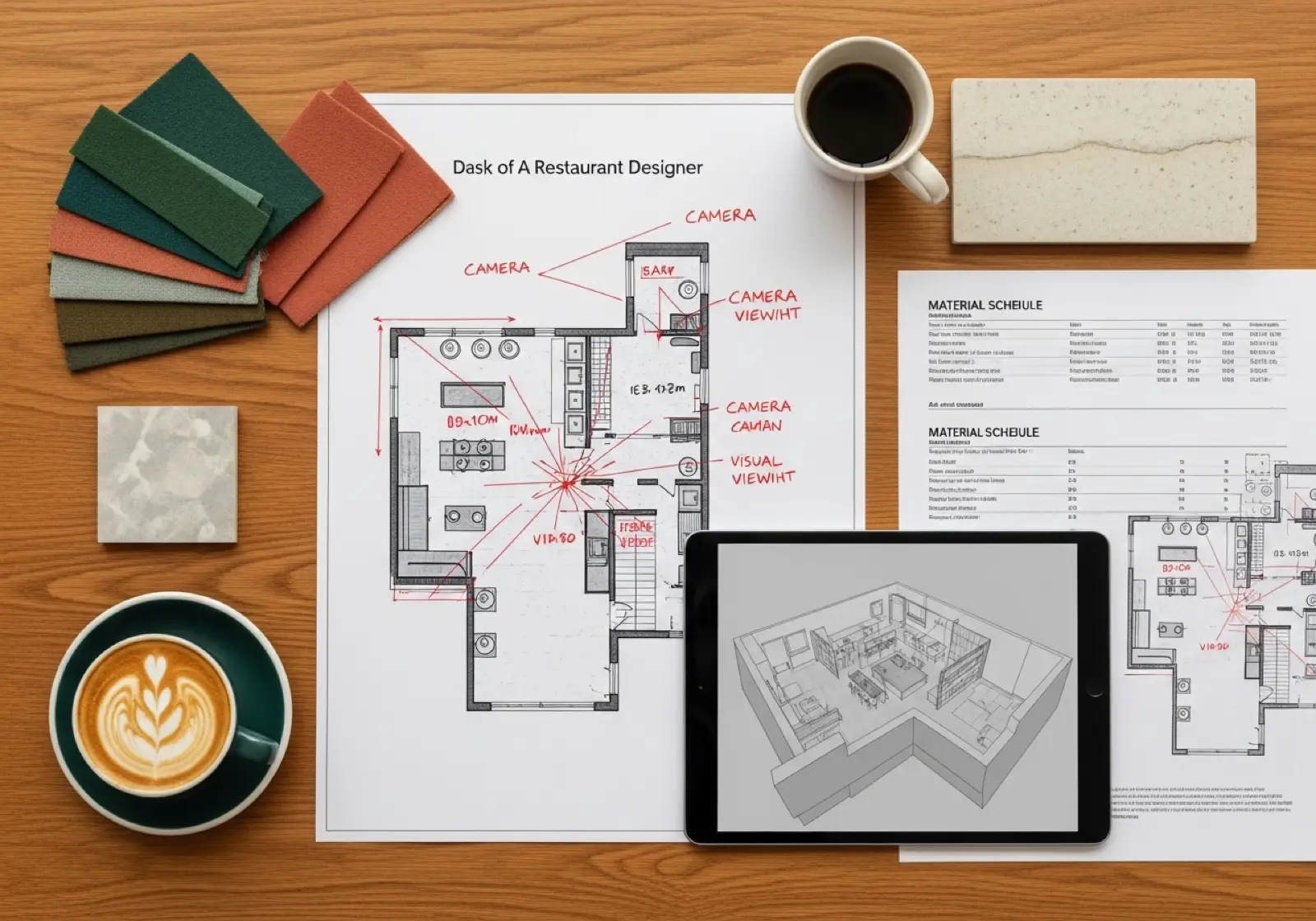
- Concept anchor — one paragraph naming the cuisine, price point, and three reference venues (e.g. ‘casual Mediterranean, R280 average spend, references: Bocca, FYN, La Tête’).
- Materiality schedule — actual finishes, ideally with supplier codes from Italtile, Tile Africa, Hertex or your joinery contractor. ‘Warm wood’ is not a brief. ‘Fumed oak veneer, Hertex Aldeco’ is.
- Lighting mood — golden-hour daylight, lunch service, evening service, or all three. Each is a separate render in pricing terms.
- Camera angles — mark them on the floor plan. Eye-level seated, standing entry, bar perspective, and a 45-degree top-down are the four that work hardest in marketing.
- People and props — empty room renders read as cold. Specify whether you want figures, plated food, glassware, and how ‘staged’ the scene should look.
Choosing a restaurant rendering studio in SA: portfolio signals that matter
Anyone with a laptop and a Sketchup licence calls themselves a rendering studio. The filter that matters is whether they have shipped hospitality work — not residential, not corporate offices, not the endless apartment block renders that dominate most SA portfolios. Restaurants are uniquely hard to render because food, glassware, soft lighting and human figures all have to read as plausible in the same frame.
When you review a portfolio, look for: glassware that does not look like resin, plated food that does not look like clipart, and people who are not obviously the same stock 3D figure rotated 30 degrees. Ask the studio for the raw client brief next to the final render — it tells you whether they interpret well or just execute literally.
BrightLocal’s 2024 Local Consumer Review Survey found that 87 percent of consumers used Google to evaluate local businesses, and visual content is now a primary trust signal in that evaluation. A restaurant rendering studio that understands this will deliver assets sized and cropped for Google Business Profile, Instagram 4:5, and TikTok 9:16 — not just the architect’s A3 PDF.
Using restaurant visualization services beyond the pitch deck
Most operators commission CGI for one purpose — investor or landlord pitch — and then shelve the files. That is leaving money on the table. The same renders should drive your pre-opening marketing for three to six months before you serve a single plate.
Hyprop and Growthpoint both now request CGI as part of new-tenant motivation packs at flagship centres like Hyde Park Corner, Mall of Africa, Canal Walk and Gateway. Approval timelines shorten when the centre management team can visualise the shopfront against neighbouring tenants. On the consumer side, render-led teaser campaigns on Meta and TikTok consistently outperform stock-image campaigns for new openings — I have seen cost-per-follow drop by 40 to 60 percent on render-led creative versus generic ‘opening soon’ graphics.
Once you have the asset library, plan its life: pre-launch teasers, Google Business Profile cover, menu PDFs, supplier negotiations, staff recruitment ads, and franchise sales decks if you ever scale. A R45,000 render set used across 18 months of marketing has a different ROI than one used for a single bank meeting.
POPIA, ASA and the SA-specific traps when publishing CGI
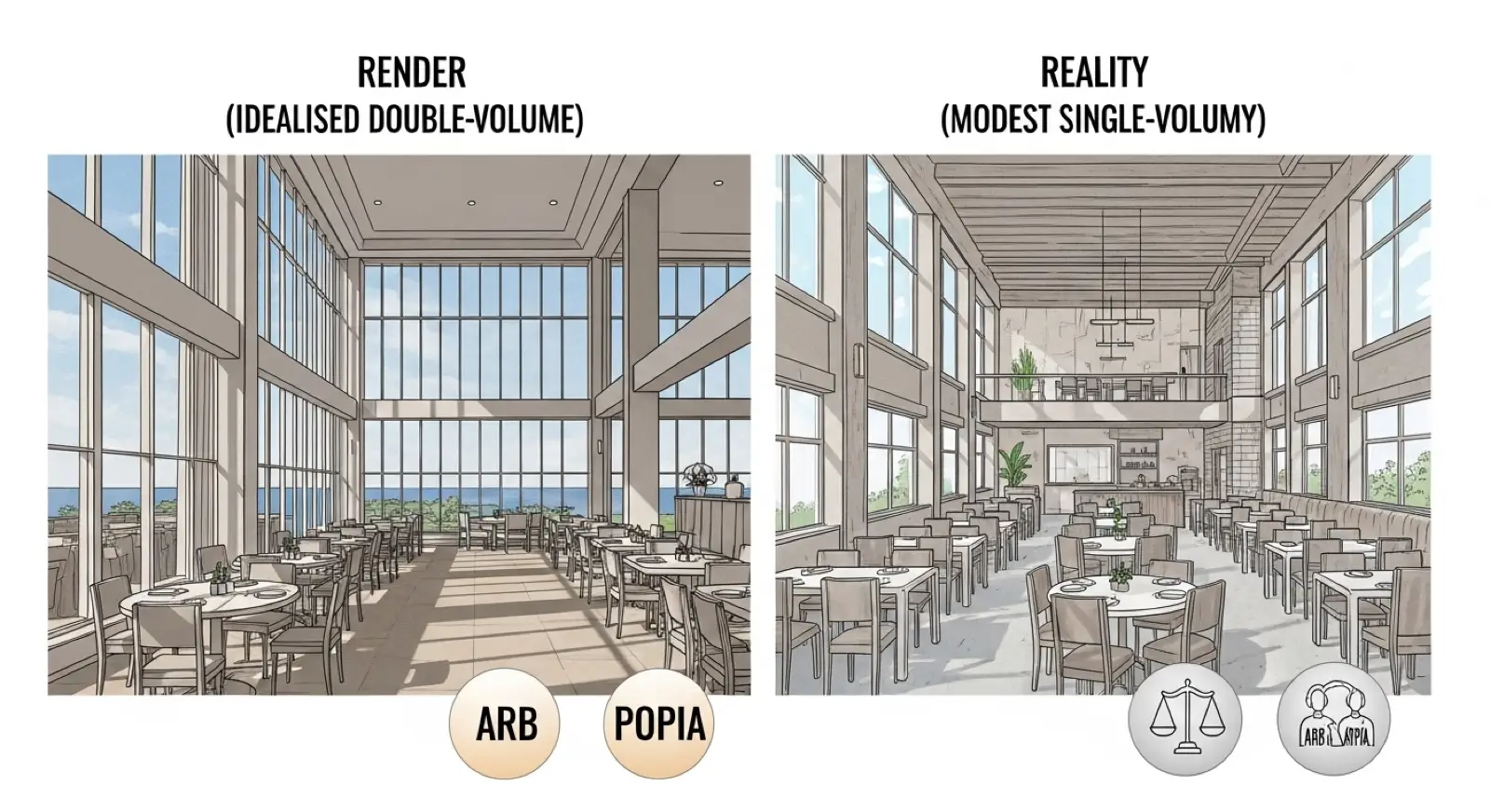
This is the section most rendering articles ignore and where I see SA operators get into trouble. CGI used in advertising is regulated. The Advertising Regulatory Board’s Code of Advertising Practice requires that visuals not mislead consumers about the nature of the product or premises. If your render shows a double-volume ceiling and floor-to-ceiling glass, and the actual venue has neither, you are exposed to ARB complaints once you open.
POPIA adds a second layer. If your studio uses photographs of real people as reference for the 3D figures in your render — a common shortcut — and those people are identifiable, you have a personal information processing question to answer. Brief your studio explicitly to use licensed 3D human assets or fully stylised figures. Get the licence documentation in writing and store it with your other compliance records.
Hellopeter is the third pressure point. SA diners increasingly post comparison shots between marketing visuals and reality, and Hellopeter reviews citing ‘false advertising’ rank quickly on branded search. The defensive move is simple: your final renders should under-promise on finishes and over-deliver in the actual fit-out, not the other way around.
Working with your rendering studio: a process that actually ships
The studios that deliver on time work in three locked stages: greybox, materials pass, final render. Insist on this structure even if the studio offers a single ‘final delivery’ workflow. Each stage is a sign-off gate where you catch problems while changes are cheap.
Greybox stage is untextured 3D geometry — you are checking spatial accuracy, camera angles and proportion. Material pass introduces finishes and lighting at draft quality. Final render is the photoreal output. Most disasters happen because operators approve a greybox without studying it, then ask for a wall to move at the final render stage, which costs a full re-render.
FAQ
How much do restaurant rendering services cost in South Africa?
A single photoreal interior still ranges from R4,500 at entry-level studios to R25,000 at premium Unreal-pipeline studios. A typical pre-launch package of four stills plus a floor-plan render sits between R18,000 and R55,000 depending on detail level and revision rounds. Walkthroughs and VR add R40,000 to R180,000. The biggest cost driver is not studio prestige — it is brief clarity. Operators who supply a tight brief with finishes, lighting mood and locked camera angles routinely pay 20 to 40 percent less than those who brief loosely and burn revisions.
How long does a restaurant CGI project take?
In 2026, a four-image still set typically takes seven to ten working days from approved brief to final delivery, assuming two revision rounds. Walkthroughs add another two to three weeks. The bottleneck is almost never rendering — modern GPUs and real-time engines like Unreal 5 and D5 Render have collapsed render times. The bottleneck is operator decision-making at the greybox and materials stages. Block out diary time for sign-offs before you commission, otherwise the project drifts past your landlord or investor deadline.
Do I need a local SA restaurant rendering studio or can I use offshore?
Both work, with trade-offs. Offshore studios in India, Vietnam and Eastern Europe price 30 to 50 percent below SA studios but communicate in time-zone-shifted email cycles that slow revisions. SA studios in Cape Town, Joburg and Durban offer same-day calls, site visits and an understanding of local materials — Hertex fabrics, Italtile finishes, SA-made joinery — that offshore teams have to research. For a single restaurant, local usually wins. For a multi-site rollout where you can absorb communication friction, offshore makes financial sense.
Can rendering visuals be used as marketing under SA advertising law?
Yes, with caution. The Advertising Regulatory Board’s Code of Advertising Practice and the Consumer Protection Act both require that marketing visuals not mislead consumers about the nature, quality or features of premises. CGI marked as a ‘concept render’ or ‘artist’s impression’ carries less risk than CGI presented as a photograph. If your final venue differs materially from the render, expect Hellopeter complaints and possible ARB action. The safest approach is to under-promise in CGI and let the actual fit-out exceed the visual.
Should small independent restaurants invest in CGI or just use photography?
Use CGI before opening, photography after. Pre-opening, you have nothing to photograph, and rendering services let you secure the landlord slot, the investor and the pre-launch hype list. Once you are trading, professional photography of the actual venue, plates and people will outperform CGI for organic social and Google Business Profile content. The smart move is to commission a small render set for pre-launch, then schedule a photography shoot in week three of trading once the venue has settled and you have a strong service rhythm.
Key takeaways
- Restaurant rendering services in South Africa cost R4,500 to R250,000 — brief clarity, not studio choice, drives most of the variance.
- A locked brief with concept anchor, materiality schedule, lighting mood and marked camera angles cuts revision rounds and final cost.
- Insist on a three-stage workflow: greybox, materials pass, final render — each with explicit sign-off.
- CGI is regulated. ARB and POPIA both apply when renders move into marketing channels — under-promise visually, over-deliver in fit-out.
- Plan an 18-month life for every render set: landlord, investor, GBP, social, supplier and recruitment use cases.
- Local SA studios beat offshore for single-site projects; offshore can win for multi-site rollouts with strong project management.
If you are planning a restaurant launch, refurb or franchise rollout in 2026 and want help briefing CGI, building the pre-launch content engine and ranking on Google before you open, book a strategy call with Watts Digital.