
TL;DR: A SETA-accredited online course is the highest-value upskilling asset an SA trainer or business can build in 2026 — accreditation lets learners earn recognised credits and unlocks skills-levy funding. Here are the seven steps: align to a SETA and NQF level, map your outcomes, and meet the platform, assessment and moderation standards to get verified.
Learning how to create a SETA accredited online course is the single most valuable upskilling investment a South African L&D provider, corporate trainer or subject-matter expert can make in 2026. A non-accredited online course can still teach — but it cannot be claimed against the Skills Development Levy, cannot earn B-BBEE scorecard points for the buyer, and cannot issue an NQF-aligned certificate. Each of those gaps removes a different bucket of buyers from your addressable market.
This guide walks through the 2026 reality of how to create a SETA accredited online course: which SETA to apply to, how the QCTO sits above the SETAs, the seven sequential steps from idea to issued accreditation, the assessment and moderation rules that catch most first-time providers out, and the realistic 9-14 month timeline. By the end you will know whether to apply directly, partner with an existing accredited provider, or scope out before you commit.
What “SETA Accredited” Actually Means in 2026
SETA accreditation is a formal recognition by one of South Africa’s 21 Sector Education and Training Authorities that your training provider, your facilitators, your learning programme and your assessment process all meet the national standards defined under the National Qualifications Framework (NQF). The accreditation attaches to a specific qualification or skills programme — you are not “SETA-accredited” in general; you are accredited to deliver a named, NQF-registered qualification.
Since the SAQA/QCTO/SETA realignment, the picture has three layers. SAQA (the South African Qualifications Authority) maintains the NQF and the national register of qualifications. The Quality Council for Trades and Occupations (QCTO) sits above the SETAs and is the quality council that signs off occupational qualifications. The individual SETAs handle the day-to-day accreditation of providers and learners against the qualifications in their sector. When you ask how to create a SETA accredited online course, you are really asking how to satisfy all three.
Why It’s Worth Knowing How to Create a SETA Accredited Online Course
Accreditation costs effort — anywhere from R80,000 to R250,000 in fees, content rework and consultant time, plus 9-14 months of elapsed time. The return justifies the spend in three places.
- SDL recovery for your buyers. Employers can only claim training spend against their Skills Development Levy when the programme is SETA-aligned. An accredited course is a tax-recoverable expense for the buyer; an unaccredited one isn’t. That single fact shifts the buying decision before price even comes up.
- B-BBEE scorecard points. The Skills Development element of the B-BBEE scorecard awards 20 points (now 25 under the amended Codes), heavily weighted toward accredited training delivered to Black learners. Corporate buyers needing to improve their B-BBEE level will pay a premium for accredited delivery.
- NQF-aligned certification. Learners value a certificate that’s registered on the National Learners’ Records Database. It carries portability across employers and counts toward formal qualifications later. Non-accredited certificates carry your brand only — accredited ones carry the country’s.
The same arithmetic that drives measuring eLearning ROI in South Africa applies here in reverse: the buyer’s grant recovery and B-BBEE points sit on the benefit side of their ROI calculation, so an accredited offering wins the procurement evaluation even at a 30-50% price premium over a non-accredited equivalent.
The Seven Steps for How to Create a SETA Accredited Online Course
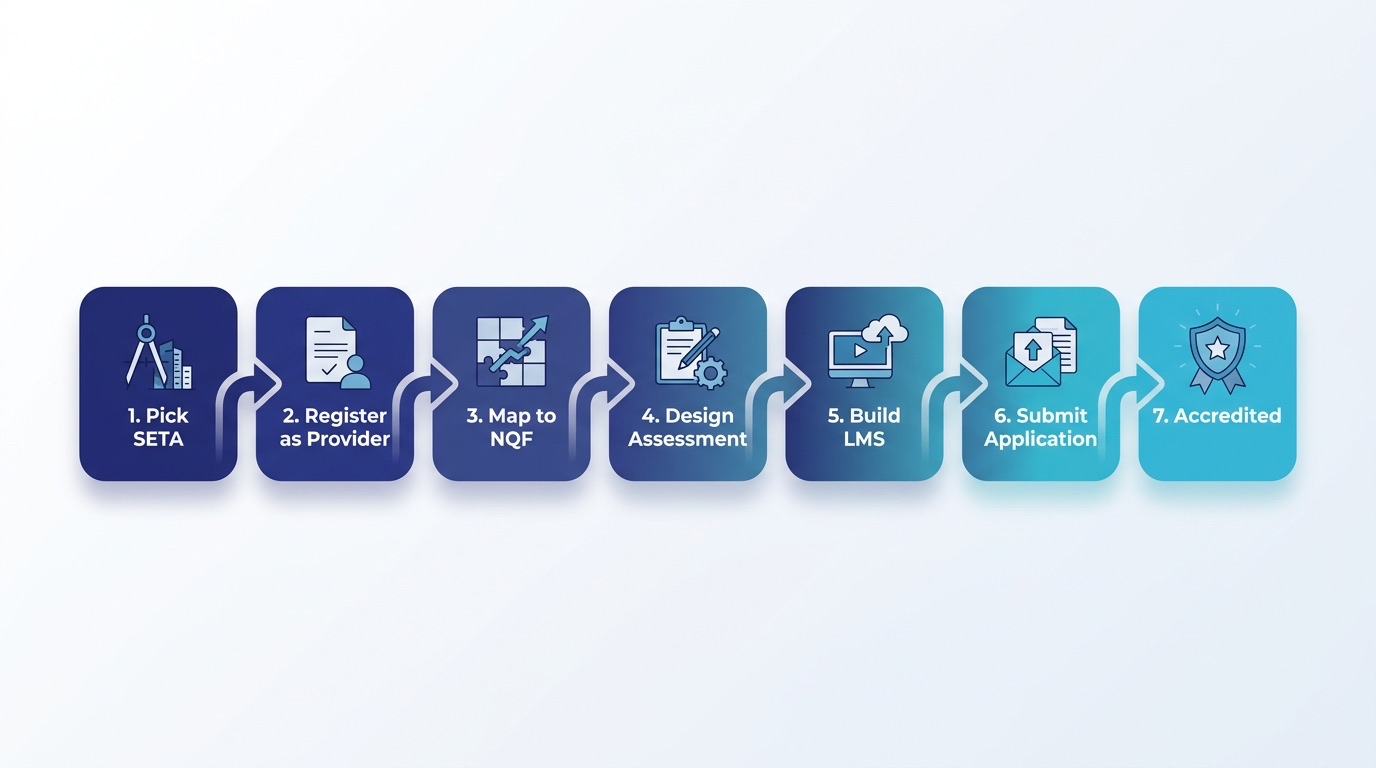
The seven steps below are sequential — you cannot productively skip ahead. Providers who try to build the LMS before they’ve picked a qualification almost always end up rebuilding the assessment side once the SETA returns the application with revisions.
- Pick the right SETA. Match your course content to the SIC code of the buyers you want to serve. ICT training → MICT SETA. Manufacturing → merSETA. Services → Services SETA. Wholesale & retail → W&RSETA. Wrong-SETA applications are the most common rejection reason.
- Register as a training provider. Provider accreditation comes before course accreditation. Submit a full provider profile, organogram, financial statements, quality management system documents and policies (assessment, moderation, RPL, learner appeals).
- Map to a registered NQF qualification or skills programme. Search the SAQA register for an existing qualification or unit standards that match your content. Don’t try to register a new qualification — that’s an 18-24 month QCTO process. Aligning to an existing one is days of work.
- Design the assessment. SETA accreditation requires formative (during learning) and summative (end of programme) assessment, both mapped to the specific outcomes of the qualification. Build the assessment instruments and the portfolio of evidence template at this point — not after the content.
- Build the LMS. Your platform must support learner registration, evidence upload, facilitator marking, moderator access, and a tamper-resistant audit trail. Our WordPress LMS comparison for South African providers covers the five WordPress plugins that meet these requirements.
- Submit the application. Provider accreditation + course alignment + assessor and moderator registration go in together. SETA verification takes 60-120 days. Expect at least one round of revisions.
- Receive accreditation and start delivery. Accreditation is issued for 3-5 years with annual quality monitoring. You can now invoice learners or corporate buyers, issue NQF-aligned certificates, and upload completion data to the National Learners’ Records Database.
Mapping Your Course to NQF Levels and Unit Standards
This is the most under-estimated step when planning how to create a SETA accredited online course. The NQF runs from Level 1 (Grade 9) to Level 10 (Doctoral). Most online vocational and corporate training lands at NQF Levels 3 to 6. Your job is to match the cognitive demand of your course content to the right level, then pick a registered qualification or skills programme that already sits there.
- Level 3-4 (FET band). Procedural skills, supervised application, basic problem-solving. Most operational and entry-level training.
- Level 5 (Higher Certificate). Specialised application, some judgement, supervisory work. Front-line management and skilled technical courses.
- Level 6 (Diploma / Advanced Certificate). Integrated knowledge, independent judgement, project responsibility. Most professional development at this level.
- Level 7+ (Bachelor’s and above). Generally requires a registered higher-education institution — out of scope for most SETA-accredited online courses.
A common mistake: writing a 16-hour course at content depth that maps to NQF 5, then trying to register it against an NQF 3 unit standard because the unit standard is easier to find on the SAQA register. The mismatch will be caught at moderation and the accreditation will be withheld. Map honestly to the level the content actually demands.
Technical Platform Requirements for an Accredited Online Course
SETA verifiers visit your LMS during the application review. The platform doesn’t have to be expensive but it has to demonstrate five specific capabilities. Don’t lock in a platform before you’ve checked this list.
- Learner profile and registration. ID number capture, race and gender fields (for B-BBEE reporting), supporting-document upload, signed learner agreement.
- Portfolio of evidence storage. Per-learner secure storage of submitted assessments, with version history and timestamps. Cannot be edited by the learner after submission.
- Facilitator and assessor access. Role-based access so the facilitator can see learners, the assessor can mark portfolios, and the moderator can sample-verify both.
- Audit trail. Every grade change, comment, resubmission and moderation decision logged with user, timestamp and reason. SETA verifiers will sample.
- Certificate generation tied to completion. Certificates issue only on confirmed competence (formative + summative pass + moderator sign-off). Hard-coding certificates to course completion alone is an audit failure.
The Assessment and Moderation Standard
Assessment is where most non-accredited courses fall short. To create a SETA accredited online course you need a constituted assessor and a registered moderator — two different people, both with their own SAQA-registered credentials. They cannot be the same person, and neither can be the course author.
- The constituted assessor is a person registered with the relevant SETA who holds the Assessor unit standard (US 115753) plus subject-matter credentials at or above the level being assessed. They mark the learner’s portfolio against the specified outcomes.
- The registered moderator holds the Moderator unit standard (US 115759) and samples a representative percentage of assessor decisions — typically 10-20% — to confirm consistency, fairness and accuracy. Their report is the document that the SETA verifier will read first.
- Internal verification. Before submission to the SETA, your quality manager signs off on the moderator’s report. This is your last chance to catch issues before external scrutiny.
Budget for paying both the assessor and moderator per learner. Typical rates in 2026 are R250-450 per portfolio for assessors and R350-600 per moderated sample for moderators. On a 100-learner intake that’s R30,000-R60,000 in assessment cost, which you must include in your unit economics.
Common Pitfalls When You Create a SETA Accredited Online Course
Across the dozens of provider applications we’ve reviewed, the same six errors keep showing up.
- Applying to the wrong SETA. Map to the SIC code of your intended buyers, not the topic of your content. A digital-marketing course aimed at retail employers goes to W&RSETA, not MICT SETA.
- Trying to register a new qualification. The QCTO occupational qualification development process is 18-24 months. Always align to an existing registered qualification or skills programme first.
- Underspecifying the assessment instruments. SETA verifiers want to see the actual assessment tasks, the marking rubric, and the moderation sampling plan. Generic “will be assessed at the end” descriptions fail.
- Using a single person as author, facilitator, assessor and moderator. Each role needs a different qualified individual. Conflict of interest is a hard rejection.
- Skipping the provider accreditation step. You cannot accredit a course before the entity delivering it is accredited as a provider.
- Insufficient quality management documentation. The QMS file (policies, procedures, registers, complaints handling, RPL policy) is non-optional and is usually where applications stall.
Realistic Budget and Timeline
Budget figures below are 2026 mid-market norms for a single skills programme of 60-120 notional hours, delivered online to 100-300 learners per intake.
| Line | Cost (ZAR) | Elapsed time |
|---|---|---|
| Consultant for provider accreditation + QMS | 40,000-80,000 | 2-3 months |
| Course content design and storyboarding | 30,000-60,000 | 2 months (parallel) |
| Assessment instrument design + mapping | 15,000-30,000 | 1 month |
| LMS setup (LearnDash + accreditation add-ons) | 20,000-50,000 | 1-2 months |
| Assessor and moderator registration fees | 5,000-12,000 | 1 month |
| SETA application fees | 3,000-8,000 | — |
| SETA verification + revisions | (consultant time) | 3-4 months |
| Total to first accreditation | R113k-240k | 9-14 months |
If 9-14 months is too long, the practical shortcut is to partner with an already-accredited provider as a subcontractor or co-delivery partner. You build the content, they hold the accreditation and the assessor/moderator pool. Revenue share is typically 60-70% to the content owner, 30-40% to the accredited provider. You can be selling to corporate buyers within 8-12 weeks instead of 9-14 months.
Bringing It Together: How to Create a SETA Accredited Online Course That Sells
Learning how to create a SETA accredited online course rewards the providers who treat accreditation as a product specification rather than a paperwork exercise. The buyers who pay the premium — corporates needing SDL recovery and B-BBEE points, individuals wanting an NLRD-recorded certificate — are evaluating you against the same six pitfalls listed above. Get those right and the application is largely a formality.
Sequence matters. Pick the SETA before you write a word of content. Register as a provider before you align a course. Build the assessment design before the LMS, and the LMS before the marketing site. Engage your assessor and moderator early — they cost less than you think and their early input prevents the costliest rework. Map honestly to the right NQF level and the right registered qualification, even if that means rescoping the course depth.
One example of how this lands in practice: when The Sales Institute engaged Watts Digital for an online learning programme, the brief required us to translate a proven face-to-face training methodology into a digital experience that earned the same level of trust from learners. The accreditation-grade discipline — clear outcomes, designed assessment, evidence trail — was the foundation that made it work.
If you’re a corporate L&D function building this for internal use, the same discipline that delivers a high-converting Google Ads playbook for South African service businesses applies here — clear outcome, single decision-maker, evidence over claims. We help South African providers and corporate L&D teams scope and stand up SETA-aligned online courses end-to-end. If you’d like a sanity check on your scope, the SETA mapping, or the LMS architecture, we’d be glad to talk.
Frequently Asked Questions
What does SETA accreditation mean for an online course?
It means a recognised Sector Education and Training Authority has verified that your course meets national standards. Learners earn credits towards a qualification, and accredited training can be claimed against the skills-development levy — which is what makes it commercially valuable.
How long does it take to get a course SETA accredited?
Realistically several months. You align to a SETA and NQF level, map outcomes to unit standards, and pass the moderation and verification stages. The timeline depends far more on the quality of your documentation than on the SETA’s queue.
Can any online course be SETA accredited?
No. The course must map to registered unit standards or a recognised qualification, and you must meet assessment and moderation requirements. A general interest course can teach beautifully and still never qualify — accreditation is about formal, credit-bearing outcomes.
What is an NQF level?
The National Qualifications Framework grades qualifications from 1 to 10 by complexity and depth. Your course must be pitched at the right level — a level 4 outcome assessed at level 2 rigour will not pass moderation, however good the content.
Does SETA accreditation unlock skills-levy funding?
Yes — that is the heart of its value. Employers paying the skills-development levy can claim accredited training back through their SETA, which turns your course from a cost into a funded investment for their staff.
Related reading
- Elearning Course Design South Africa: Master 2
- How Microlearning Is Transforming Employee Tra
- How To Ensure You Design For eLearning Accessi
- Measuring eLearning ROI in South Africa: A 202
Ready to put this into action?
If you’d rather have a team that does this every day, we’re here. Book a free 20-minute consult and we’ll give you the three highest-impact next steps for your business — no obligation.