
TL;DR: In 2026, proving eLearning ROI is a budget-defence baseline, not a nice-to-have. Measure it with the Kirkpatrick + Phillips framework: tally every cost (build, platform, learner time), quantify the real returns (productivity, retention, fewer errors), and express it as a ratio. We walk through a worked 200-employee South African example so you can defend your L&D spend with numbers, not vibes.
Measuring eLearning ROI in South Africa is no longer a “nice to have” for L&D leaders — it is the baseline budget-defence requirement of 2026. Training and development spend in South African mid-market businesses grew sharply in the post-pandemic period, but the CFO conversation has shifted. Every rand of training spend now has to come with a defensible return calculation, particularly when the Skills Development Levy, SETA grants and B-BBEE scorecard interact to change both sides of the equation.
This guide gives you the framework South African L&D leaders are actually using in 2026: the Kirkpatrick + Phillips five-level model adapted for the local context, the SETA and B-BBEE offsets you must include, and a worked example for a 200-employee South African manufacturer. By the end you will have a calculation you can defend in any executive review.
What Measuring eLearning ROI in South Africa Actually Means
Most South African L&D teams confuse output with outcome. Completion rates, satisfaction scores and hours logged are outputs — they tell you the learning event happened, but not whether it returned value to the business. Measuring eLearning ROI in South Africa requires a rand figure on one side and a rand figure on the other, then division.
The local twist is that the cost side is rarely just the invoice from your LMS or content vendor. The Skills Development Levy you already pay to SARS each month, the SETA mandatory and discretionary grants you can recover, and the B-BBEE scorecard points your training programme earns all reshape the calculation. Ignoring them in either direction will produce an ROI number that’s wrong by a factor of two or three, and that’s the number your CFO will use to decide next year’s budget.
The framework that handles this cleanly is the Kirkpatrick model extended with Jack Phillips’s fifth level — five sequential evaluations from learner reaction at the bottom to monetised business return at the top.
The Kirkpatrick + Phillips Framework, Applied to South Africa
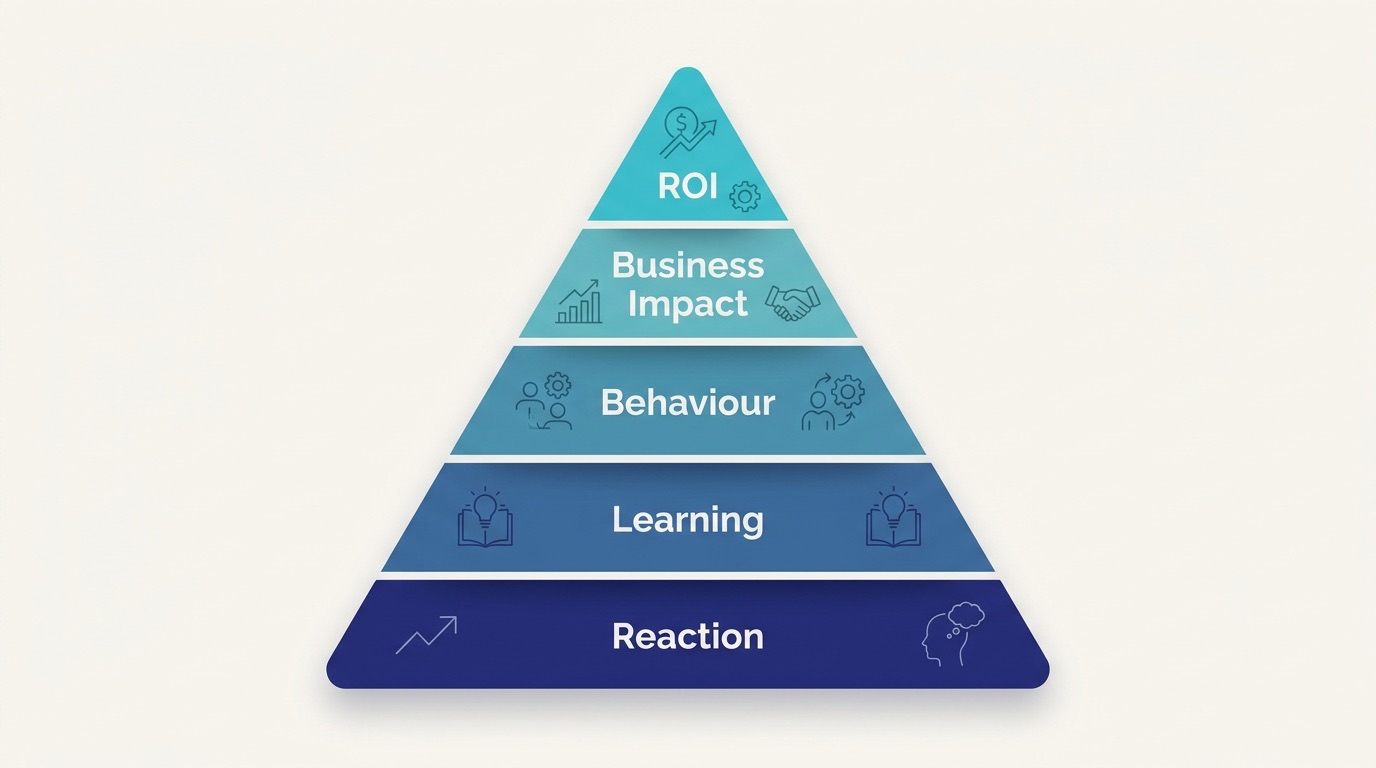
Each level builds on the one below. Skipping levels — particularly the jump from Level 2 (learning) to Level 4 (business impact) — is the most common reason South African L&D programmes get cancelled in the second year. When measuring eLearning ROI in South Africa, the middle level — behaviour change — is where real value is created and where most companies fail to instrument.
- Level 1 — Reaction. Did the learner enjoy the course? Net Promoter Score, satisfaction surveys, dropout rate. Table stakes. Easy to measure, weakest signal.
- Level 2 — Learning. Did knowledge transfer happen? Pre- and post-assessment delta, demonstrated skills assessment, certification pass rate.
- Level 3 — Behaviour. Are learners applying the learning on the job 60-90 days after the programme? Manager observation, peer review, workflow telemetry. This is where most South African programmes lose the audit trail.
- Level 4 — Business Impact. Are the KPIs the programme was designed to shift actually shifting? Sales, defect rate, customer satisfaction, time-to-competency, safety incidents, retention. Must be benchmarked pre-training.
- Level 5 — ROI. Phillips’s addition: convert the business impact to a rand figure, subtract the fully-loaded cost, divide by cost, multiply by 100. This is the number your CFO wants.
Programmes that stop at Level 2 under-sell themselves by 60–80% — they capture knowledge transfer but not the business outcome that justifies the spend. Programmes that try to jump straight to Level 5 without Levels 3 and 4 can’t defend the attribution and lose credibility the moment the CFO probes the assumptions.
Cost Inputs to Include When Measuring eLearning ROI in South Africa
When measuring eLearning ROI in South Africa, your training cost denominator should be net of every recoverable rand. Most calculations we audit start with the LMS subscription and content invoices, and stop there. That overstates the cost — sometimes dramatically.
- Skills Development Levy (SDL). 1% of monthly payroll, paid to SARS, compulsory for employers with payroll above R500,000 annually. See SARS’ Skills Development Levy guide for the full schedule. The levy is paid regardless of whether you train, but a portion becomes recoverable when you do.
- SETA Mandatory Grant. 20% of your SDL contribution is returned via the relevant SETA if you submit a Workplace Skills Plan and Annual Training Report on time. For a 200-staff manufacturer with R12M payroll, that’s about R24,000 a year back from merSETA, FoodBev or the appropriate SETA.
- SETA Discretionary Grant. The remaining 80% of your SDL sits in the SETA’s discretionary pool. Submit a project proposal — a learnership, internship, or skills programme — and you can claw back a meaningful share. Win rates of 40–60% are realistic for well-structured proposals tied to scarce-skills lists.
- B-BBEE Skills Development scorecard. 12 points are available, weighted toward Black and Black-female learners. The points translate to procurement opportunities with B-BBEE-conscious buyers — often the single largest hidden benefit of an L&D programme.
- Direct programme costs. LMS subscription (LearnDash, LearnWorlds, Docebo), content production (in-house or vendor), instructor time, learner assessment and certification.
- Indirect productivity cost. Learner time off the floor, costed at fully-loaded labour cost (salary + benefits + overhead, roughly 1.4× base salary).
The net cost figure that goes into your ROI denominator is: direct + indirect costs, minus mandatory grant recovery, minus realistic discretionary grant recovery. For most mid-market SA businesses, this nets out at 60-75% of the gross spend.
The Benefit Side: What Counts as Return in the SA Context
Quantifying the benefit side is where most L&D leaders flinch — but the rigour is worth the effort. When measuring eLearning ROI in South Africa, you have several quantifiable benefit streams that often go uncounted:
- Productivity gains. Measure output per FTE before and after the programme. Even a 3-5% lift on a R40M revenue base is R1.2-2M a year — typically the largest single benefit line.
- Rework, defect and error reduction. Track the cost of rework before and after. In manufacturing and services, this can match or exceed the productivity gain.
- B-BBEE scorecard improvement. A move from Level 6 to Level 4 unlocks RFPs from B-BBEE-conscious buyers, especially in the public sector and large corporates. Quantify by counting the procurement opportunities your current level locks you out of.
- Compliance cost avoidance. POPIA, OHS, ISO and industry-specific training directly avoid fines, lawsuits and incident costs.
- Retention. The cost to replace a trained employee is typically 6-9 months of their salary. A retention lift of just 2-3 percentage points on a 200-staff base is worth R500k-1M a year.
A Worked Example: 200-Employee South African Manufacturer
A real anonymised example to anchor the framework for measuring eLearning ROI in South Africa. The business: a Gauteng-based mid-market manufacturer with 200 staff, R45M annual revenue, R12M annual payroll, and a goal to roll out compliance and competency training via a WordPress-based LMS.
| Line | Year 1 (ZAR) |
|---|---|
| LMS platform + setup (LearnDash on WP + customisation) | 120,000 |
| Content production (10 courses, internal SME + vendor support) | 180,000 |
| Instructor and admin time (in-house, 0.5 FTE) | 50,000 |
| Learner time off the floor (200 × 8h × R150 fully-loaded) | 240,000 |
| Gross investment | 590,000 |
| SETA Mandatory Grant recovery (20% of R120k SDL) | (24,000) |
| SETA Discretionary Grant (50% of R180k application) | (90,000) |
| Net investment | 476,000 |
| Productivity gain (4% on R45M revenue) | 1,800,000 |
| Rework / scrap reduction (12% on R900k baseline) | 108,000 |
| B-BBEE Level 6 → Level 4 procurement uplift (conservative) | 900,000 |
| Retention improvement (3 fewer departures at R180k each) | 540,000 |
| Gross benefit | 3,348,000 |
| Net benefit (benefit − net investment) | 2,872,000 |
| ROI = net benefit / net investment × 100 | 603% |
The ROI looks high — that’s because the calculation includes the B-BBEE procurement uplift and the retention saving, which most ROI calculations omit. Strip those two lines out and the ROI is still 305% — a defensible number to take to the board.
If you’re rolling out an LMS on WordPress and want a high-converting enrolment page to feed it, the same principles that make a Google Ads landing page best practices for South Africa work also apply to course landing pages — clarity of outcome, single CTA, social proof.
Common Mistakes When Measuring eLearning ROI in South Africa
Across the L&D programmes we’ve audited, the same five errors come up over and over. Each one materially distorts the final number, and each one is easy to fix once you know to look for it.
- Forgetting the SETA grant offset in the denominator. Adding R114k of recovered grant straight to the cost side changes the ROI by 20-30%. Always net the grant recovery before you divide.
- Treating B-BBEE as a soft benefit. It’s not. The procurement uplift is quantifiable by counting the RFPs you’d be eligible for at the next level. Your sales team can hand you that list in an afternoon.
- Skipping Level 3 evaluation. Without a 60-90 day behaviour check, your Level 4 business-impact data has no provable attribution to the training, and the CFO is right to push back.
- No pre-training baseline. If you didn’t measure the KPI before the programme started, you can’t credibly claim the post-training value as ROI. Measure first, train second.
- Counting hours instead of outcomes. “Delivered 2,400 training hours” tells your CFO nothing about whether the business is different on the other side of the programme.
Tools and Frameworks to Use in 2026
For South African mid-market businesses measuring eLearning ROI in South Africa, the practical tooling stack tends to settle on:
- LMS platform. LearnDash on WordPress (most flexible, lowest total cost), LearnWorlds (best-in-class for selling courses externally), or Docebo (enterprise-scale).
- Measurement framework. The Phillips ROI Institute methodology is the credentialed standard if you’re presenting numbers externally.
- SETA compliance. Workplace Skills Plan + Annual Training Report templates from your sector SETA. Submission deadline is 30 April each year.
- Immersive content. For technical training, 3D walkthroughs and product visualisations boost retention — see our 3D rendering for SMB marketing guide for what’s achievable on a mid-market budget.
Bringing It Together
Measuring eLearning ROI in South Africa rewards the L&D leaders who do the work to instrument every level of the framework, who include the local cost offsets — SDL, SETA, B-BBEE — that most spreadsheets miss, and who quantify the procurement and retention benefits that other functions don’t even know to count. Done well, the ROI numbers you’ll defend are in the 300-600% range and they will survive any CFO probe.
The practical sequence is straightforward. Set the business KPI the programme is meant to move and measure it now, before any training happens. Map the five Kirkpatrick + Phillips levels to the specific evidence you’ll collect at each one. Net the SETA mandatory and discretionary recoveries off the gross cost. Quantify the B-BBEE procurement uplift and the retention saving on the benefit side. Then divide. The arithmetic is simple once the discipline is in place.
For a concrete example of what the multi-service approach looks like in practice — website, digital marketing, and online learning delivered together — see our work with The Sales Institute, where the brief evolved across three separate mandates over multiple years.
If your business is at the point where you’re ready to invest seriously in L&D, the highest-leverage move is to instrument Level 3 (behaviour) and Level 4 (business impact) from day one of the programme. Almost every South African business we audit has Level 1 and Level 2 data they’re not using, and no Level 3 or 4 data at all — which means they have an unprovable programme defending an unfalsifiable budget. Closing that gap is the single most valuable change you can make to your training function this year.
The same discipline that delivers defensible eLearning ROI is the discipline behind every high-performing marketing programme — and it’s the foundation of our Google Ads ROI playbook. If you’d like help architecting the LMS or the measurement framework that proves the return, we’d be glad to talk.
Frequently Asked Questions
How do you calculate eLearning ROI?
Add up every cost — build, platform, and learner time off the floor — then quantify the returns: productivity gains, lower error rates, retention. Express it as a ratio of net benefit to cost. The discipline is in counting learner time and capturing the soft returns most people ignore.
What is the difference between the Kirkpatrick and Phillips models?
Kirkpatrick measures four levels: reaction, learning, behaviour and results. Phillips adds a fifth — ROI — by converting the results into a rand figure and comparing it against cost. We use them together: Kirkpatrick for the story, Phillips for the number.
What costs should I include when measuring training ROI?
All of them. Content build, platform and licensing, administration, and — the one most people forget — the salary cost of the hours learners spend away from their work. Leave learner time out and your ROI looks artificially rosy.
How long does it take to see ROI on eLearning?
For skills tied directly to output, you can see movement within a quarter. For behavioural or culture change, give it six to twelve months. Set the measurement window before you launch, not after, so you are not moving the goalposts.
Can you measure ROI on soft-skills training?
Yes, but you measure it through proxies — fewer customer complaints, lower staff turnover, faster onboarding. Pick the proxy before training begins and baseline it. Soft skills resist a clean number, but they leave fingerprints on the metrics that matter.
Related reading
- Elearning Course Design South Africa: Master 2
- How to Create a SETA Accredited Online Course:
- Ultimate Guide to Choosing the Best eLearning
- How Microlearning Is Transforming Employee Tra
Ready to put this into action?
If you’d rather have a team that does this every day, we’re here. Book a free 20-minute consult and we’ll give you the three highest-impact next steps for your business — no obligation.