
TL;DR: WooCommerce vs Shopify is the platform call most likely to cap or unlock your store’s growth in South Africa. Shopify wins on speed-to-launch but locks you into higher transaction fees, app subscriptions and rented infrastructure. WooCommerce takes more setup but you own it — cheaper at scale and far more flexible for SA payments and logistics. For most growing SA stores, WooCommerce wins.
Quick Answer
WooCommerce vs Shopify South Africa is the single platform decision most likely to cap or unlock your store’s growth. Shopify wins on time-to-launch but locks you into Stripe-style transaction fees, app subscriptions, and theme constraints. WooCommerce wins on margins, payment gateway choice (PayFast, Peach, Paystack, Ozow), and ownership — at the cost of needing a competent build partner. For SA stores targeting R500k+ monthly revenue, WooCommerce wins on lifetime cost almost every time.
The WooCommerce vs Shopify South Africa debate isn’t academic — it’s the single platform decision that determines whether your store scales past R500k a month or gets stuck bleeding profit through transaction fees, app subscriptions and platform constraints. The South African e-commerce landscape in 2026 is a R400 billion gold rush, but for every success story there are ten Advertising Victims — owners who built a pretty store on the wrong foundation.
If you are a business owner in Johannesburg or Cape Town, you’ve likely been told the same lie: “Just put your products online and the sales will come.”
The truth? Your platform choice is either the engine of your growth or the anchor that drags you down.
Most entrepreneurs fall into the “Platform Trap.” They choose simplicity over scalability. They choose a dashboard they like rather than a system their customers trust. This is the definitive guide for the “African Powerhouse”—the business owner who refuses to play small and wants to own their digital territory.
WooCommerce vs Shopify South Africa: The R400 Billion Foundation Decision
By the end of 2025, online retail turnover in South Africa surpassed R130 billion, capturing nearly 10% of total retail sales. We are no longer in the “emerging” phase. We are in the “expansion” phase.
For context on the broader e-commerce growth pattern, the Statista South Africa e-commerce outlook projects continued double-digit CAGR through 2027 — making platform choice a compounding decision, not a reversible one.
However, the market is fractured. You have the urban elite in Sandton who demand same-day delivery, and you have the R900 billion untapped township economy where 60% of businesses are still informal and cash-based.
If your store isn’t built to handle the unique chaos of the African market—the logistics, the trust gap, and the 77% mobile-first reality—you aren’t building a business. You’re just playing with a digital hobby.
The Shopify Trap: The “Rented Land” Problem
Shopify is seductive. It’s easy to set up. It has pretty templates. But for a scaling South African business, it often becomes a “Template Trap.”
The Hidden Truth: When you build on Shopify, you are building on rented land.
- The Transaction Tax: They take a cut of every sale unless you use their proprietary gateways (which aren’t always optimised for Africa).
- The SEO Ceiling: You don’t have full control over your server or your underlying code. In a world where Generative SEO and AI search dominance are the new standards, being “locked in” is a death sentence.
- The Customization Wall: Want to move a button to trigger a specific “Loss Aversion” response? Good luck. You’re stuck with what the template allows.
For a complete view of how we build bespoke ecommerce stacks for SA SMBs, see our services overview.
Why WooCommerce Beats Shopify in South Africa: The High-Velocity Engine
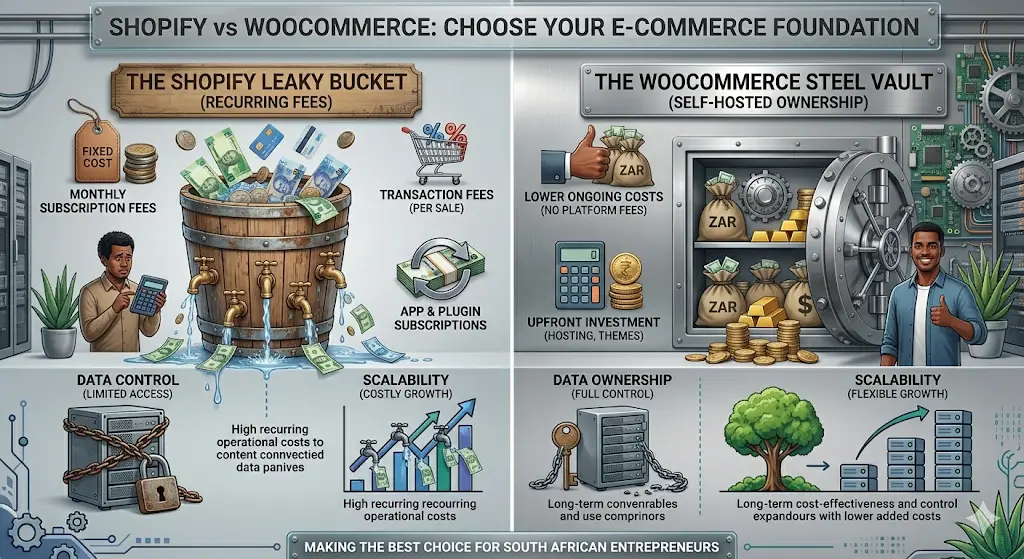
We only advocate for WooCommerce powered by Elementor Pro. Why? Because it gives the “African Powerhouse” total control over their data, their design, and their destiny.
| Feature | The Shopify “Trap” | The Bespoke WooCommerce Build |
| Data Ownership | They own the platform; you rent it. | You own every pixel and byte. |
| Transaction Fees | Extra 2% “success tax” on every sale. | R0. You only pay your gateway provider. |
| Mobile Speed | Hard to optimise beyond templates. | Sub-2.0s with Elementor optimisation. |
| African Payments | Limited local integration. | Deep integration with Paystack & Ozow. |
| Scalability | Monthly app fees stack up fast. | Open-ended growth without “App Bloat.” |
The “Big Secret” is that WooCommerce allows us to implement Science-Informed Design. We don’t guess where Sarah Taylor (your ideal customer) will click. We use Elementor Pro to build bespoke journeys that guide her through the “Chain of Belief”—moving her from “just browsing” to “pulling out the credit card” in under three steps.
Killing the 75% Cart Abandonment Monster
In South Africa, the average cart abandonment rate sits at a staggering 75% to 83.5%. Most of your marketing budget is being spent on people who leave at the finish line.
This isn’t because they don’t want your product. It’s because your checkout process failed the “Trust Test.”
Payment Gateway Buffet: The Real WooCommerce vs Shopify South Africa Difference
South Africans are wary of fraud. If you only offer one way to pay, you lose. You need to offer a “buffet” of secure, local options to build instant authority.
- Paystack: The gold standard for localized mastery. With its Stripe-backed infrastructure, it offers a 95% success rate on local transactions and 24-hour payouts.
- Ozow: Essential for the “Trust-First” buyer. Instant EFT is familiar to South Africans and bypasses the fear of sharing card details.
- PayJustNow (BNPL): Buy Now, Pay Later is projected to double by 2026. If you aren’t offering Sarah Taylor the ability to split her payments, she’s going to your competitor who does.
The Mobile-First Mandate
98.4% of South Africans access the web via mobile. If your store was built for desktop first, you are effectively invisible. We build for “one-thumb” use. Every button, every product image, and every form must be frictionless on a R2,000 Android handset as well as a R30,000 iPhone.
A WooCommerce store on the wrong technical SEO foundation will lose to faster competitors — see how we approach technical SEO and digital marketing for SA stores.
Logistics: The Silent Profit Killer
Logistics is the “last mile” that determines if Sarah Taylor ever buys from you again. Higher logistics efficiency equals higher purchase frequency.
The “African Powerhouse” doesn’t just hire a courier. They build a narrative around delivery.
- Transparency: 67.3% of SA shoppers say “Free Delivery” is the #1 driver for a purchase.
- Flexibility: 86% of shoppers prefer home delivery, but they want the option to change the day.
- Context: Delivering to a secure estate in Sandton is different from delivering to a taxi rank in Soweto. You need partners who understand both.
The ROI of a Smarter Infrastructure
Marketing is no longer about “Brand Awareness.” That is a luxury for corporations with billions to waste. For you, marketing is about Attributable Revenue.
Organisations that invest in high-performance digital infrastructure report 24% higher profit margins. By moving away from “Template Traps” and building a bespoke sales engine, you:
- Lower your Cost per Acquisition (CPA).
- Increase your Average Order Value (AOV) through strategic upselling.
- Boost Customer Lifetime Value (LTV) by owning the relationship, not renting it from a platform.
For more SA-specific ecommerce and SEO breakdowns, see the Watts Digital blog.
Curious how SA payment processing economics actually compare? The PayFast fees breakdown and Shopify’s public pricing schedule make the WooCommerce vs Shopify South Africa cost gap concrete — typically a 1–2% margin swing per transaction in WooCommerce’s favour at SA scale.
Conclusion: Stop Playing Small
The South African digital landscape in 2026 is moving at breakneck speed. You can continue to struggle with a store that costs you money in hidden fees and lost conversions, or you can build a powerhouse.
Sustainability requires a rejection of the status quo. It requires owning your platform, optimising for the 77% mobile majority, and using direct-response psychology to close every deal.
Stop letting your profit leak through a broken checkout. It is time to build a digital empire that works as hard as you do.
Summary of E-Commerce Strategic Assets
| Domain | Mandatory Tech Stack | Core Business Driver |
| Platform | WooCommerce + Elementor | Total Ownership & SEO Control. |
| Payments | Paystack / Ozow / BNPL | Trust & Frictionless Checkout. |
| Performance | WP Rocket / Image Optimiser | Mobile Speed (Under 2s). |
| Strategy | Direct Response / AIDA | Lead Attraction & ROI. |
Implementation Checklist: The Next 30 Days
- [ ] Audit Your Steps: Count the clicks from “Product” to “Paid.” If it’s more than three, you are losing Sarah Taylor.
- [ ] Check Your Speed: If your store loads in more than 2 seconds on a 4G connection, you are invisible to Google.
- [ ] Test Your Gateways: Do you offer Instant EFT and BNPL? If not, add them this week.
- [ ] Identify the “Who”: Write down your Sarah Taylor avatar’s top 3 frustrations with your current site.
Don’t build a shop. Build a sales machine.
Related Watts Digital reading: Platform choice is half the battle — picking the right build partner is the other half. See our guide to choosing a web design partner in Johannesburg for the SMB checklist. Once your store is live, paid traffic typically outpaces organic in the first 90 days — the Google Ads agency South Africa primer covers ROAS expectations for SA ecommerce. And for local discovery, once you start ranking, the SA local SEO reviews guide shows how to compound trust signals.
Frequently Asked Questions
Is WooCommerce or Shopify cheaper in South Africa?
Shopify is cheaper to start; WooCommerce is cheaper at scale. Shopify’s monthly fees, app subscriptions and transaction cuts compound as you grow, whereas WooCommerce trades higher setup effort for lower ongoing cost and no per-sale tax.
Which platform is better for South African payment gateways?
WooCommerce, generally. It integrates cleanly with local gateways like PayFast, Yoco and Ozow, and avoids Shopify’s third-party transaction fees on non-Shopify payment providers — a real saving on South African volumes.
Can I migrate from Shopify to WooCommerce later?
Yes. Products, customers and orders can be migrated, though it takes planning to preserve URLs and SEO. It is far easier to plan the move deliberately than to be forced into it once Shopify’s fees start capping your margin.
Does WooCommerce require more maintenance than Shopify?
Yes — you own the updates, backups and security that Shopify handles for you. That is the trade for control and lower fees. Good hosting and a maintenance plan turn it from a chore into a non-issue.
Which is better for SEO, WooCommerce or Shopify?
WooCommerce gives you deeper control — full access to URLs, schema, content and technical settings through WordPress. Shopify’s SEO is capable but more constrained. For a store competing on organic search, that control matters.
Ready to put this into action for woocommerce vs shopify south africa?
If you’d rather have a team that does this every day, we’re here. Book a free 20-minute consult and we’ll give you the three highest-impact next steps for your business — no obligation.