
TL;DR:
- If your site loads slower than 3 seconds on a 4G connection in Sandton, you are bleeding leads before the homepage even renders.
- High converting website design in South Africa is a CRO problem first, an aesthetics problem last — fix forms, trust signals and load times before you redesign.
- Track CPA, lead quality and revenue per session. Bounce rate and time-on-page are vanity metrics that will get your marketing budget cut.
Most South African SMB owners I meet have been sold a website twice. The first time by a creative agency that delivered a beautiful Webflow build that ranks for nothing and converts at 0.4%. The second time by a freelancer who patched it together in WordPress and disappeared. Both invoices were paid in rand. Neither produced a customer.
This guide is about high converting website design South Africa businesses can actually defend in a board meeting — not a moodboard, not a Behance entry, but a site that turns 4G mobile traffic into qualified leads, bookings or sales. I’ll cover what to fix first, what to measure, and where most local agencies waste your money.
I run Watts Digital and audit roughly 60 SA SMB sites a year. The patterns are depressingly consistent: slow hosting on US servers, contact forms with eight fields, no POPIA notice, and a hero video that adds 4MB to the page weight. Every one of those is a conversion leak you can plug this week.
Why Most South African SMB Websites Don’t Convert
The brutal truth: the average SA small business website is built for the founder’s ego, not the buyer’s decision. It opens with a stock photo carousel, a tagline nobody understands, and a ‘Welcome to our website’ paragraph. Meanwhile the visitor — on a 4G connection in Midrand, on a Samsung A-series phone, with one bar of signal — has already swiped back to Google.
Google’s own research via Think with Google (2023) found that bounce probability rises 90% when page load goes from 1 to 5 seconds on mobile. In South Africa, where the median mobile connection sits well below European 4G speeds and load shedding regularly knocks out fibre, that five-second threshold is generous. I treat three seconds as the hard ceiling.
Then there’s the trust deficit. South African consumers have been burned — by Hellopeter horror stories, by EFT scams, by fake online stores. If your site doesn’t immediately signal legitimacy (real address, real phone number, POPIA-compliant privacy policy, payment logos, recent reviews), conversion dies regardless of how clever your copy is.
- Slow hosting — many SA agencies still deploy to US or EU shared hosting, adding 200-400ms latency before TTFB.
- Bloated hero sections — autoplay video, sliders, and 4MB JPGs that crush mobile data budgets.
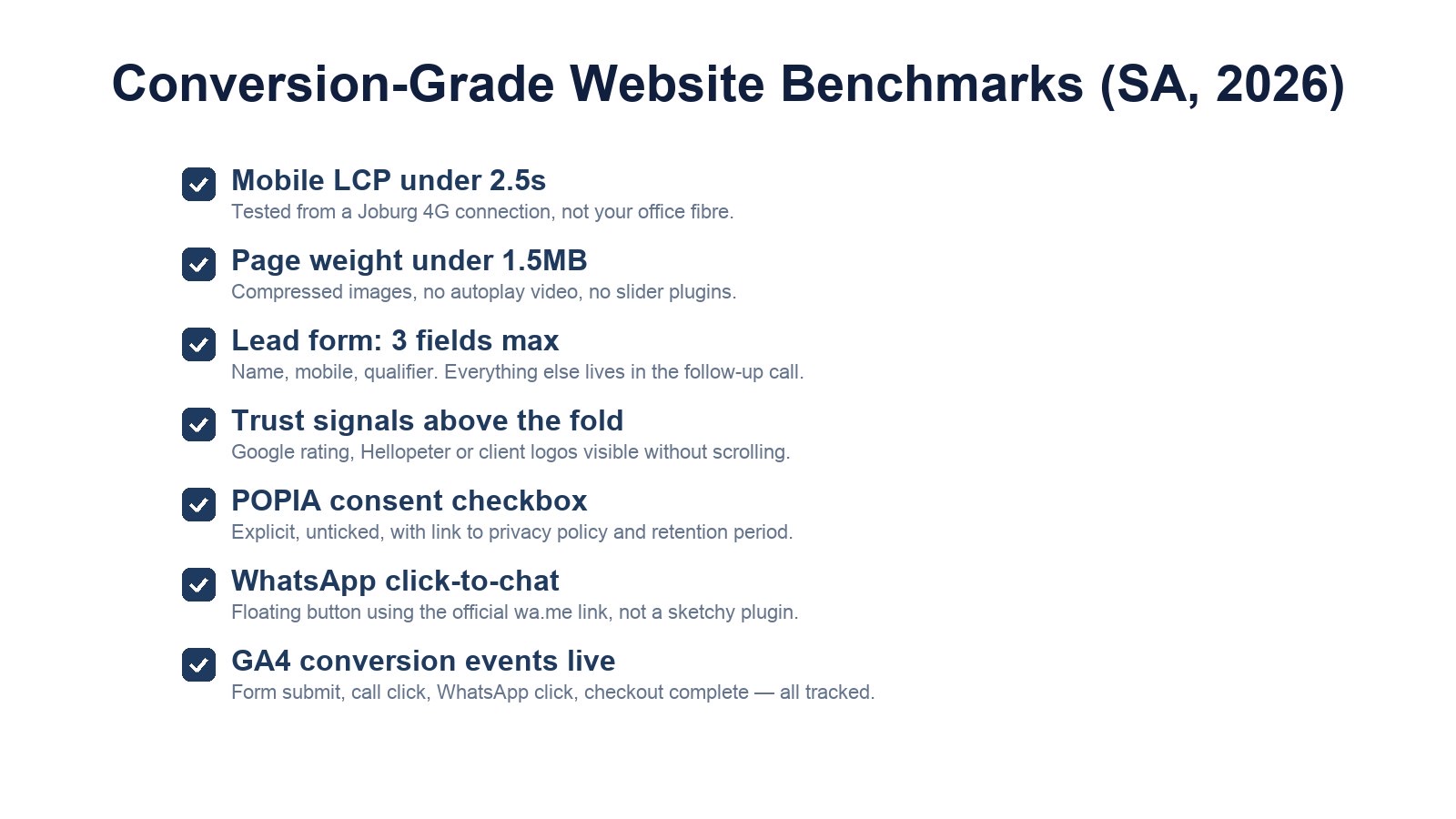
- Forms that ask for everything — name, surname, company, role, phone, email, message, captcha. Each field after three drops conversion roughly 10%.
- No social proof above the fold — Hellopeter ratings, Google reviews and recognisable client logos belong on screen one, not buried on an ‘About’ page.
- Generic CTAs — ‘Submit’ and ‘Learn More’ instead of ‘Get my free quote’ or ‘Book a 15-minute call’.
The Five-Second Rule: Speed as a Conversion Lever
If I could only fix one thing on an SA SMB site, it would be load speed. Not because Google rewards it (it does), but because South African users punish slowness ruthlessly. Data costs are real — Icasa’s 2024 cost-to-communicate review still shows mobile data as a meaningful expense for the average household — and a heavy site burns the visitor’s airtime before it earns their trust.
Run your homepage through Google PageSpeed Insights and WebPageTest with the location set to Johannesburg. If your Largest Contentful Paint is over 2.5 seconds on mobile, you have work to do. The fixes are usually unsexy: switch to a local host (Xneelo, Afrihost, or a Cape Town AWS region), compress images to WebP, defer third-party scripts, and kill the slider plugin.
Load shedding adds another wrinkle. If your site relies on a single uplink in a Gauteng office, a stage-6 evening will take you offline at exactly the time evening shoppers are browsing. Use a CDN (Cloudflare’s free tier is fine) and host outside your physical office. I’ve watched a Centurion electrician’s site lose three weekend leads in one weekend because their ‘self-hosted’ WordPress sat on the office NAS.
| Metric | Acceptable | Good | Conversion-grade |
|---|---|---|---|
| LCP (mobile, 4G Joburg) | Under 4.0s | Under 2.5s | Under 1.8s |
| Total page weight | Under 3MB | Under 1.5MB | Under 800KB |
| Time to Interactive | Under 5s | Under 3.5s | Under 2.5s |
| Form fields | 5 | 4 | 3 or fewer |
What High Converting Website Design South Africa Actually Looks Like
Forget the awwwards.com aesthetic. A high converting website design in South Africa is closer to a well-run Yoco checkout than a Cape Town agency portfolio. The hierarchy is ruthless: one promise, one proof, one action — repeated down the page in slightly different forms.
Above the fold you need four elements visible in under two seconds: a specific value proposition (not ‘innovative solutions’), one primary CTA, a trust marker (Google rating, Hellopeter score, or a recognisable client logo), and a phone number that’s clickable on mobile. SA buyers still phone — the call-to-form ratio I see in service businesses is roughly 60/40 in favour of calls.
Below the fold, the sequence that converts is: problem → outcome → proof → process → price-or-CTA → FAQ. The FAQ block is doing more lifting than people realise. It pre-empts objections (Do you work in my suburb? Are you POPIA-compliant? What does it cost?) and feeds Google’s AI Overviews with structured answers it can lift.

CRO Tactics That Move the Needle for SA SMBs
Conversion rate optimisation is not button-colour roulette. Baymard Institute’s ongoing checkout research (2024) catalogues hundreds of usability issues that quietly cost ecommerce sites between 20-35% of potential revenue — and most of those issues exist on SA sites I audit weekly. The fixes are tactical, not aspirational.
Start with form friction. A Cape Town accounting practice I worked with last year had a ‘Get a quote’ form with nine fields. We cut it to three (name, mobile, what you need) and conversion went from 1.1% to 4.6% in six weeks. The lead quality didn’t drop — they were qualifying on the call anyway.
Next, add WhatsApp. South Africa runs on WhatsApp. A floating WhatsApp button (using the official Click-to-Chat link, not a sketchy plugin) routinely doubles enquiry volume on service sites. For ecommerce, a WhatsApp support widget reduces cart abandonment because buyers can ask ‘do you deliver to Bloemfontein’ without abandoning the basket.
- Audit every form. Cut fields to the minimum needed to start a conversation. Phone, email, one qualifier.
- Add visible trust above the fold: Google rating with star count, Hellopeter badge if positive, and 2-3 recognisable client logos.
- Replace ‘Submit’ with outcome-based CTAs: ‘Get my Sandton quote’, ‘Book my free site audit’, ‘WhatsApp us now’.
- Install Hotjar or Microsoft Clarity (Clarity is free) and watch 20 session recordings before you redesign anything. You will be horrified, then informed.
- Run one A/B test at a time using Google Optimise alternatives like VWO or a simple split via your CMS. Test headlines and CTAs before you test colours.
POPIA, Trust Signals and the Compliance Layer
POPIA isn’t optional and the Information Regulator has been issuing enforcement notices since 2023. Every form on your site that collects personal information needs a clear consent mechanism, a link to a real privacy policy, and a defined retention period. ‘By submitting this form you agree to our terms’ with no checkbox is not consent.
Beyond legal compliance, POPIA notices are a conversion asset. SA buyers have become more privacy-aware post-Experian and post-TransUnion breaches. A short, plain-English line under your form — ‘We’ll only use your details to respond to this enquiry. We don’t sell data. POPIA-compliant.’ — measurably lifts form completion in the tests I’ve run.
The other trust layer is the Consumer Protection Act. If you’re selling online, your refund and returns policy needs to be one click from any product page, not buried in a footer modal. Ecommerce stores I audit that surface their returns policy in the product description block see lower abandonment in the checkout — buyers want to know the exit door before they walk in.

Measuring ROI: The Metrics That Defend Your Marketing Budget
If you walk into a board meeting with bounce rate and average session duration, you will lose your budget. Those are vanity metrics. The metrics that defend marketing spend in 2026 are cost per acquisition (CPA), lead-to-customer rate, customer lifetime value (CLV), and revenue per session.
Set up GA4 properly with conversion events for every meaningful action: form submit, WhatsApp click, phone click, quote download, checkout complete. Then connect it to your CRM — even a simple Pipedrive or HubSpot free tier will do — so you can attribute closed revenue back to the channel and landing page that produced it.
Here’s the calculation I run for every client at quarterly review: (Revenue attributed to organic + paid web) ÷ (Total spend on web design, hosting, content, SEO, ads). If that number isn’t above 3:1 within 12 months of a redesign, the redesign failed. Set that benchmark with your agency before you sign, not after.
| Metric | What it tells you | Defensible? |
|---|---|---|
| Bounce rate | Almost nothing in GA4 | No |
| Time on page | Engagement, weakly | No |
| Conversion rate (by source) | Which channels work | Yes |
| CPA by channel | Where to scale spend | Yes |
| Lead-to-customer rate | Sales/marketing alignment | Yes |
| Revenue per session | True site value | Yes |
Choosing an Agency Without Getting Burned Again
Performance Paul, the SME growth lead I write most of this for, has usually been burned by at least one creative agency before he finds me. The pattern is the same: gorgeous pitch deck, R85,000 invoice, six months of delays, a launched site that doesn’t rank and doesn’t convert, and an upsell for ‘phase two’ to fix the things phase one was meant to deliver.
The fix is in the brief. Don’t ask for a ‘beautiful website’. Ask for a website that delivers X qualified leads per month at a CPA below R-something, measured in GA4 with conversion tracking signed off before launch. Tie a portion of the fee to performance milestones if the agency will accept it — most won’t, which tells you everything.
Ask three specific questions in the first call: Where will you host it and why? How many form fields will the primary lead form have? What’s your target LCP on a Joburg 4G connection? If the answers are vague, walk. If the answers are specific and include numbers, you’ve found someone who builds for conversion, not for their portfolio.
FAQ
What does a high converting website cost in South Africa in 2026?
For a service-based SMB, expect to pay R45,000 to R120,000 for a properly built, conversion-focused site on WordPress or Webflow, including CRO planning, copy, basic SEO setup and POPIA compliance. Ecommerce on Shopify or WooCommerce typically runs R75,000 to R250,000 depending on product volume and payment integrations. Anything under R25,000 is usually a templated build with no strategy. Anything over R300,000 for a standard SMB site is paying for agency overhead, not better conversion. Always tie a portion of the spend to measurable lead targets.
How long does it take to see ROI from a website redesign?
Realistically, three to nine months. The first 30 days post-launch are about Google re-crawling and stabilising rankings. Months two and three are when CRO improvements (form fixes, speed, trust signals) start showing in conversion rate. By month six you should have enough attribution data in GA4 to calculate CPA reliably. If your redesign hasn’t returned its cost in qualified pipeline within 12 months, something is structurally wrong — usually targeting, offer or load speed, not design.
Is WordPress still the right CMS for SA small businesses?
For most service SMBs, yes. WordPress on local hosting (Xneelo, Afrihost) gives you flexibility, a massive plugin ecosystem and developers in every SA city. Webflow is excellent for design-led brands but locks you into a USD subscription. Shopify is the default for ecommerce under 500 SKUs. Avoid Wix and proprietary ‘website builder‘ platforms sold by hosting companies — they’re cheap upfront but you cannot properly optimise speed or technical SEO, and migrating off them later is painful and expensive.
Do I really need POPIA compliance on a small business website?
Yes, regardless of business size. If your site collects any personal information — names, emails, phone numbers via a contact form — POPIA applies. The minimum compliance package: a published privacy policy linked from every page, an explicit consent checkbox on forms (not pre-ticked), a defined data retention period, and a designated Information Officer registered with the Information Regulator. The Regulator has been actively issuing enforcement notices since 2023, and complaints from customers are the most common trigger. It’s a half-day of work, not a project.
What’s the single biggest conversion mistake SA SMB sites make?
Slow mobile load times on 4G connections. I audit dozens of sites a year and the median mobile LCP is over 4.5 seconds — well past the point where most South African visitors have already left. The cause is usually a combination of overseas hosting, uncompressed hero images, and a stack of WordPress plugins loading on every page. Fixing this single issue typically lifts conversion 20-40% with no other changes. Test your site with Google PageSpeed Insights set to mobile, today.
Key takeaways
- Speed is the single biggest conversion lever for SA SMB sites — target sub-2.5s LCP on mobile 4G or watch leads evaporate.
- Cut form fields to three. Every field after three drops conversion by roughly 10%, and you can qualify on the call.
- Trust signals belong above the fold: Google rating, Hellopeter score, recognisable logos and a clickable phone number.
- POPIA compliance is both legal protection and a measurable conversion asset — visible privacy assurance lifts form completion.
- Measure CPA, lead-to-customer rate and revenue per session. Bounce rate and time on page won’t survive a board meeting.
- Brief agencies on outcomes (qualified leads at target CPA), not aesthetics. Tie fees to performance milestones where possible.
If your website looks fine but the leads aren’t landing, the problem is almost always fixable inside a 30-day sprint. Book a free conversion audit with Watts Digital and we’ll send you a written report with the three highest-impact fixes for your specific site — no pitch deck, no upsell.
About the author: David Watts is the founder of Watts Digital, a South African SEO and content agency working with SMBs across Gauteng and the Western Cape. He has 12+ years of experience in digital marketing and writes about website conversion, technical SEO and lead generation for South African business owners.